The Supreme Court will decide whether assault weapons bans violate the Second Amendment
 A Critic of Beijing Falls Short in Taiwan’s Key Mayoral Election
 EPA says no rise in contamination after Army detonates lead azide stockpile in Iowa
 Israeli Strike Kills 2 Workers at Gaza Clinic, Doctors Without Borders Says
 McQueen Pre-Fall 2027
Prey and water may be why tiger Explorer has stopped exploring in Andhra’s NTR district
**
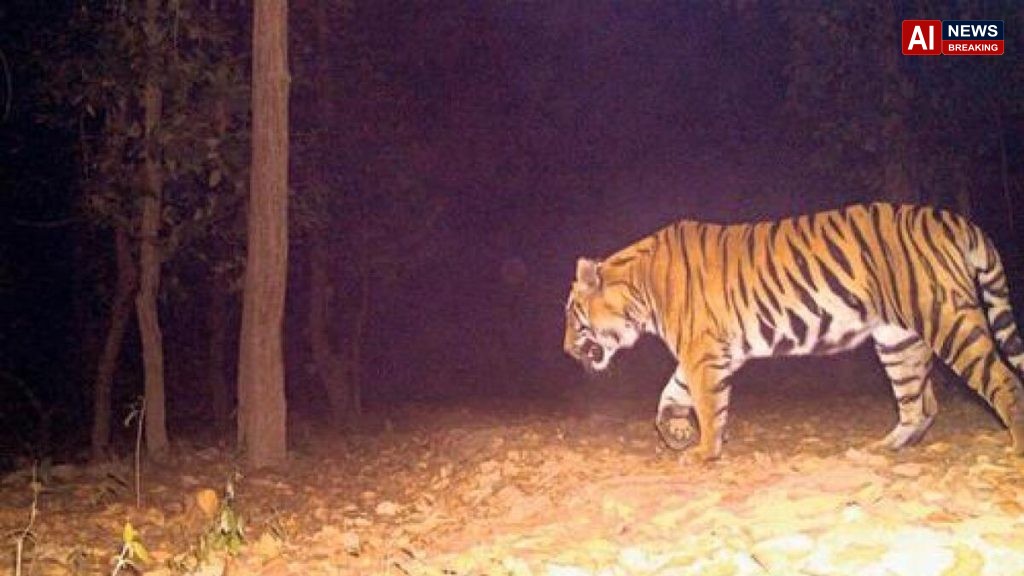
Prey and water may be why tiger Explorer has stopped exploring in Andhra’s NTR district - AI News Breaking
prey water tiger explorer:
Prey and water may be why tiger Explorer has stopped exploring in Andhra’s NTR district A solitary male tiger, known to wildlife officials as “Explorer,” has remained within the borders of the newly formed NTR district in Andhra Pradesh for several weeks, prompting concerns among forest officials and conservationists. The animal, which was first spotted moving between the Nagarjunasagar‑Srisailam Tiger Reserve and the far‑off Tadoba forest corridor, has now halted its trek, prompting the Divisional Forest Officer (DFO) to warn that its next move is difficult to predict. The tiger’s unexpected pause has reignited debate over habitat connectivity and the adequacy of prey and water resources along the corridor..
The DFO, R. Srinivas, explained that Explorer’s journey was initially encouraging, suggesting that the tiger might be using the historic “Mahanadi” wildlife corridor that links two of India’s most important tiger strongholds. “When we first tracked his footprints in March, we believed he was testing the route between Nagarjunasagar and Tadoba, which could significantly enhance genetic flow,” Srinivas said. However, recent field surveys indicate that the tiger has not crossed any major water bodies or large patches of natural forest in the past ten days, a behavior that diverges from typical dispersal patterns observed in adult males..
The NTR district, named after former Chief Minister Nandamuri Taraka Rama Rao, encompasses a mosaic of agricultural lands, small settlements, and fragmented forest patches. While the district’s creation aims to improve administrative focus on development, it has also introduced new challenges for wildlife management. Officials note that the rapid expansion of irrigation projects and the conversion of scrubland into paddy fields have reduced the availability of natural waterholes that tigers traditionally rely on during long-distance movements..
“Without reliable water sources, a tiger’s stamina wanes, and it may opt to stay close to known territories,” the DFO added. Prey availability is another factor that experts believe may be influencing Explorer’s behavior. Recent camera‑trap data from the peripheral zones of Nagarjunasagar‑Srisailam Tiger Reserve show a noticeable decline in medium‑sized ungulates such as chital and sambar, largely due to increased human‑wildlife conflict and poaching incidents reported in the past year..
“A male tiger needs a steady supply of prey to sustain its energy reserves, especially when it is on the move,” said Dr. Anitha Rao, a wildlife biologist with the Andhra Pradesh Forest Department. “If prey densities dip below a certain threshold, the tiger may choose to linger in areas where it can still hunt, even if those areas are suboptimal.” Local farmers have reported an uptick in livestock predation in villages bordering the reserve, a development that could further discourage the tiger from venturing deeper into the corridor..
According to a survey conducted by the district’s Livestock Department, there have been 27 reported attacks on cattle in the past month, a figure that doubles the average for the same period last year. While some incidents may be attributable to other predators such as leopards, the presence of a large tiger in the vicinity raises the stakes for both farmers and conservation agencies. In response, forest officials have intensified patrols along known tiger pathways, deploying both foot teams and camera traps to monitor Explorer’s movements..
The DFO’s office has also coordinated with the State Wildlife Crime Control Bureau to investigate any potential poaching activities that might be disrupting prey populations. “We are employing a multi‑pronged approach: increased anti‑poaching vigilance, community outreach, and rapid response teams to address human‑tiger conflict,” Srinivas explained. These efforts aim to create a safer passage for the tiger while simultaneously safeguarding local livelihoods..
The state government, aware of the delicate balance between development and wildlife conservation, has announced a set of mitigation measures. Chief Minister Y. S. Jagan Mohan Reddy’s administration plans to allocate funds for constructing artificial waterholes at strategic points along the corridor, a move designed to supplement natural water sources during the dry season. Additionally, the government intends to launch a compensation scheme for farmers who suffer livestock losses, a policy that experts hope will reduce retaliatory killings..
Conservation NGOs have welcomed the government’s initiatives but caution that long‑term success hinges on habitat restoration. “Artificial water points are a stop‑gap solution; the real answer lies in restoring contiguous forest tracts and ensuring a robust prey base,” argued Meena Patel, director of the Wildlife Protection Society of India’s Andhra Pradesh chapter. She highlighted ongoing reforestation projects that aim to plant native tree species in degraded areas, thereby expanding the tiger’s potential range and improving ecological resilience..
Meanwhile, satellite imagery analyzed by the Indian Space Research Organisation (ISRO) reveals that the NTR district’s forest cover has contracted by roughly 8 per cent over the past five years, primarily due to illegal logging and encroachment for agricultural expansion. The data underscores the urgency of implementing stricter land‑use regulations, a point echoed by the Ministry of Environment, Forests and Climate Change. In a recent briefing, the ministry’s spokesperson emphasized that protecting corridor integrity is essential not only for Explorer’s safe passage but also for the broader goal of maintaining viable tiger populations across the subcontinent..
International bodies have taken note of the situation, with the World Wildlife Fund (WWF) India issuing a statement that highlighted the NTR district as a “critical juncture” for tiger dispersal between two major reserves. The organization called for increased funding for corridor management and urged the Indian government to incorporate scientific corridor mapping into regional planning processes.
Updated: November 25, 2026
The tiger’s halt exposes how rapid agrarian expansion and piecemeal water projects are eroding the very corridors that underpin genetic health of India’s tiger metapopulations; without decisive habitat restoration, “Explorer” becomes a symptom of a fragmented future.
Artificial waterholes may buy time, but they mask a deeper policy failure—unless land‑use rules curb encroachment and rebuild prey bases, the corridor will remain a bottleneck, jeopardizing both wildlife and