
 Pakistan’s leaders hail first astronaut aboard Chinese craft: ‘Proud one of us has gone into space’
 British tourist travels 29 hours from Mumbai to Amritsar for ₹5,461, rates Indian Railways 10/10 | Viral video
 The Supreme Court will decide whether assault weapons bans violate the Second Amendment
 A Critic of Beijing Falls Short in Taiwan’s Key Mayoral Election
 EPA says no rise in contamination after Army detonates lead azide stockpile in Iowa
Solomon Islands signs security partnership with Australia
**
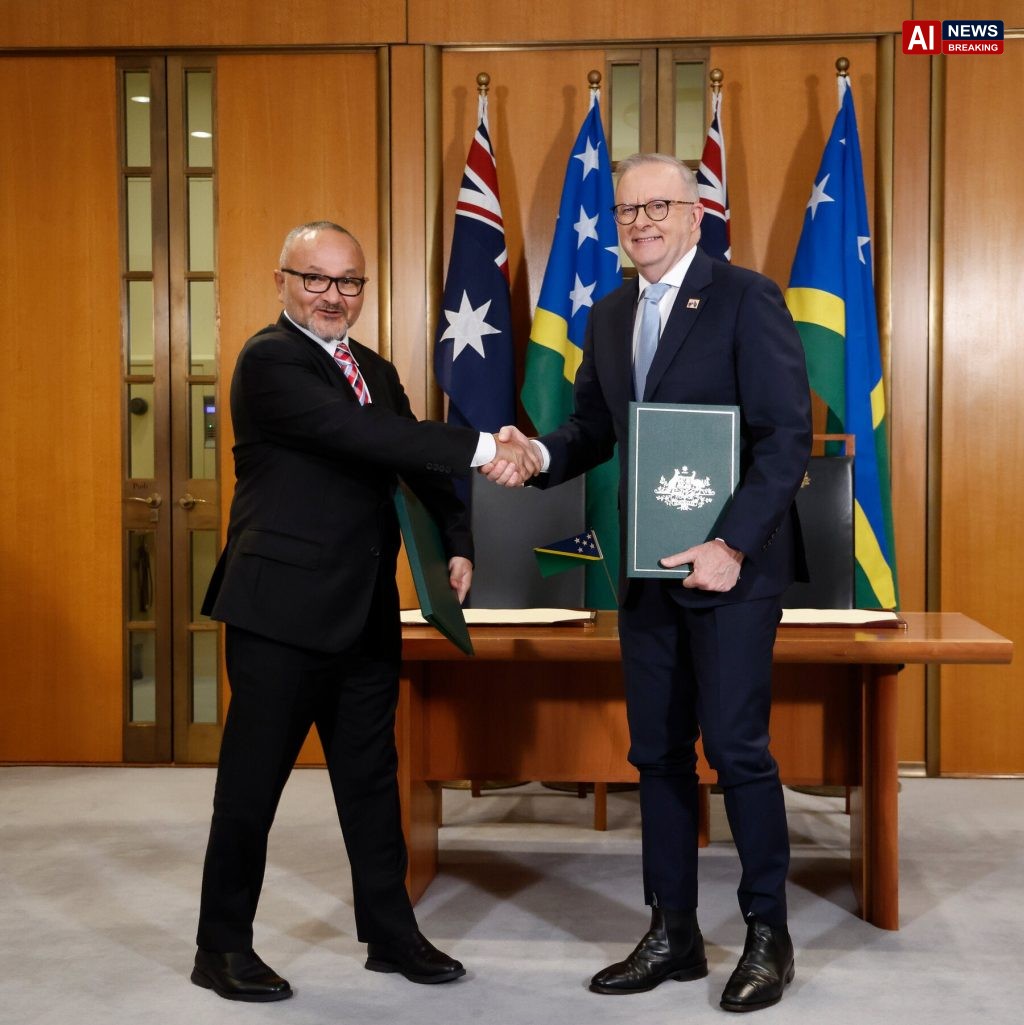
Solomon Islands Enters Security Treaty With Australia, in a Blow to China - AI News Breaking
The Solomon Islands has signed a new security partnership with Australia, marking a shift in the Pacific nation’s strategic alignment and prompting analysts to reassess Beijing’s growing influence in the region. The agreement, concluded in early November, replaces a 2022 memorandum of understanding with China that had raised concerns in Canberra and Washington about the possibility of a Chinese military foothold on the islands. While the Solomon Islands government stresses that the new pact is aimed at enhancing its own defence capabilities and addressing trans‑national threats, observers see it as a clear signal that the archipelago is moving away from a potentially contentious relationship with Beijing.Under the terms of the Australia‑Solomon Islands security arrangement, the two countries will cooperate on a range of issues, including maritime surveillance, disaster response, and capacity‑building for the Solomon Islands’ nascent defence force..
Australian personnel are expected to provide training, equipment, and advisory support, with the aim of strengthening the smaller nation’s ability to monitor its exclusive economic zone and respond to natural calamities. The agreement also establishes a framework for joint exercises and the sharing of intelligence on matters such as illegal fishing, smuggling, and piracy—activities that have long plagued the Pacific’s vast oceanic spaces.The Solomon Islands’ decision comes after a period of diplomatic friction with China. In 2022, the Solomons signed a comprehensive cooperation agreement with Beijing that included provisions for infrastructure development, health assistance, and, notably, a clause that allowed Chinese personnel to assist in training local security forces..
While the text did not explicitly mention a military base, analysts warned that the language could be interpreted to permit the establishment of a Chinese presence that would extend beyond mere advisory roles. The concern was amplified by similar moves in neighboring Pacific states, where China has been expanding its diplomatic and economic outreach, often accompanied by strategic infrastructure projects.Australian officials have framed the new pact as a response to the Solomon Islands’ request for greater support in safeguarding its maritime domain. “We are responding to a partner’s expressed need for assistance in building a resilient defence capability,” an Australian defence spokesperson said in a briefing..
“Our engagement is focused on capacity‑building, not on the deployment of our own forces on Solomon Islands territory.” The statement underscores a key difference between the Australian and Chinese arrangements: the former explicitly excludes the establishment of permanent foreign bases on Solomon Islands soil, a stipulation that was absent from the earlier Chinese deal.In the capital, Honiara, reactions to the treaty have been mixed. Some members of the opposition view the shift as a pragmatic step that will bring needed expertise and resources, while others warn that aligning too closely with Australia could alienate other development partners. “We must be careful not to replace one dependency with another,” said a senior opposition lawmaker, who declined to be named..
The ruling party, led by Prime Minister Manasseh Sogavare, has defended the decision as a sovereign choice aimed at protecting national interests. Sogavare, who has previously courted both Beijing and Canberra, described the partnership as “a balanced approach that strengthens our security without compromising our autonomy.”The security pact also carries implications for regional geopolitics. The United States, a long‑standing ally of Australia, has been vocal about countering Chinese influence in the Pacific..
In a recent statement, the U.S. ary of State highlighted the Solomon Islands’ new alignment as “a positive development that reinforces the rules‑based order in the Indo‑Pacific.” Washington’s Pacific Command has increased its engagement with Pacific Island nations over the past few years, offering assistance in areas such as cyber security, maritime domain awareness, and climate resilience. The Australian‑Solomon Islands agreement therefore dovetails with a broader network of security collaborations that the United States and its allies are fostering across the region.China’s response to the development has been measured..
A spokesperson for the Chinese foreign ministry expressed “respect for the sovereign decisions of the Solomon Islands” and reiterated Beijing’s willingness to continue its development assistance under existing agreements. The tone, while cordial, reflects an awareness that overt criticism could further strain Beijing’s ties with Pacific partners already feeling pressure from competing powers. In recent months, Chinese officials have emphasized economic cooperation over military engagement, promoting projects such as renewable energy installations and health infrastructure upgrades in the Solomon Islands.The shift also about the future of the 2022 China‑Solomon Islands agreement..
Legal experts note that while the two accords are not mutually exclusive, certain provisions may need to be renegotiated to avoid overlap. “If the Solomon Islands are now receiving security assistance from Australia that explicitly excludes foreign bases, it creates a practical incompatibility with any future Chinese deployment that might be inferred from the earlier memorandum,” explained a professor of international law at the University of Queensland. The government has not indicated an intention to terminate the Chinese agreement, but it has signalled a desire to prioritize the Australian partnership for defence matters.Economic considerations remain central to the Solomon Islands’ foreign policy calculus..
Chinese investment has funded a number of high‑profile projects, including a new airport terminal and upgrades to telecommunications infrastructure. However, critics have pointed to a lack of transparency in some deals and concerns about debt sustainability. The Australian government, for its part, has pledged a modest package of aid earmarked for maritime security and disaster preparedness, funds that are likely to be welcomed by a nation still recovering from the impacts of climate‑related events such as cyclones and rising sea levels.Regional bodies are watching the development closely..
The Pacific Islands Forum, which convenes leaders from across the South Pacific, has been urging its members to adopt a cohesive approach to security challenges, emphasizing the need for “collective self‑reliance” while respecting each nation’s sovereign choices. In a recent forum meeting, the ary‑general highlighted the Solomon Islands‑Australia treaty as an example of “strategic partnership that balances external support with internal capacity building.” The sentiment reflects a broader trend among Pacific nations to diversify their security relationships, seeking assistance from multiple partners rather than relying on a single external power.In the coming months, the effectiveness of the new security arrangement will be tested by practical outcomes on the ground. Monitoring the Solomon Islands’ exclusive economic zone for illegal fishing incursions, improving early warning systems for natural disasters, and conducting joint exercises with Australian forces will provide tangible measures of the partnership’s impact..
If the collaboration succeeds in delivering measurable improvements, it may encourage other Pacific states to pursue similar agreements, potentially reshaping the strategic landscape of a region that has long been a focal point of great‑power competition. Conversely, any missteps or perceived infringements on sovereignty could reignite debates within the Solomon Islands about the appropriate balance between external assistance and national autonomy..
Updated: November 25, 2026
Summary: The Solomon Islands has swapped its 2022 China security pact for a new agreement with Australia, focusing on maritime surveillance, disaster response and defence capacity‑building. Analysts view the shift as a strategic realignment that curtails Beijing’s foothold while deepening ties with Australia and its U.S. allies in the Pacific.
Australia’s security pact turns the Solomon Islands into a de‑facto “watchtower” for Western maritime interests, nudging the Pacific’s power balance away from Beijing’s ambiguous foothold. If the aid delivers tangible surveillance gains, other island states may follow suit, accelerating a regional shift toward a multi‑





