Pakistan’s leaders hail first astronaut aboard Chinese craft: ‘Proud one of us has gone into space’
 British tourist travels 29 hours from Mumbai to Amritsar for ₹5,461, rates Indian Railways 10/10 | Viral video
 The Supreme Court will decide whether assault weapons bans violate the Second Amendment
 A Critic of Beijing Falls Short in Taiwan’s Key Mayoral Election
 EPA says no rise in contamination after Army detonates lead azide stockpile in Iowa
Supreme Court rebuffs Trump administration appeal over DEI funding cuts
**
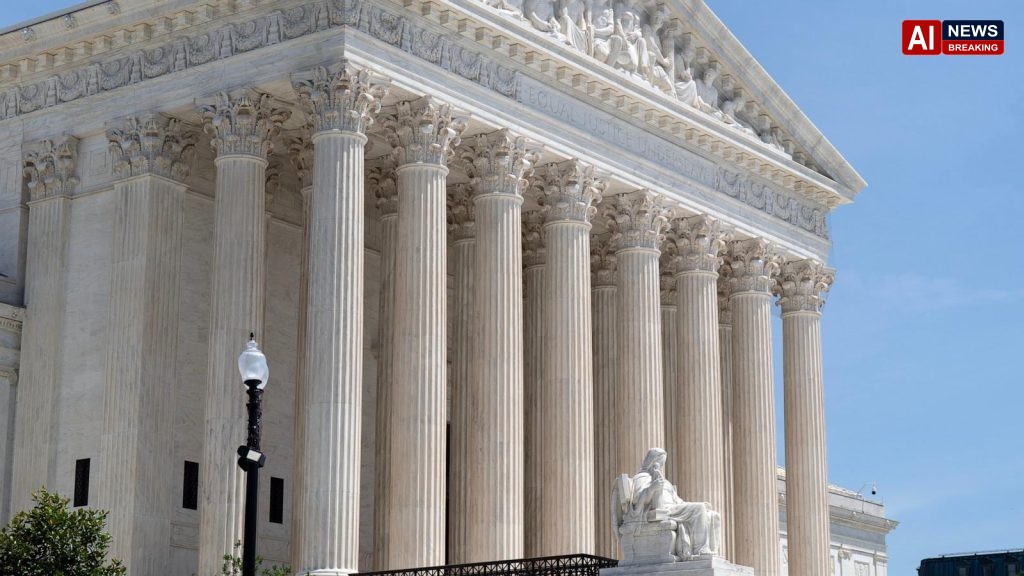
Supreme Court rebuffs Trump administration appeal over DEI funding cuts - AI News Breaking
The United States Supreme Court has dismissed an appeal by the former Trump administration seeking to reinstate a policy that curtailed federal funding for diversity, equity and inclusion (DEI) programmes in academic research. The decision, delivered in a per curiam order, leaves in place a lower‑court ruling that blocked the administration’s attempt to redirect billions of dollars away from initiatives aimed at increasing the representation of historically under‑served groups in science, technology, engineering and mathematics (STEM) fields. Legal analysts say the judgment underscores the courts’ reluctance to intervene in the political decisions of a former administration, while also signalling that the judiciary remains wary of abrupt policy reversals that lack clear statutory authority.The case originated in 2022, when the Department of Education and the Department of Health and Human Services issued guidance that effectively barred institutions receiving federal research grants from using those funds to support DEI‑related activities..
The guidance was framed as a compliance measure to ensure that federal monies were spent solely on “core scientific research” and not on ancillary programmes deemed politically motivated. Critics, including a coalition of universities, research institutes and civil‑rights groups, argued that the rule violated the Administrative Procedure Act by bypassing the notice‑and‑comment process required for substantive policy changes, and that it contravened the statutory purpose of the funding statutes, which explicitly allow for the promotion of diversity in the research workforce.A federal district court in Washington, D.C., ruled in favour of the plaintiffs, finding that the guidance was “arbitrary and capricious” and that it exceeded the agencies’ statutory authority. The court ordered the departments to rescind the policy and to reinstate funding for DEI initiatives..
The Trump administration appealed the decision, contending that the lower court had misinterpreted the agencies’ discretion under the Higher Education Act and the National Institutes of Health (NIH) Revitalization Act, both of which contain language permitting the promotion of a diverse scientific community. The administration also argued that the guidance was a reasonable interpretation of the law, given the need to safeguard taxpayer dollars from what it described as “politically driven” expenditures.In its brief to the Supreme Court, the administration emphasised that the policy was a legitimate exercise of executive authority and that the lower court had overstepped by imposing procedural requirements that were not mandated by the statutes in question. It further asserted that the judiciary should defer to the executive branch on matters of policy formulation, especially when the agencies involved possess the expertise to assess the appropriate allocation of research funds..
The government’s position was bolstered by several amicus briefs from former officials who warned that overturning the guidance could set a precedent for judicial interference in agency discretion.The Supreme Court’s per curiam order, issued without a full opinion, simply denied the petition for a writ of certiorari. By refusing to hear the appeal, the Court effectively upheld the district court’s injunction, allowing the DEI programmes to continue receiving federal support. While the order did not include a detailed rationale, legal scholars note that the Court’s denial of certiorari is often interpreted as an indication that the justices see no compelling reason to overturn the lower‑court judgment, particularly in cases where the administrative record does not present a clear statutory conflict.Observers point out that the timing of the decision—just months after the inauguration of President Joe Biden—may have influenced the Court’s calculus..
The Biden administration has signalled a strong commitment to restoring and expanding DEI initiatives across federal agencies, reversing many of the previous administration’s policies. The Supreme Court, now with a more liberal majority following recent appointments, may have been less inclined to endorse a policy that starkly contrasts with the current executive agenda. Nonetheless, the Court’s refusal to engage with the case does not constitute an endorsement of the DEI funding model; it merely reflects a procedural choice to leave the lower‑court ruling intact.The impact of the ruling is immediate for research institutions that had begun to reallocate resources in anticipation of the funding cuts..
Universities such as the University of California system and the Massachusetts Institute of Technology, which had halted certain DEI‑related hiring and mentorship programmes, can now resume those activities without fear of violating federal grant terms. The decision also restores confidence among grant‑making bodies like the National Science Foundation and the NIH, which had expressed concerns that the guidance could jeopardise compliance with their own diversity mandates.Financial implications are also significant. The federal budget for research and development, already strained by inflationary pressures and competing priorities, will continue to include allocations for DEI initiatives that total an estimated $1.2 billion annually..
Advocates argue that these funds are essential for addressing systemic inequities that have long plagued the scientific enterprise, while detractors maintain that they divert resources from core research. The Supreme Court’s denial of the appeal does not resolve this policy debate, but it does preserve the status quo for the foreseeable future.The case may yet influence future litigation over administrative authority. Some legal commentators suggest that the Court’s refusal to take up the appeal could be read as a subtle warning that agencies must adhere more strictly to procedural requirements when issuing guidance that has substantive fiscal effects..
Others contend that the decision simply reflects the Court’s limited docket and its strategic choice to focus on cases with broader constitutional implications. In either view, the outcome underscores the importance of the notice‑and‑comment process as a safeguard against abrupt policy shifts that affect large swaths of the public sector.For the plaintiffs, the victory is both symbolic and practical. Organizations such as the American Association for the Advancement of Science and the National Association of Diversity Officers in Higher Education have hailed the ruling as a reaffirmation of the principle that federal research funding should be used to foster inclusive academic environments..
They argue that diverse research teams produce higher‑quality science and are better equipped to address complex societal challenges. The continuation of DEI funding, they say, will help close the persistent gaps in representation that have been documented in fields ranging from biomedical research to engineering.The Trump administration, now out of power, has signalled that it will continue to challenge the policy through other legal avenues, though prospects appear dim. Former ary of Education Mick Zais has indicated that the administration may seek to revisit the issue through legislative means, advocating for amendments to the Higher Education Act that would explicitly restrict the use of federal funds for DEI activities..
Such efforts would require bipartisan support in Congress, a prospect that seems remote given the current political climate and the strong backing DEI initiatives have among many Democratic lawmakers.In the broader context, the Supreme Court’s action reflects an ongoing national conversation about the role of the federal government in shaping the demographic composition of the research workforce..
Updated: November 16, 2026