
 Pakistan’s leaders hail first astronaut aboard Chinese craft: ‘Proud one of us has gone into space’
 British tourist travels 29 hours from Mumbai to Amritsar for ₹5,461, rates Indian Railways 10/10 | Viral video
 The Supreme Court will decide whether assault weapons bans violate the Second Amendment
 A Critic of Beijing Falls Short in Taiwan’s Key Mayoral Election
 EPA says no rise in contamination after Army detonates lead azide stockpile in Iowa
Trump Will Miss Most of the ASEAN Summit
**
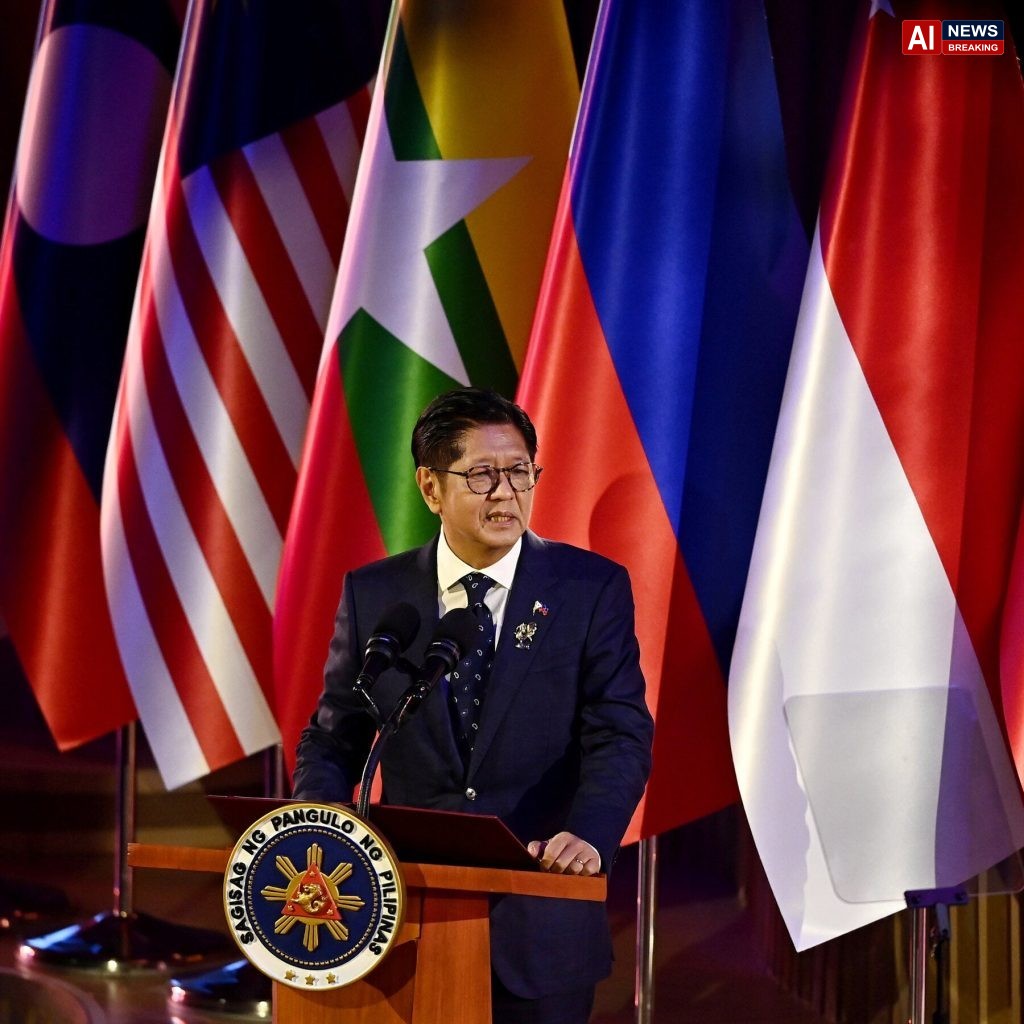
Trump Will Miss Most of the ASEAN Summit - AI News Breaking
President Donald Trump is expected to arrive in Manila on Thursday evening, after the ASEAN summit concludes for the day. His late arrival has drawn attention to the United States’ increasingly delicate position in Southeast Asia, a region where Washington’s interests often collide with Beijing’s expanding influence. The timing of the trip, and the fact that the former president will miss the majority of the summit’s key sessions, has raised questions about the strategic calculus behind his itinerary.The ASEAN summit, which convenes the leaders of ten member states, is a critical forum for discussing a range of issues from trade to security to regional cooperation..
Over the past weeks, the gathering has focused on a new ASEAN‑China Free Trade Area agreement, the situation in the South China Sea, and the ongoing economic fallout from the pandemic. In the United States, the administration has signaled a willingness to strengthen ties with Southeast Asia, but it has also expressed concern about China’s military build‑up in the disputed waters. This dual stance has led to a perception that the U.S..
is attempting to maintain a balance between supporting its regional partners and avoiding direct confrontation with Beijing.The decision to bring Trump to Manila after most of the summit’s proceedings have finished appears to be driven more by optics than by substantive policy objectives. While the former president’s presence could offer a brief moment of U.S. visibility, it will likely have little effect on the core agenda items that are being debated by the ASEAN leaders..
By contrast, Washington’s official delegation, led by the ary of State, is expected to attend the full schedule and engage in the substantive negotiations. Their presence will signal that the United States remains a key player in the region’s diplomatic landscape, even if Trump’s arrival is delayed.In addition to the timing, the choice of the former president as a guest reflects a broader trend in U.S. foreign policy, where former officials are increasingly used as symbolic representatives..
While Trump’s brief appearance in Manila may not alter the dynamics of the summit, it could reinforce a narrative that the U.S. is still invested in Southeast Asia’s future. However, critics argue that relying on a former president for diplomatic visibility risks conflating political rhetoric with concrete policy action..
They point to the limited capacity for Trump to influence ongoing negotiations, which are primarily guided by the current administration’s strategic objectives.The implications of this move extend beyond the ASEAN summit itself. The region is currently witnessing a heightened military presence from both the U.S. The United States has expanded its naval patrols in the South China Sea, citing freedom of navigation and support for its allies..
China, meanwhile, has continued to assert its claims through increased maritime patrols and the construction of artificial islands. These parallel actions have intensified the sense of a geopolitical tug‑of‑war in the area. gesture—whether real or symbolic—can have a ripple effect on regional perceptions of power dynamics.Trump’s delayed arrival also coincides with a period of domestic political turbulence in the United States..
The former president is facing ongoing investigations related to his 2020 campaign and allegations of interference in the 2021 election. These legal challenges may have influenced the decision to keep the former president’s trip separate from the official U.S. By doing so, the administration can maintain a clear line between its official foreign policy stance and the public spectacle of Trump’s presence..
This separation may also mitigate any potential backlash from Southeast Asian partners wary of associating too closely with a figure still embroiled in controversy.Moreover, the ASEAN leaders have expressed a preference for a direct and uninterrupted dialogue with U.S. In a recent statement, the Indonesian president highlighted the importance of sustained engagement with Washington on issues such as trade and cybersecurity. The Philippines, meanwhile, has called for a renewed focus on maritime security cooperation, especially given recent incidents involving Chinese vessels..
The absence of the former president from the key sessions may therefore be seen as a missed opportunity for the United States to reinforce its commitment to the region’s security framework.The broader regional narrative is one of careful balancing. ASEAN states are increasingly conscious of the need to maintain a relationship with both Washington and Beijing while asserting their own sovereign interests. The ASEAN‑China Free Trade Area, for instance, has been a contentious point of negotiation, with some member states wary of being economically dependent on China..
In this climate, the United States’ engagement is viewed as a counterbalance to Beijing’s influence. However, the effectiveness of this counterbalance hinges on the consistency and depth of U.S. diplomatic efforts rather than on high-profile appearances.Looking ahead, the U.S..
has planned a series of high‑level meetings with ASEAN leaders in the coming weeks, focusing on trade liberalization, infrastructure development, and climate resilience. These engagements will take place after the ASEAN summit, allowing for a more sustained dialogue. The timing of Trump’s arrival, therefore, may be seen as a strategic decision to separate the former president’s visit from the core policy discussions, thereby preserving the integrity of the U.S..
diplomatic mission while still delivering a symbolic gesture of solidarity.In the end, the United States’ role in Southeast Asia will likely depend on its ability to deliver concrete benefits to the region. Trade agreements that reduce tariffs, investment in critical infrastructure projects, and tangible support for disaster response are expected to be the most persuasive signals of U.S. While Trump’s late arrival in Manila will capture headlines, the substantive outcomes of the U.S..
engagement with ASEAN leaders will ultimately determine how the region perceives Washington’s strategic intentions..
Trump’s late Manila stop is less a policy pivot than a calculated splash, letting Washington keep its official delegation focused on the hard‑talk while the former president delivers a headline‑making, low‑stakes signal of U.S. interest. In a region where every gesture is read as a balance‑of‑





