 France deploys patrol fleet to curb Channel migrant crossings
  From a Nepal in Pain, a Young Leader Makes a Case for Climate Reparations
  Ukraine transfers two North Korean POWs to South Korea.
  Australia probes AI‑driven breach of My Health Record portal
  Engineering student’s ‘suicide’ turns out to be murder two arrested
 Trump’s Election Speech Sparks Controversy: Critics Say Remarks Could Undermine Confidence in U.S. Voting System
** President Donald Trump’s recent speech on election security has sparked controversy, with critics arguing that his remarks could undermine confidence in the US voting system. Trump claimed that China had obtained voter information on 220 million Americans, but failed to provide evidence to support the allegation.
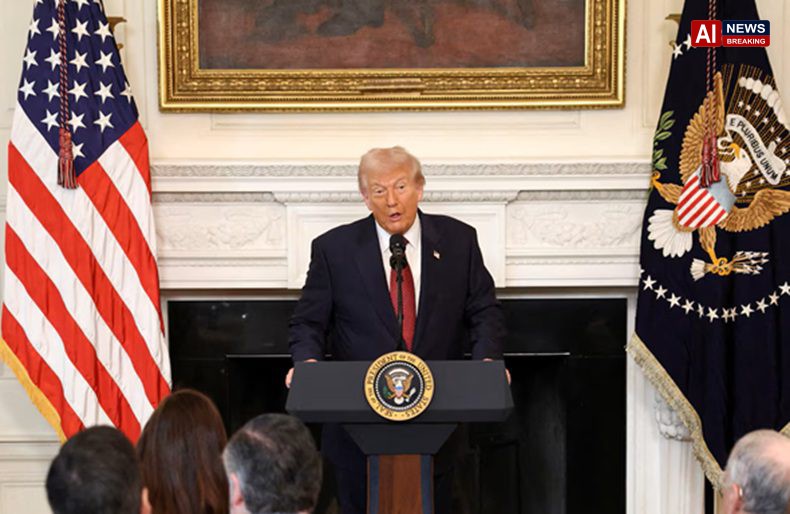
Trump's Election Speech Sparks Controversy: Critics Say Remarks Could Undermine Confidence in U.S. Voting System - AI News Breaking
trumps election speech sparks:
News Summary:
- President Donald Trump’s White House address on election security has drawn criticism from political analysts and opponents, who argue that his remarks could weaken public trust in the American electoral process.
- Trump claimed that China had obtained voter information belonging to 220 million Americans but did not present publicly available evidence to substantiate the allegation during his speech.
The US president has been accused of trying to undermine confidence in American elections in a presidential address on Thursday that left many questioning the true intentions behind his words. Donald Trump’s speech, delivered from the East Room at the White House, was a carefully crafted effort to lay the groundwork for further destabilizing the electoral system ahead of November’s midterm elections. Critics have long been wary of Trump’s willingness to blur the lines between fact and fiction, and this latest address appears to be nothing more than another attempt to spread misinformation and uncertainty..
Trump’s address was a prime example of how he continues to use the imprimatur of the presidency to shape public opinion and advance his own agenda. He attempted to give the impression that his administration had uncovered new bombshell findings about vulnerabilities in the US’s election system, and in doing so, aimed his fire squarely at China. According to Trump, Beijing had illicitly acquired voter information on a staggering 220 million Americans..
This, he claimed, was a clear example of China’s ongoing attempts to interfere with the democratic process. The problem is that Trump failed to provide any concrete evidence to back up his claims. He didn’t explain the means by which China acquired the alleged voter information, nor did he offer any details about the nature of the interference..
This lack of transparency only served to fuel concerns that Trump was using his position to spread misinformation and sow discord. The silence from his administration on these matters has been deafening, leaving many to wonder what other bombshell revelations might be just around the corner. The significance of the address cannot be overstated, particularly in the context of the upcoming midterm elections..
With Trump’s presidency hanging precariously in the balance, he is desperate to create the illusion of crisis and uncertainty. By highlighting perceived vulnerabilities in the electoral system, he hopes to erode the public’s faith in the democratic process and, by extension, create a justification for further intervention by his administration. The goal, quite simply, is to undermine the integrity of the midterms and ensure that his party is positioned to take advantage of the resulting chaos..
Critics have been quick to respond to Trump’s address, accusing him of attempting to politicize the intelligence agencies and undermine the very foundations of American democracy. They argue that the president’s actions amount to little more than a thinly veiled attempt to justify greater control over the electoral process. By painting Chinese interference as a serious threat to the integrity of US elections, Trump is, in effect, paving the way for the implementation of new and potentially far-reaching measures to address the so-called issue..
One such measure that has been floated in recent weeks is the implementation of a national voter ID requirement. Such a move would undoubtedly serve to disproportionately impact marginalized communities and minority groups, who are already subject to a range of systemic barriers that make it more difficult for them to participate in the democratic process. By casting Chinese interference as a major threat, Trump is attempting to create a pretext for the imposition of new voter restrictions, the likes of which have long been rejected as discriminatory and unconstitutional.
Claims About Chinese Interference
Trump’s allegation that China obtained voter-related information on 220 million Americans became one of the most widely discussed aspects of the address.
The president suggested that Beijing’s actions formed part of broader efforts to influence American democratic processes. Foreign interference in elections has been a longstanding concern among U.S. intelligence agencies, which have previously warned about cyber activities originating from various state actors.
However, critics have noted that Trump’s speech did not include:
- Public intelligence assessments supporting the claim.
- Technical details regarding the alleged data breach.
- Information about affected databases or agencies.
- Evidence demonstrating election manipulation.
- Specific measures undertaken in response.
Without additional documentation, analysts say it remains difficult to independently evaluate the scope and significance of the allegations.
Historical Context of Trump’s Election Messaging
Donald Trump has consistently made election integrity a central political issue throughout his presidency and subsequent political campaigns. Since the 2020 presidential election, he has repeatedly called for reforms involving:
- Voter identification requirements.
- Citizenship verification measures.
- Election audits.
- Stricter mail-in voting regulations.
- Enhanced cybersecurity protections.
Supporters argue that these proposals reflect legitimate concerns about safeguarding elections, while opponents contend that some of Trump’s rhetoric has unnecessarily undermined confidence in electoral institutions.
His latest address continues this longstanding focus on election-related issues and signals that election security is likely to remain a major political priority.
The fallout from Trump’s address has been immediate and far-reaching. In the hours that followed, officials from the Chinese government were quick to deny any wrongdoing, stating categorically that Beijing had not engaged in any such activities. This, of course, was not unexpected, given that China has consistently maintained that it does not engage in cyber attacks against the US or any other country..
By spreading false information and creating an atmosphere of uncertainty, Trump is playing a highly reckless game, one that risks exacerbating tensions between the world’s two largest economies. Moreover, the long-term implications of Trump’s actions are equally concerning. By politicizing the intelligence agencies and using them to further his own agenda, he risks creating a toxic culture of mistrust and suspicion within the national security apparatus..
Agents and analysts who are simply trying to do their job will find themselves increasingly vulnerable to pressure and manipulation, as Trump and his allies use the intelligence agencies to spread propaganda and further their own interests. The impact on American society has also been significant, with many people expressing outrage and dismay at Trump’s tactics. The Democratic-led House of Representatives has responded by calling on the president to provide concrete evidence to support his claims, and to clarify the extent of Chinese interference in US elections..
So far, Trump has remained silent, preferring instead to issue a series of vague and unsubstantiated claims about the nature and extent of the supposed threat. Meanwhile, a growing number of experts and academics are speaking out against Trump’s actions, warning that they have the potential to create a crisis of confidence in the US electoral system that will have far-reaching implications for American democracy. By spreading misinformation and undermining trust in the democratic process, Trump is, in effect, perpetuating a culture of cynicism and distrust that threatens to undermine the very foundations of the country’s institutions..
As the midterms approach, it remains to be seen how the public will respond to Trump’s attempts to destabilize the electoral system. One thing is certain, however: the fallout from this address has the potential to be far-reaching and destructive, with serious consequences for American democracy and the rule of law. In a country where the president is supposed to uphold the Constitution and defend the integrity of the democratic process, Trump’s actions are nothing short of treasonous..
Updated: July 17, 2026
Trump’s attempts to destabilize the electoral system reveal a deeper concern – the erosion of trust in institutions, which can have a lasting impact on American democracy. By perpetuating a culture of cynicism and distrust, Trump is ultimately undermining the legitimacy of the very system he was elected to lead.