
 Pakistan’s leaders hail first astronaut aboard Chinese craft: ‘Proud one of us has gone into space’
 British tourist travels 29 hours from Mumbai to Amritsar for ₹5,461, rates Indian Railways 10/10 | Viral video
 The Supreme Court will decide whether assault weapons bans violate the Second Amendment
 A Critic of Beijing Falls Short in Taiwan’s Key Mayoral Election
 EPA says no rise in contamination after Army detonates lead azide stockpile in Iowa
US Catholic bishops convene in Baltimore to adapt anti‑abortion strategy after Democratic gains
**
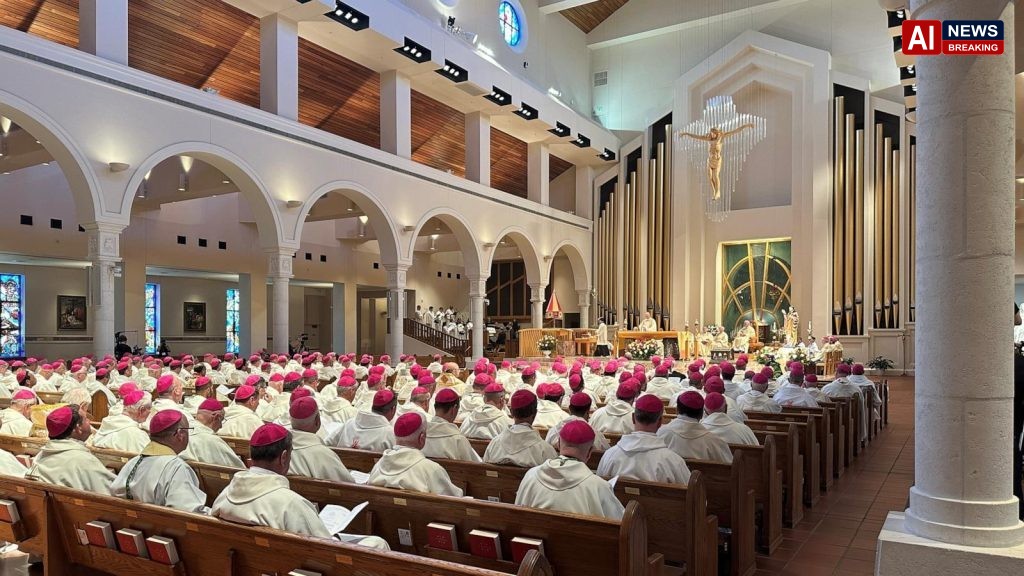
US Catholic bishops meet after Democrats' big wins help reshape abortion debates - AI News Breaking
catholic bishops convene baltimore:
US Catholic bishops meet after Democrats’ big wins help reshape abortion debates The United States Conference of Catholic Bishops has gathered in Baltimore for a three‑day summit that will be the first of its kind since the 2022 midterm elections handed Democrats control of the House and narrowed the Republican margin in the Senate. Bishops from across the country are convening to assess how the new political landscape will affect the Church’s long‑standing anti‑abortion advocacy. Organisers say the agenda will include strategic planning, theological reflection and dialogue with lay partners, as the hierarchy seeks to adapt its messaging in a climate where several states are poised to tighten abortion restrictions while others move toward codifying Roe v..
The timing of the meeting has drawn considerable media attention because the Democrats’ victories have reshaped the national conversation on reproductive rights. In the House, a Democratic majority now holds the power to advance legislation that would protect abortion access at the federal level, while Senate Republicans retain a filibuster that makes such measures uncertain. Bishops are aware that the political calculus has shifted from a focus on state‑by‑state battles to a potential federal showdown, prompting them to reconsider how best to influence lawmakers and mobilise their faithful..
Lori, president of the USCCB, opened the summit with a call for “courageous fidelity” to Church teaching amid “rapidly changing public policy”. He warned that the “political winds” cannot dictate doctrine, but emphasised the need for a coordinated pastoral response that reaches beyond the pulpit into the civic arena. Lori’s remarks set the tone for a series of plenary sessions that will examine the role of Catholic social teaching, the ethical dimensions of bodily autonomy, and the responsibility of clergy to engage with elected officials without compromising ecclesial integrity..
One of the key themes under discussion is the concept of “pro‑life solidarity”, which the bishops describe as a holistic approach that links opposition to abortion with advocacy for the unborn, the poor, and the marginalized. Several speakers highlighted the importance of framing the anti‑abortion stance within a broader narrative of dignity and social justice, aiming to appeal to younger Catholics who increasingly view the issue through a lens of gender equity and healthcare access. The bishops hope that a more expansive narrative will counter accusations that the Church’s position is solely about restricting women’s rights..
The summit also includes a round‑table with representatives from pro‑life organisations such as the National Right to Life Committee and the Catholic Medical Association. These partners will share data on recent legislative trends, including the introduction of “heartbeat” bills in multiple states and the push for a federal “Human Life Protection Act”. By pooling resources, the bishops intend to develop a unified advocacy strategy that leverages both moral persuasion and political lobbying, while respecting the canonical limits on direct partisan involvement..
A contentious issue on the agenda is how to respond to the growing number of Catholic politicians who support abortion rights. The bishops have previously issued statements urging Catholic lawmakers to act in accordance with Church teaching, but critics argue that such admonitions blur the line between religious guidance and political coercion. At the summit, a theologian from the Pontifical University of Saint Thomas Aquinas presented a nuanced view, suggesting that bishops can offer “conscience‑forming counsel” without imposing canonical penalties, thereby preserving the Church’s moral authority without alienating members of the faithful who hold divergent political views..
In addition to policy discussions, the Baltimore meeting features workshops on pastoral care for women who have had abortions. Bishops are seeking to reinforce the sacrament of reconciliation and to provide resources for healing that align with the Church’s emphasis on mercy. These sessions are being led by psychologists and canon lawyers who will advise dioceses on how to balance doctrinal fidelity with compassionate accompaniment, a balance that has become increasingly scrutinised in the age of social media activism..
The bishops are also confronting the reality of declining Mass attendance and the erosion of Catholic identity among younger generations. Survey data presented at the summit show that only 30 % of Catholics under 30 identify as “practicing”, and many cite the Church’s stance on reproductive issues as a factor in disengagement. In response, the USCCB is considering a “listening tour” of college campuses and urban parishes, aiming to gather feedback that could inform future catechetical materials and public statements..
The goal is to demonstrate that the Church’s pro‑life ethic is rooted in a consistent ethic of life, rather than a single‑issue platform. The political implications of the bishops’ deliberations extend beyond the United States. International observers from the Vatican’s Dicastery for the Doctrine of the Faith have been invited to observe the proceedings, signalling the global relevance of the American abortion debate..
Pope Francis, who has repeatedly called for a “culture of encounter” and a “merciful Church”, is expected to address the USCCB later this month, offering guidance that may shape the bishops’ final communiqué. Analysts predict that his remarks will stress the need for dialogue with dissenting voices while reaffirming the inviolability of unborn life. Critics of the bishops’ approach argue that the Church is missing an opportunity to champion reproductive justice more broadly, including access to contraception and comprehensive sex education..
Progressive Catholic advocacy groups have organised protests outside the Baltimore Convention Center, holding signs that read “Life includes all women”. In response, several bishops reiterated that the Church’s teaching on contraception remains unchanged, but they expressed a willingness to engage in “respectful conversation” with those who hold different perspectives, seeking common ground on.
US bishops convened in Baltimore to rethink anti‑abortion strategy as Democratic gains shift the debate toward potential federal action, emphasizing a broader “pro‑life solidarity” narrative that links opposition to abortion with social‑justice concerns. The summit blends theological reflection with political planning, seeking a unified pastoral response while navigating internal tensions over how to counsel Catholic lawmakers and engage younger faithful.
The bishops are pivoting from a purely “anti‑abortion” stance to a broader life‑justice narrative, hoping to win over younger Catholics who view reproductive rights through a social equity lens. By framing pro‑life as part of a universal ethic of dignity, they aim to sidestep accusations of





