Pakistan’s leaders hail first astronaut aboard Chinese craft: ‘Proud one of us has gone into space’
 British tourist travels 29 hours from Mumbai to Amritsar for ₹5,461, rates Indian Railways 10/10 | Viral video
 The Supreme Court will decide whether assault weapons bans violate the Second Amendment
 A Critic of Beijing Falls Short in Taiwan’s Key Mayoral Election
 EPA says no rise in contamination after Army detonates lead azide stockpile in Iowa
White Police Officers Are Convicted of Beating a Black Man in France
In February 2024, a Paris court sentenced three white police officers to three years in prison (with two years suspended) for violently beating Black music producer Michel Zecler during a 2020 raid. The high‑profile verdict has revived France’s heated debate over police racism, accountability, and the need for systemic reform.
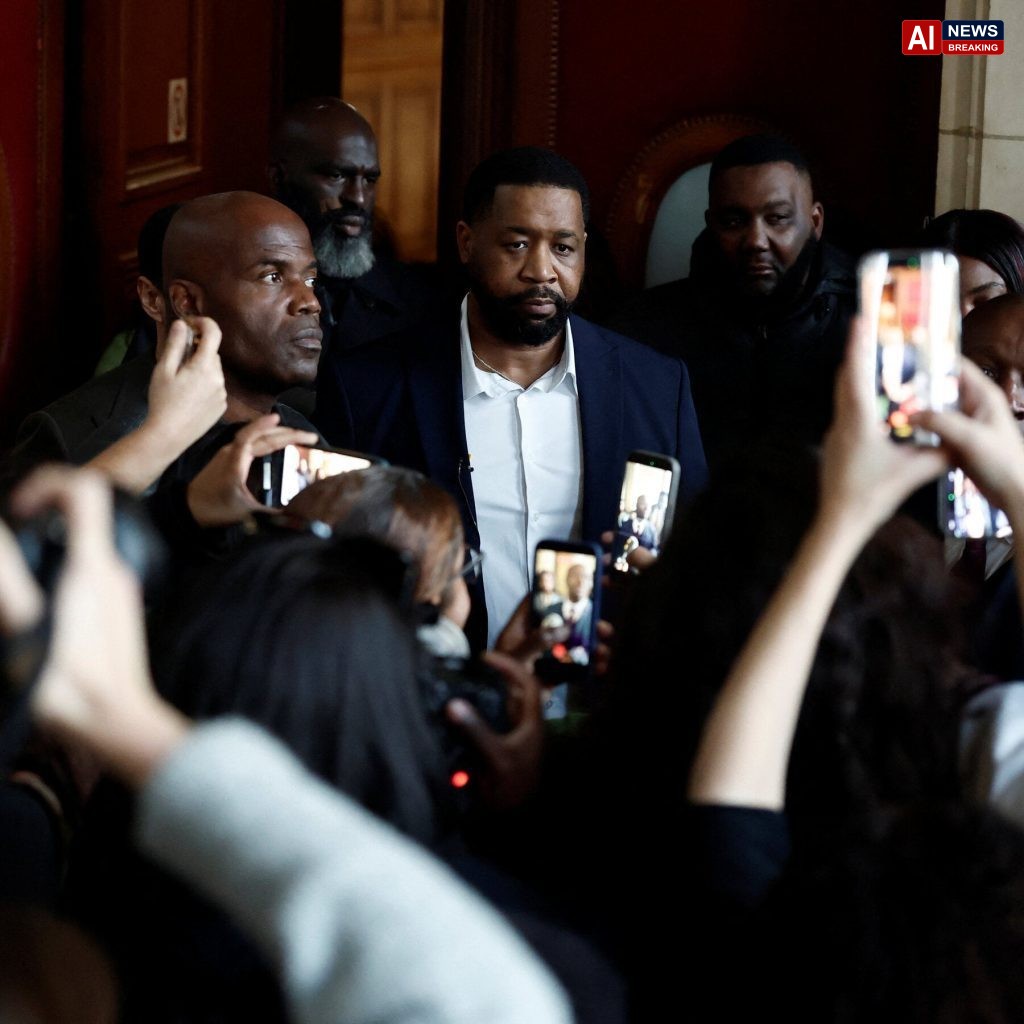
White Police Officers Are Convicted of Beating a Black Man in France - AI News Breaking
white police officers convicted:
The arrest and subsequent conviction of three French police officers for assaulting Michel Zecler, a Black music producer, has sparked a renewed debate over police conduct and institutional racism in France. The incident, captured on video and widely circulated on social media in 2020, showed the officers entering Zecler’s Paris recording studio and repeatedly striking him with batons while shouting commands. The footage, which quickly went viral, prompted protests across the country and intensified calls for greater accountability within the national police force..
The three officers – identified as Serge Dupont, Julien Martin and Karim Bouchard – were later tried and found guilty of aggravated assault, a verdict that has been both hailed and criticised by different segments of French society.The episode began on a cold evening in March 2020 when the three officers, acting on an undisclosed warrant, entered Zecler’s studio in the 19th arrondissement. According to court documents, they were searching for a suspect linked to a separate investigation and claimed that Zecler had obstructed their entry. Zecler, who was in the middle of a recording session, denied any wrongdoing and asserted that the police had no legal basis for the raid..
The confrontation escalated rapidly; the officers, wearing full riot gear, forced their way into the small room, seized Zecler’s equipment and began beating him while shouting “Move!” and “You’re under arrest!” The entire episode was filmed by a colleague who later uploaded the video to YouTube, where it amassed millions of views within days.The video’s circulation coincided with the global resurgence of the Black Lives Matter movement, and French activists quickly drew parallels with other high‑profile cases of alleged police brutality. Demonstrations were organised in Paris, Lyon and Marseille, with participants demanding the dismissal of the officers involved and a broader overhaul of policing practices. The Ministry of the Interior initially defended the officers, stating that they had been acting within the scope of their duties..
However, as public pressure mounted, the interior minister, Gérald Darmanin, ordered an independent inquiry and pledged to cooperate fully with the judicial process.The trial, which began in September 2023, was closely watched by both national and international observers. Prosecutors presented the video evidence alongside testimonies from Zecler, his colleagues and an independent forensic expert who concluded that the injuries sustained – bruises, a fractured rib and a concussion – were consistent with the force shown in the footage. The defence argued that the officers had acted in self‑defence, claiming that Zecler had become violent and attempted to seize their weapons..
The judge, however, found the defence’s argument unconvincing, noting that the officers had not identified themselves adequately and had used disproportionate force against an unarmed civilian.On 12 February 2024, the court handed down its verdict, sentencing Dupont, Martin and Bouchard to three years’ imprisonment each, with two years suspended, and ordering them to pay €15,000 in compensation to Zecler. The sentence, while significant, fell short of the maximum penalty for aggravated assault under French law, prompting criticism from civil‑rights groups who argued that the punishment did not reflect the severity of the abuse of power. Zecler’s legal team welcomed the ruling as a “step forward” but warned that “systemic issues remain unaddressed”.The case has reignited discussions about the presence of racial bias in French policing, an issue that has traditionally been downplayed in a nation that officially rejects the concept of race in its legal framework..
Scholars at the French National Institute of Statistics and Economic Studies (INSEE) have pointed out that Black and North‑African citizens are disproportionately represented in police stop‑and‑search data, a fact that many politicians have been reluctant to acknowledge. In the wake of the Zecler conviction, several members of the National Assembly have called for a parliamentary commission to examine policing practices, including the use of force and the transparency of internal investigations.In response to the public outcry, the Ministry of the Interior announced a series of reforms aimed at improving police accountability. Among the measures proposed are mandatory body‑camera deployment for all frontline officers, a revamp of the disciplinary procedure to allow for independent review, and enhanced training on de‑escalation techniques..
Critics, however, argue that these steps are insufficient without a cultural shift within the police hierarchy, noting that similar reforms have been announced after previous incidents but rarely resulted in substantive change.The Zecler case also had repercussions beyond France’s borders. International human‑rights organisations, including Amnesty International and Human Rights Watch, issued statements urging the French government to adopt more robust safeguards against police misconduct. The European Court of Human Rights, which has previously ruled against France in cases involving excessive force, is now monitoring the situation closely..
Meanwhile, the music industry rallied around Zecler, with several prominent French artists publicly expressing solidarity and using their platforms to highlight broader issues of racial inequality.As the legal process concludes, the broader societal implications of the case continue to unfold. For many observers, the convictions represent a rare instance of accountability in a system where police officers are often shielded by a culture of impunity. Yet the relatively modest sentences and the continued prevalence of complaints against law enforcement suggest that deeper reforms are needed..
The debate now centres on whether France can reconcile its republican ideals of universalism with the lived realities of discrimination experienced by its minority communities.The story of Michel Zecler, a man whose career in music production was abruptly interrupted by a violent police raid, serves as a stark reminder of the delicate balance between public security and individual rights. While the courtroom verdict provides a measure of justice for the victim, it also underscores the ongoing challenges France faces in confronting entrenched biases within its institutions. The coming months will test the government’s willingness to translate promises of reform into concrete action, and will determine whether this case becomes a catalyst for lasting change or a fleeting footnote in an otherwise persistent pattern of police‑related controversies..
Updated: November 21, 2026
Three French police officers were convicted of aggravated assault after a viral video showed them brutally beating Black music producer Michel Zecler in his Paris studio, reigniting nationwide debate over police racism and accountability. The court’s three‑year sentences, though hailed as a rare step toward justice, have drawn criticism for being too lenient, prompting calls for deeper reforms and a parliamentary inquiry into policing practices.
Insight: The Zecler conviction proves that French courts can bite, yet the lukewarm sentences reveal a justice system still calibrated to protect its own. It forces a reckoning: without a cultural overhaul, reforms will remain cosmetic and the republic’s “color‑blind” myth will keep eroding public trust.