
 Pond heron found dead in Coimbatore tests positive for avian influenza
 Pakistan’s leaders hail first astronaut aboard Chinese craft: ‘Proud one of us has gone into space’
 British tourist travels 29 hours from Mumbai to Amritsar for ₹5,461, rates Indian Railways 10/10 | Viral video
 The Supreme Court will decide whether assault weapons bans violate the Second Amendment
 A Critic of Beijing Falls Short in Taiwan’s Key Mayoral Election
‘We are now proudly at #2’: Why Harsh Goenka is congratulating everyone who insisted on bursting more firecrackers
**
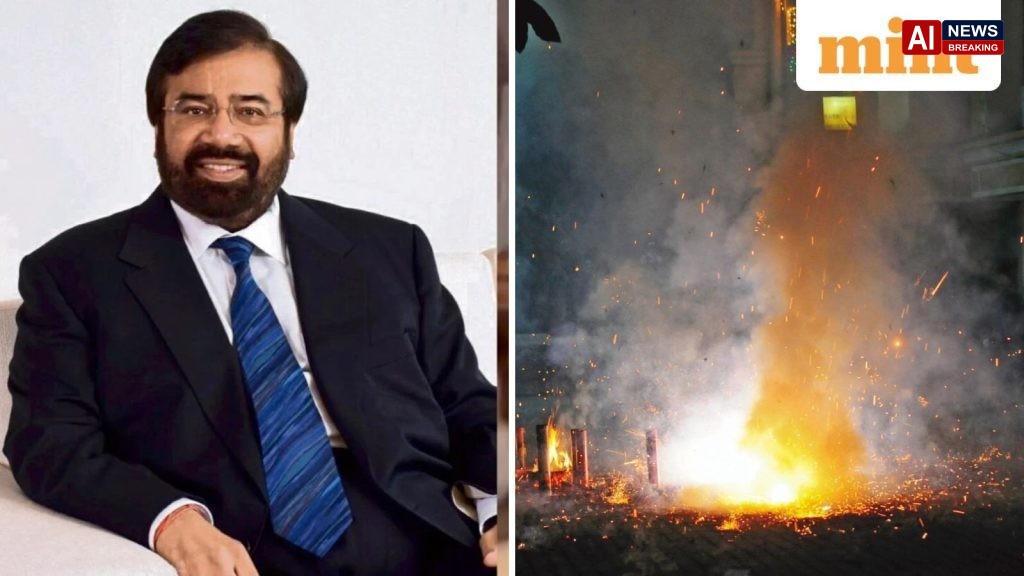
‘We are now proudly at #2’: Why Harsh Goenka is congratulating everyone who insisted on bursting more firecrackers - AI News Breaking
proudly harsh goenka congratulating:
The late afternoon glow of Delhi’s skyline was punctuated by the sudden burst of fireworks that had turned the night into a kaleidoscopic display. The air, heavy with the sweet and acrid scent of pyrotechnic chemicals, carried an unmistakable thrum that many Indians associate with celebrations and festive zeal. Yet, for the industrial tycoon Harsh Goenka, the spectacle was more than a fleeting moment of joy – it was a reminder of the environmental toll that India continues to shoulder on a global scale.Goenka, who heads the conglomerate that dominates sectors from energy to telecommunications, took to the social media platform X – a name still used in the wake of its rebranding – to offer a commentary that was as candid as it was controversial..
In a single post that attracted thousands of comments and retweets, he congratulated those who had insisted on “bursting more firecrackers” and, with a sardonic smile, implied that India had missed the coveted “Number One” position in global pollution rankings. The post was a thinly veiled jab at the country’s inability to curb its rising emissions, and a nudge at the populace for which the festive season had become an excuse to indulge in environmentally damaging practices.The commentary sparked an immediate and polarized reaction. On one side, environmental activists and scientists decried Goenka’s remark as a dangerous trivialisation of the very real ecological crisis that the world faces..
They pointed to the fact that India’s annual particulate matter levels, especially in metropolitan hubs, regularly breach World Health Organization limits. Their argument was that, rather than congratulating people for lighting crackers, corporate leaders should be urging them to adopt cleaner alternatives and adopt stricter regulations on fireworks. On the other side, some commentators perceived the post as a provocative gesture, designed to ignite debate and perhaps even rally support for an upcoming campaign that would focus on sustainable celebrations.The question of whether Goenka’s comment was meant in jest or as a serious critique is one that will be debated for weeks..
In an era where corporate leaders are increasingly held accountable not only for their business performance but also for their social responsibility, a single tweet can create ripples that reverberate beyond the digital realm. The very fact that Goenka took to X – a platform that is often a crucible for rapid, sometimes unfiltered, expression – suggests he was aiming to spark conversation rather than merely comment.The roots of India’s pollution problem run deep. For decades, the country has strived to achieve rapid economic growth, a drive that has inevitably led to industrialisation and urbanisation at a scale that outpaces the environmental safeguards that are often required to keep emissions in check..
According to a report by the International Energy Agency, India’s carbon output is the second-highest in the world, trailing only behind China. The situation is compounded by a heavy reliance on coal for electricity generation and a widespread use of older, less efficient machinery across the manufacturing sector.Beyond the industrial sector, the festive season itself is a significant contributor to India’s air quality degradation. The tradition of setting off fireworks is deeply embedded in Indian culture, with celebrations ranging from Diwali to local festivals and personal milestones..
In many households, the act of lighting crackers is not just a display of joy but a rite of passage and an expression of communal identity. However, the environmental cost is stark – the particulate matter released during fireworks can reach concentrations that are multiple times above safe levels, especially when coupled with vehicular emissions and industrial pollution.It is within this context that Goenka’s message can be understood. While he may have used sarcasm to point out India’s inability to secure the top spot in global pollution rankings, the underlying intent appears to be a call to action..
By publicly congratulating those who “insist on bursting more crackers,” he is, arguably, holding the public accountable for their role in the environmental crisis. Yet, the approach about the efficacy and appropriateness of using humour or sarcasm to address such a serious issue.The reaction from the public and experts alike indicates that the line between humour and advocacy is a fine one. A report from the Centre for Science and Environment highlighted that the average annual mortality attributed to air pollution in India is over 1.5 million people..
In such a scenario, a satirical tone that seems to celebrate the consumption of firecrackers can be interpreted as insensitive or dismissive. Conversely, proponents of Goenka’s stance argue that the public’s perception of the issue is deeply ingrained and that provocative messaging can serve as a catalyst for change by forcing people to confront uncomfortable realities.Beyond the immediate debate, Goenka’s post opens up a larger conversation about the responsibilities of corporate leaders in shaping societal norms and environmental outcomes. India’s corporate sector is increasingly recognising its role in sustainability through initiatives such as the Indian Green Building Council’s guidelines and the promotion of renewable energy..
The question that emerges is whether corporate leaders should use their platforms to influence behavioural patterns around festivals or to push for policy reforms.The Indian government, for its part, has introduced several measures aimed at curbing firecracker pollution. In 2016, the Ministry of Environment, Forest and Climate Change implemented a ban on fireworks in the capital during the festival season, a move that was later extended to other major cities. The ban was an attempt to reduce the particulate emissions that are typically highest during the festive season..
Nonetheless, enforcement has been uneven and the ban has faced criticism from various quarters, including local businesses that rely on the sales of fireworks.In addition to policy, there is a growing movement towards “green” celebrations. Organisations and NGOs have promoted the use of LED light displays, biodegradable fireworks and alternative festive practices such as “Light of Love” projects, where families replace firecrackers with light-based celebrations. These initiatives have found limited traction among the mainstream public, but they have begun to carve out a niche that is slowly influencing the cultural narrative..
Perhaps Goenka’s post is an attempt to accelerate this shift by calling attention to the environmental cost associated with traditional firecracker usage.The broader context of India’s environmental policy reveals a mixed track record. The country has committed to the Paris Agreement and has set ambitious targets for renewable energy. The government’s plan to achieve 40% renewable energy by 2030, as per the “National Solar Mission,” is a step toward decarbonisation..
Yet the reality on the ground is that coal-fired power plants continue to expand and that the enforcement of emissions regulations remains a challenge. The interplay between economic growth, industrial demand, and environmental protection has been a persistent tension in India’s policy discourse.In this climate, Goenka’s post is a reminder that corporate entities, with their massive resource base, can play an influential role in driving change..
Updated: November 10, 2026






