Pakistan’s leaders hail first astronaut aboard Chinese craft: ‘Proud one of us has gone into space’
 British tourist travels 29 hours from Mumbai to Amritsar for ₹5,461, rates Indian Railways 10/10 | Viral video
 The Supreme Court will decide whether assault weapons bans violate the Second Amendment
 A Critic of Beijing Falls Short in Taiwan’s Key Mayoral Election
 EPA says no rise in contamination after Army detonates lead azide stockpile in Iowa
US unemployment claims rise to 200,000
**
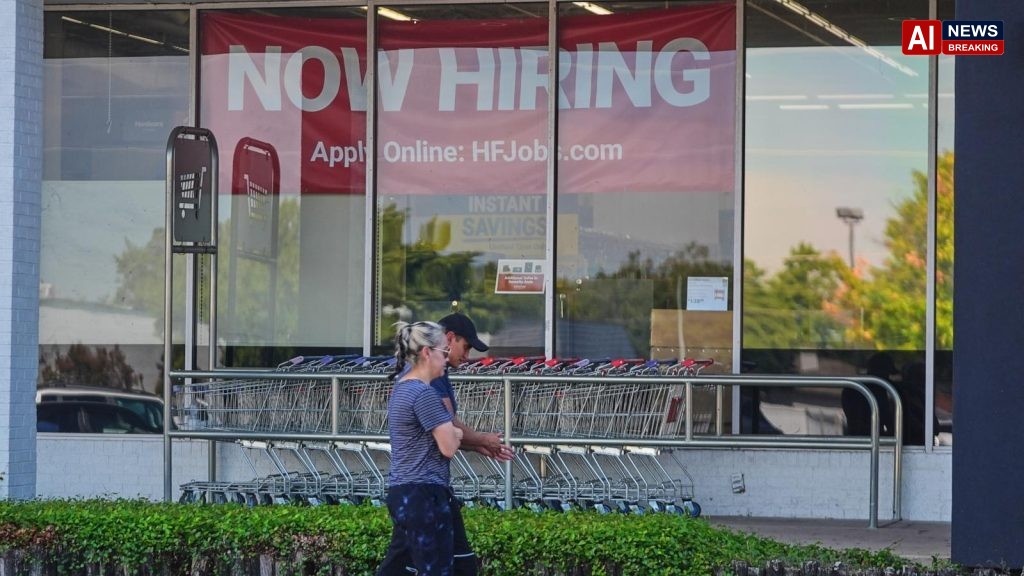
US jobless claims tick up to 200,000 but remain low by historic standards - AI News Breaking
unemployment claims rise 200000:
More than 200,000 Americans filed new claims for unemployment benefits last week, a modest increase that lifted the weekly total to 210,000, the Department of Labor reported on Thursday. The rise marks the first uptick in weekly filings since mid‑April and ends a three‑week streak of declines, but even at its higher point the figure remains far below the levels seen during the pandemic’s peak. In February 2020, before the coronavirus shock, the average weekly initial claim count hovered around 220,000, while the pandemic’s worst weeks in 2020 saw more than 6 million applications..
By contrast, the current level is roughly one‑tenth of those historic highs and sits within a range that analysts describe as “historically low” for the post‑recession era.The modest climb in filings comes amid a labour market that, despite a series of modest layoffs in the technology and retail sectors, continues to demonstrate resilience. The Bureau of Labor Statistics’ (BLS) latest employment report showed that the United States added 311,000 jobs in August, a figure that slightly outpaced expectations and underscored the economy’s capacity to absorb workers even as the Federal Reserve tightens monetary policy. Unemployment held steady at 3.8 percent, a rate that, while higher than the 3.5 percent seen in early 2022, still reflects a tight market where vacancies outnumber job seekers in many industries.Economists note that the current claims figure, while higher than the 190,000 reported three weeks earlier, is still well within the “normal” band that has characterized the labour market since early 2022..
The Federal Reserve’s preferred gauge, the insured unemployment rate, has hovered between 1.5 and 2 percent for most of the past year, a level that signals both low frictional unemployment and a scarcity of large‑scale corporate downsizing. “We are seeing a labour market that is unusually stable,” said Karen Hsu, senior economist at the Center for Economic Research. “Even when there are headline‑grabbing layoffs, they are largely confined to specific sectors and do not translate into a systemic surge in unemployment.”The rise in initial claims does, however, reflect a degree of caution among workers who have been monitoring the impact of higher interest rates on their employment prospects..
Since the Federal Reserve began raising rates in March 2022, borrowing costs have risen sharply, prompting a slowdown in housing construction, a cooling of consumer credit, and a slowdown in capital‑intensive industries such as aerospace and automotive manufacturing. Some firms have responded by trimming headcount modestly, leading to a handful of furloughs that have been captured in the weekly claims data.Yet the broader picture remains one of relative job security. The BLS’s continuation claims—people who have already filed for unemployment and are receiving benefits—have slipped to 1.71 million, the lowest level since the pandemic began..
Continuation claims are often viewed as a lagging indicator, showing whether people who have already lost jobs are staying out of work for an extended period. The decline suggests that those who have been laid off are finding new employment quickly, a trend that has been consistent throughout 2023 and into 2024.Demographic breakdowns of the new claims reveal a mixed set of stories. Younger workers, particularly those aged 20‑24, accounted for roughly 30 percent of the recent filings, a proportion that mirrors their historically higher turnover rates..
Meanwhile, the share of claims from workers over 55 remained low, underscoring the “age‑gradient” in job security that many analysts have highlighted since the pandemic. Women’s claims, which had spiked in the early months of the crisis due to childcare disruptions, have now stabilized at levels close to pre‑pandemic norms.Geographically, the increase was most pronounced in the Midwest and the South, where manufacturing and logistics firms have reported modest staff reductions in response to slower demand for goods. States such as Ohio, Indiana and Texas each saw weekly increases of 5,000 to 7,000 claims, while the West Coast continued to post the smallest gains, reflecting a more diversified economy that has absorbed shocks more readily..
The regional variation points to the uneven nature of the slowdown, with certain pockets of the country feeling the effects of tighter credit more acutely than others.Policy makers have taken note of the data but remain cautiously optimistic. The White House’s Council of Economic Advisers highlighted the claims figures in a recent briefing, noting that “the labour market remains strong, and the modest rise in filings is not indicative of a broader deterioration.” The Treasury Department, which oversees the unemployment insurance system, emphasized that the modest increase is consistent with normal cyclical fluctuations and does not signal a systemic problem. Nevertheless, officials warned that continued monetary tightening could eventually test the durability of the current employment landscape.Looking ahead, the consensus among forecasters is that the unemployment rate will edge higher in the coming months, but that the increase will be gradual and limited in scope..
The Federal Reserve’s projections suggest a “soft landing” scenario in which inflation is reined in without precipitating a sharp rise in joblessness. For now, the labour market’s underlying strength—reflected in low continuation claims, steady job growth and a relatively small pool of active claimants—offers a buffer against the modest uptick in initial filings. As the economy navigates the final stages of a prolonged tightening cycle, the resilience of the job market will remain a key barometer for both policymakers and investors..
Updated: November 12, 2026
Initial claims rose to 210,000 last week, the first increase since mid‑April, but the figure stays far below pandemic highs. Despite modest sector‑specific layoffs, job growth and low continuation claims signal a resilient labour market that can absorb the current uptick.
Insight: The uptick in claims is a quiet reminder that even a tight labor market can feel the drag of higher rates, but the rapid absorption of displaced workers shows the economy’s depth is still intact. Policymakers may tread lightly, yet the lingering regional strains suggest that a one‑size‑fits‑all tightening strategy could soon test the resilience of already‑fragile sectors.