
 Pakistan’s leaders hail first astronaut aboard Chinese craft: ‘Proud one of us has gone into space’
 British tourist travels 29 hours from Mumbai to Amritsar for ₹5,461, rates Indian Railways 10/10 | Viral video
 The Supreme Court will decide whether assault weapons bans violate the Second Amendment
 A Critic of Beijing Falls Short in Taiwan’s Key Mayoral Election
 EPA says no rise in contamination after Army detonates lead azide stockpile in Iowa
Scientists name new Indian Ocean shark species
**
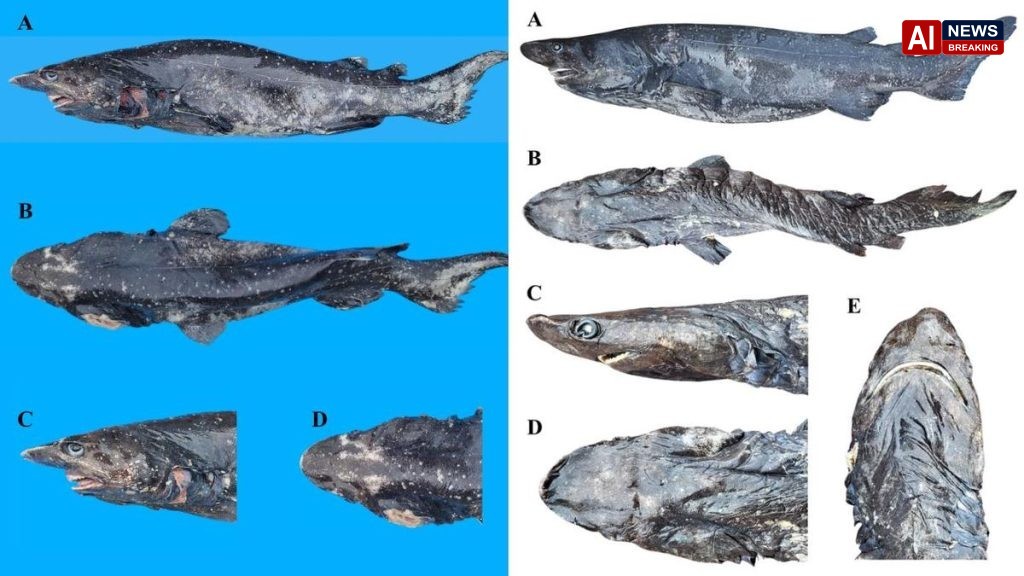
New shark species identified in Indian Ocean after decades of misclassification - AI News Breaking
scientists name indian ocean:
Scientists have announced the discovery of a new shark species in the Indian Ocean, overturning decades of taxonomic confusion that had long obscured its distinct identity. The creature, formally described as Echinorhinus roineei and colloquially dubbed the Indian Bramble Shark, belongs to the family Echinorhinidae, a group of deep‑water sharks noted for their rough, thorn‑covered skin. The finding, published in the peer‑reviewed journal Marine Biodiversity, follows an extensive morphological and genetic analysis that revealed the Indian Ocean population to be genetically divergent from its Atlantic and Pacific counterparts, which were previously all lumped under the single species Echinorhinus brucus.The research team, led by Dr..
Anjali Menon of the National Institute of Oceanography in Goa, India, spent five years sampling shark specimens from a range of depths between 400 and 1,200 metres across the western Indian Ocean. “We initially set out to map the distribution of known bramble sharks,” Dr. Menon explained, “but the morphological variations we observed – particularly in dermal denticle patterns and vertebral counts – prompted us to investigate further.” The team collected tissue samples from 73 individuals and sequenced mitochondrial DNA markers, focusing on the cytochrome oxidase I (COI) gene, a standard barcode for animal identification..
Their genetic data showed a clear split between the Indian Ocean specimens and those from the Atlantic and Pacific, with an average genetic distance of 4.7 per cent, a divergence level that typically justifies species separation in cartilaginous fishes.The new species, Echinorhinus roineei, is named in honour of Dr. Rini Patel, a pioneering marine biologist who contributed to the early study of deep‑sea sharks in the region. The naming follows the International Code of Zoological Nomenclature, which requires a unique epithet and a detailed species description..
In addition to genetic evidence, the researchers highlighted several distinctive physical traits. The Indian Bramble Shark possesses a more elongated snout, a higher count of dorsal fin spines, and a denser array of dermal prickles that give its skin a pronounced bristly texture. These characteristics set it apart from E..
brucus, which typically exhibits a shorter snout and fewer dermal denticles.The discovery carries implications beyond taxonomy, shedding light on the biodiversity of deep‑sea ecosystems that remain poorly understood. “Deep‑water habitats are among the least explored on the planet,” noted Dr. “Identifying a new shark species in waters that have been fished for decades underscores how much we still have to learn about these environments.” The Indian Ocean, with its complex system of currents, upwellings and continental margins, hosts a range of endemic species, and the addition of E..
roineei expands the known inventory of its apex predators. This, in turn, informs ecosystem models that rely on accurate species counts to predict trophic dynamics and resilience to environmental change.Conservationists have welcomed the finding, pointing to the vulnerability of deep‑sea sharks to by‑catch and habitat disturbance. Bramble sharks are slow‑growing, late‑maturing, and produce few offspring, traits that make them particularly susceptible to overexploitation..
While the Indian Bramble Shark has not yet been assessed by the International Union for Conservation of Nature (IUCN), its discovery may prompt a reassessment of fishing impacts in the region. “If we have been misidentifying these sharks for decades, our catch statistics could be significantly off,” warned Priya Singh, a marine policy analyst with the World Wildlife Fund. “Accurate species identification is a prerequisite for effective management and for setting appropriate quotas or protection measures.”The study also highlights the challenges of deep‑sea taxonomy, where limited access to specimens and the high cost of sampling have historically constrained research..
Advances in molecular techniques, such as next‑generation sequencing and environmental DNA (eDNA) sampling, are beginning to bridge this gap. Menon’s team employed eDNA analysis of seawater collected from the same depths, detecting E. roineei DNA signatures in locations where physical specimens were scarce..
This dual approach of traditional morphology combined with modern genetics exemplifies a growing trend in marine biology, enabling researchers to uncover cryptic species that would otherwise remain hidden.International collaboration played a key role in the research, with contributions from institutions in France, Japan, and the United States. The French National Museum of Natural History provided comparative specimens from the Atlantic, while the University of Tokyo supplied sequencing facilities that accelerated the genetic work. Such partnerships are increasingly common in marine science, reflecting the transboundary nature of oceanic ecosystems..
“No single country can claim ownership of deep‑sea biodiversity,” said Dr. “Our collective effort underscores the importance of sharing data and resources to advance knowledge.”The announcement of Echinorhinus roineei arrives at a time when global attention to marine conservation is intensifying. The United Nations’ Sustainable Development Goal 14 calls for the protection of marine life, and the identification of new species contributes directly to baseline assessments required for policy formulation..
Moreover, the discovery may stimulate further exploration of the Indian Ocean’s abyssal zones, which are still largely unmapped. Researchers hope that the recognition of this new shark will encourage funding bodies to support additional deep‑sea expeditions, potentially revealing more undiscovered taxa.While the scientific community celebrates the addition of Echinorhinus roineei to the catalog of known sharks, the broader implications underscore a fundamental truth: the oceans continue to hold s that challenge our understanding of biodiversity. Menon reflected, “Each new species we describe is a reminder that our planet’s lifeforms are more intricate than we imagined..
Recognising and protecting this diversity is not just an academic exercise; it is essential for the health of marine ecosystems and, ultimately, for human societies that depend on them.”.
Updated: November 12, 2026
The Indian Bramble Shark’s hidden identity reveals that even heavily fished deep‑sea zones still conceal undiscovered apex predators, suggesting our current stock assessments may be fundamentally flawed.
If management policies ignore such cryptic diversity, they risk underestimating ecosystem vulnerability and misdirecting conservation resources just when marine






