Pakistan’s leaders hail first astronaut aboard Chinese craft: ‘Proud one of us has gone into space’
 British tourist travels 29 hours from Mumbai to Amritsar for ₹5,461, rates Indian Railways 10/10 | Viral video
 The Supreme Court will decide whether assault weapons bans violate the Second Amendment
 A Critic of Beijing Falls Short in Taiwan’s Key Mayoral Election
 EPA says no rise in contamination after Army detonates lead azide stockpile in Iowa
SpaceX’s attempt for a Starship double catch was thwarted when the booster ended up in the gulf
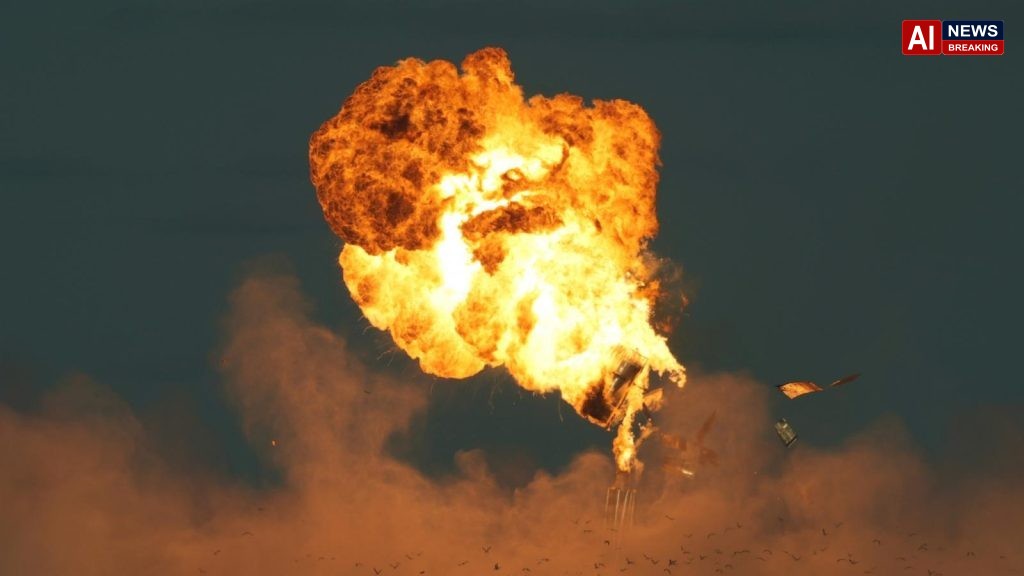
SpaceX’s attempt for a Starship double catch was thwarted when the booster ended up in the gulf - AI News Breaking
spacexs attempt starship double:
SpaceX’s ambitious attempt to perform a double-stage Starship test flight met an unexpected setback when the booster’s recovery trajectory veered off course, sending the massive first stage into the Gulf of Mexico instead of the designated landing zone. The mishap, which unfolded on a humid spring afternoon, underscores the growing risks associated with the company’s rapid development timetable and highlights the challenges of ensuring reliable recovery for the next generation of heavy-lift launch vehicles.The test, scheduled for the 12th of March, was part of the company’s iterative approach to refining the Starship system. Engineers had designed the first flight to demonstrate a full-scale ascent, controlled descent, and precise landing of both the Starship upper stage and the Super Heavy booster..
While the upper stage was designed to be dropped and left to burn up in the atmosphere, the booster was intended to re‑enter and land autonomously on a floating platform in the Gulf. The company’s public statements had suggested that a successful landing would prove the viability of a reusable launch system capable of dramatically reducing the cost of space access.The day of the test, launch conditions were nominal. The weather at the launch complex in Boca Chica, Texas, featured clear skies and winds under 10 knots, within the operational limits set by SpaceX’s flight control team..
The propulsion systems were primed, with the supercharged methane engines running at their planned thrust levels. As the Starship ascended, the telemetry indicated a smooth flight profile, with the vehicle maintaining the designed trajectory and velocity parameters.At 3:32 p.m. local time, the booster’s engines were throttled down in preparation for atmospheric re‑entry..
The vehicle’s guidance software, which had been refined through numerous simulations and suborbital tests, was supposed to calculate the optimal re‑entry corridor and deploy the landing legs. However, a software glitch in the navigation module caused the booster’s attitude control system to misinterpret sensor data. As a result, the vehicle pitched slightly off its intended angle, causing the descent trajectory to deviate from the planned landing corridor.The deviation became apparent only moments before the booster reached the Gulf..
Engineers on the ground, monitoring the flight’s telemetry, noticed an anomaly in the pitch and yaw rates. An automatic abort sequence was triggered, attempting to correct the course. Unfortunately, the corrective maneuvers were too late to bring the booster back on target..
The first stage, now on a trajectory that intersected the Gulf of Mexico, entered the water at a shallow angle, generating a plume of black smoke as its heat shield ruptured upon impact.SpaceX officials released a brief statement acknowledging the incident and expressing disappointment over the failed recovery. “We have taken this as a learning opportunity,” the statement read. “Our teams will be conducting a thorough review of the flight data to determine the root cause and to prevent a recurrence in future missions.” The company also confirmed that no personnel were injured and that the launch site’s emergency response protocols were activated as required.The incident has reignited debates over the practicality of developing a fully reusable heavy-lift launch system at the pace it is currently being pursued..
Critics argue that the rapid iteration cycle may be compromising safety margins. “The Starship program has shown a remarkable ability to learn from failures,” said Dr. Elena Marquez, a propulsion engineer at the Jet Propulsion Laboratory..
“Yet, each incident raises concerns about whether we are putting enough time between tests to fully understand and mitigate the complexities involved.”Supporters of SpaceX counter that the company’s approach is consistent with the aerospace industry’s historical pattern of incremental testing and failure. “SpaceX’s track record demonstrates a willingness to push boundaries and learn quickly,” said Jonathan Chen, a senior analyst at the Space Policy Institute. “The company has already recovered and refurbished multiple boosters from earlier programs, and it is a matter of scaling up that success to the Starship platform.”The Gulf impact also raises environmental concerns..
Although the booster’s heat shield and structural components were designed to survive re‑entry and minimize debris, the impact on marine life is uncertain. The Gulf of Mexico hosts a diverse ecosystem, including sensitive habitats such as seagrass beds and coral reefs. A spokesperson for the U.S..
Department of the Interior’s National Marine Fisheries Service indicated that an environmental assessment would be conducted in the days following the incident to evaluate potential contamination or damage.From a technical standpoint, the primary failure point appears to be the navigation and attitude control software that guided the booster through the critical re‑entry phase. The company’s internal data suggests that a single erroneous data point from one of the inertial measurement units triggered a cascade of incorrect attitude corrections. The software’s error handling protocols were not designed to accommodate such anomalies, leading to a loss of control..
Engineers are now working to implement more robust fault detection and isolation mechanisms in the next iteration of the guidance system.SpaceX’s next planned flight, originally slated for late April, has been rescheduled to a later date to allow the engineering teams sufficient time to analyze the recovered booster’s telemetry and to redesign the re‑entry trajectory algorithms. The company has also announced a temporary suspension of any booster landing attempts until the new software has been fully validated in flight. Instead, the focus will shift to refining the Starship upper stage’s autonomous docking and fuel transfer capabilities, which are critical for future interplanetary missions.The incident has broader implications for the commercial space sector, as other companies plan similar reusable launch systems..
Blue Origin, with its New Shepard and forthcoming New Glenn rockets, and United Launch Alliance, with its Vulcan Centaur, all rely on robust recovery and refurbishment processes to keep launch costs competitive. The failure of a SpaceX booster to land as intended may prompt a re‑evaluation of risk assessments and contingency planning across the industry.Regulatory bodies are also paying close attention. The Federal Aviation Administration’s Office of Commercial Space Transportation has requested detailed flight data from SpaceX to assess compliance with airspace safety regulations..
Space Force’s Space Development Agency, which is exploring potential collaborations with commercial providers for satellite deployment and reconnaissance missions, has expressed concern over the reliability of reusable launch vehicles for mission-critical operations.Despite the setback, SpaceX’s overarching ambition remains intact. The company’s CEO, Elon Musk, has repeatedly emphasized the importance of rapid iteration in achieving the goal of making life multiplanetary. “Every failure is a step toward success,” Musk told reporters after the incident..
“We learn from each flight, and we keep moving forward.” His words reflect the broader ethos of the private space sector, where resilience and adaptability are often seen as prerequisites for breakthrough innovations.In the immediate aftermath of the incident, the launch site’s control tower, a sprawling complex of antennas and monitoring equipment, became a hub of activity..
This development highlights evolving dynamics and may have broader implications in the near term.