
 Pakistan’s leaders hail first astronaut aboard Chinese craft: ‘Proud one of us has gone into space’
 British tourist travels 29 hours from Mumbai to Amritsar for ₹5,461, rates Indian Railways 10/10 | Viral video
 The Supreme Court will decide whether assault weapons bans violate the Second Amendment
 A Critic of Beijing Falls Short in Taiwan’s Key Mayoral Election
 EPA says no rise in contamination after Army detonates lead azide stockpile in Iowa
The Nvidia scandal is heightening America’s AI rivalry with China ahead of Trump’s visit
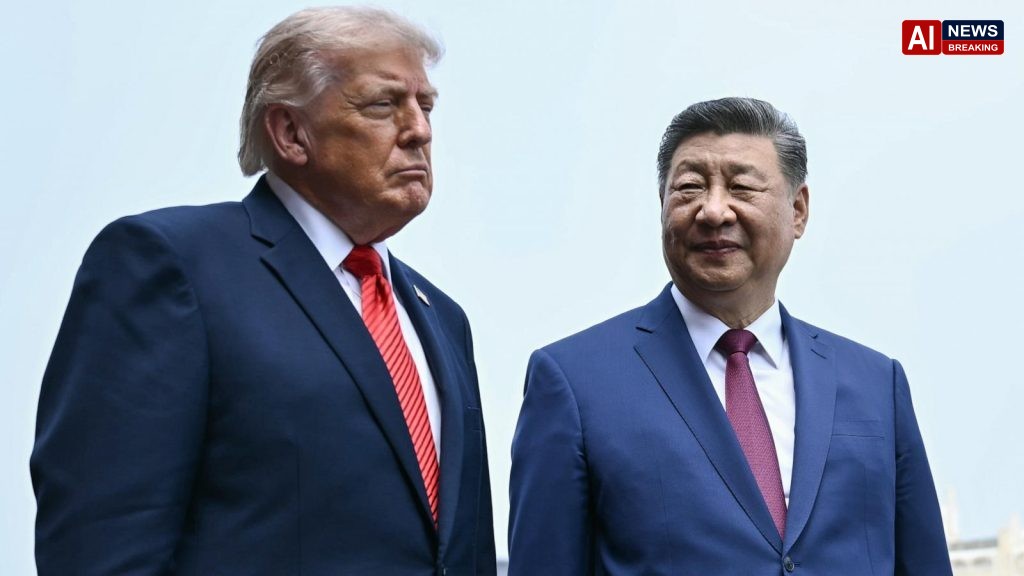
The Nvidia scandal is heightening America's AI rivalry with China ahead of Trump's visit - AI News Breaking
nvidia scandal heightening americas:
The resignation of Jensen Huang as chief executive of Nvidia has sent shockwaves through the technology sector and is poised to sharpen the strategic competition between the United States and China over artificial intelligence. Huang, who co‑founded the semiconductor giant in 1993 and guided it to become the world’s leading supplier of graphics processing units, stepped down after an internal investigation uncovered a series of ethical breaches involving the disclosure of confidential information to Chinese partners. While the company has pledged to cooperate fully with regulators, the episode has amplified concerns in Washington about the security of advanced AI hardware and the potential for technology transfer to Beijing.Nvidia’s chips, particularly the A100 and the newer H100 models, are widely regarded as the backbone of high‑performance computing and large‑scale AI training..
They power data centres, autonomous‑vehicle platforms and a growing array of cloud‑based services. The United States has long treated such equipment as a critical component of national security, imposing export controls to prevent its use in military applications by rival states. The scandal, which centres on a breach of those controls, raises fresh doubts about the effectiveness of existing safeguards and may prompt a tightening of the already complex licensing regime that governs the flow of semiconductor technology.The allegations centre on a senior engineering team that allegedly provided detailed technical specifications to a Chinese research institute without the requisite licences..
Internal emails, now part of the investigative record, suggest that the team believed the information would accelerate collaborative AI research, but senior management failed to verify the legal status of the exchange. The breach was discovered during a routine compliance audit, leading to an expedited review by the Department of Commerce’s Bureau of Industry and Security. Although no formal charges have been filed, the investigation is ongoing and could result in substantial penalties for both the individuals involved and the corporation itself.For Washington, the incident arrives at a moment of heightened sensitivity..
Over the past two years, the United States has escalated its efforts to limit China’s access to cutting‑edge AI tools, citing concerns that advances in machine learning could be repurposed for autonomous weapons, surveillance and cyber‑espionage. In October, the White House unveiled a new policy framework that expands the list of controlled AI components and imposes stricter end‑user verification procedures. The Nvidia breach is likely to be cited as a concrete example of how gaps in corporate compliance can undermine broader geopolitical objectives.The political backdrop to the scandal is further complicated by the imminent visit of former President Donald Trump, who is scheduled to meet senior officials in Beijing later this month..
Trump’s trip is expected to focus on trade, investment and the future of bilateral cooperation in emerging technologies. While the former president has previously advocated for a more conciliatory approach to China, his campaign has also highlighted the need for “American dominance” in AI and other high‑tech fields. Analysts suggest that the Nvidia episode could become a talking point in diplomatic negotiations, with U.S..
officials pressing Beijing for greater transparency and enforcement of export restrictions.Chinese officials have so far refrained from commenting on the specifics of the case, but the Ministry of Commerce reiterated its commitment to “mutual benefit and fair competition” in the technology sector. In a statement released on Monday, it warned that any attempts to exploit foreign technology in violation of international norms would be “firmly opposed” and could lead to “appropriate counter‑measures.” The ambiguous wording leaves open the possibility of retaliatory steps, such as tightening import controls on U.S. semiconductor equipment or accelerating domestic development of AI‑specific chips.Industry observers warn that the fallout could have wider ramifications for the global supply chain..
Nvidia is a publicly traded company with a market capitalisation exceeding $1 trillion, and its stock has already experienced a noticeable dip since the resignation was announced. Suppliers, ranging from Taiwanese wafer manufacturers to U.S. software firms that build AI frameworks, may see delayed orders or heightened scrutiny from regulators..
Moreover, the incident could influence the strategic decisions of other semiconductor firms that are navigating the delicate balance between lucrative Chinese markets and stringent U.S. export regimes.The academic community, which often serves as a bridge between corporate research and governmental policy, is also watching closely. Several leading universities that collaborate with Nvidia on AI research have launched internal reviews of their own data‑sharing practices..
Professor Li Wei, director of a prominent AI lab in Shanghai, noted that “the line between open scientific collaboration and illicit technology transfer is increasingly blurred,” and called for clearer international guidelines that protect both innovation and security.In Washington, lawmakers are already drafting legislation that would expand the scope of the Export Administration Regulations to cover a broader array of AI‑related hardware and software. A bipartisan group of senators has proposed a “Technology Integrity Act” that would impose mandatory reporting requirements on companies dealing with advanced chips, along with stiffer penalties for non‑compliance. Critics argue that such measures could hamper the competitiveness of U.S..
firms by creating an overly burdensome regulatory environment, while supporters contend that the national security stakes justify a more aggressive stance.As the United States prepares for Trump’s diplomatic overture to Beijing, the Nvidia scandal serves as a stark reminder of the intertwined nature of corporate conduct and geopolitical strategy. Whether the episode will lead to a recalibration of export controls, a shift in diplomatic tone or a broader reassessment of the AI rivalry remains to be seen. What is clear is that the incident has added a new layer of complexity to an already fraught relationship, highlighting the challenges of governing a rapidly evolving technology landscape where the line between commercial innovation and strategic asset is increasingly thin..
This development highlights evolving dynamics and may have broader implications in the near term.






