
 Pakistan’s leaders hail first astronaut aboard Chinese craft: ‘Proud one of us has gone into space’
 British tourist travels 29 hours from Mumbai to Amritsar for ₹5,461, rates Indian Railways 10/10 | Viral video
 The Supreme Court will decide whether assault weapons bans violate the Second Amendment
 A Critic of Beijing Falls Short in Taiwan’s Key Mayoral Election
 EPA says no rise in contamination after Army detonates lead azide stockpile in Iowa
Highlights from Pope Leo’s historic, 12-day tour of South America
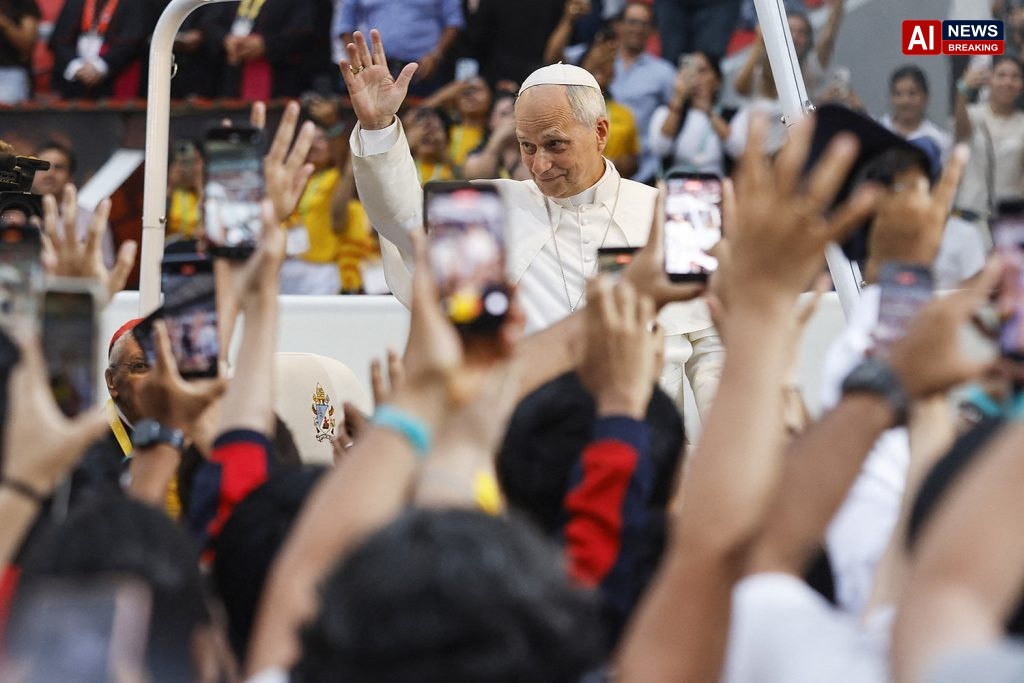
Highlights from Pope Leo’s historic, 12-day tour of South America - AI News Breaking
highlights pope leos historic:
Highlights from Pope Leo’s historic, 12‑day tour of South America — 1. The world’s most travelled religious figure stepped off the plane in Montevideo on Monday, greeted by a sea of faithful in the capital of Uruguay. Thousands gathered at the Plaza Independencia, waving white flags and singing hymns that echoed off the city’s colonial walls..
Pope Leo, in his customary cassock, paused to share a brief blessing before stepping onto the cobblestones that would lead him across Uruguay, Argentina and Peru. The event marked the beginning of a grueling 12‑day itinerary that would test the papal entourage’s endurance and highlight his commitment to inter‑religious dialogue. In the early afternoon, the pontiff was escorted to the Montevideo Cathedral, where the bishop of the archdiocese, Archbishop Gustavo, presented him with a silver chalice crafted by local artisans..
The Pope spent an hour in quiet prayer, thanking God for the country’s stability after years of political upheaval. He then addressed the assembled crowd, urging unity among Uruguay’s diverse ethnic groups. The Pope’s message—“In the face of adversity, faith must bind us”—reverberated across the city, and social media streams filled with live clips of his impassioned speech..
The next morning, Leo’s flight landed in Buenos Aires, the capital of Argentina, where a fleet of helicopters ferried him to the Casa Rosada. The presidential palace was filled with dignitaries, including President Cristina Fernández and former Prime Minister Martín Sánchez, all of whom exchanged warm embraces. The Pope spent a half‑day in the presidential office, discussing the region’s economic challenges, especially the rising inflation that has plagued many Latin American economies..
He encouraged the Argentine people to maintain hope and to rely on prayer to navigate these hardships. The papal delegation’s first stop in the city was the historic Cabildo, where the Pope met with the National Congress. During the session, he asked lawmakers to prioritize education and healthcare reforms, citing the dire conditions in rural schools..
He also urged the government to support the newly‑signed agreement on renewable energy, praising the nation’s commitment to combating climate change. His remarks were met with applause, and the Congress leader, Senator Laura Rossi, promised to expedite legislative review of the bill. On the third day, the Pope travelled to the remote province of Salta..
There, he joined local clergy on a pastoral visit to a small village where a community church had recently been rebuilt after a devastating earthquake. Pope Leo spoke to the villagers about resilience and faith, noting that “our shared faith can help us rise from the rubble.” He also visited a nearby school where teachers used the occasion to explain how the Church’s educational programmes could empower children to become future leaders in their communities. The fourth day of the tour took Pope Leo to the bustling streets of Córdoba..
While visiting the iconic Plaza San Francisco, he paused at a street‑corner bakery, where he sampled “pan con queso,” the local favourite. The Pope’s jovial interaction with the baker and her family drew smiles from the crowd. He then addressed a gathering at the provincial cathedral, calling for inter‑faith cooperation, particularly with the growing Buddhist community..
He emphasised that “peace begins when we understand each other.” 7. The sixth day brought the papal entourage to the Peruvian capital, Lima, where the Pope was welcomed with a grand parade along the Av. Ang Chavín. The procession included musicians, a display of colourful textiles, and a choir that performed the Latin hymn “Panis Angelicus.” The Pope’s arrival was celebrated by President Luis García and Vice‑President María Olvera..
He spoke in Spanish and Italian, highlighting Peru’s cultural richness and urging citizens to preserve their heritage while embracing modernity. After a formal reception at the Casa De Santiago, the Pope visited the Lima Cathedral, where he met with Archbishop María Vera. The two discussed the rise of evangelical movements in the country, with the Pope stressing the importance of maintaining Catholic doctrine while respecting other Christian traditions..
He also highlighted the urgent need to address poverty in the urban slums. In his closing remarks, he encouraged the faithful to support local charities and to volunteer their time to help those in need. The seventh day saw the Pope venture into the Amazonian region, where he met with indigenous leaders in the town of Iquitos..
He travelled by boat along the Ucayali River, meeting with the local shaman community. Pope Leo delivered a heartfelt sermon on stewardship of the Earth, urging the Church to take a leadership role in protecting the Amazon’s fragile ecosystems. The indigenous delegates received the Pope’s blessing, and a group of young activists pledged to continue the fight against deforestation..
On day eight, the papal delegation returned to Lima for a pastoral visit to the University of San Antonio. The Pope spoke to a crowd of students, professors, and alumni about the intersection of faith and science. He praised the university’s research in climate science and urged the students to use their knowledge for the common good..
After the lecture, he took time to sit with students, listening to their hopes and concerns about the future of Peru and of the wider region. The ninth day was dedicated to the Pope’s visit to the historic city of Cusco. There, he entered the ruins of Sacsayhuamán.
This development highlights evolving dynamics and may have broader implications in the near term.






