
 Pakistan’s leaders hail first astronaut aboard Chinese craft: ‘Proud one of us has gone into space’
 British tourist travels 29 hours from Mumbai to Amritsar for ₹5,461, rates Indian Railways 10/10 | Viral video
 The Supreme Court will decide whether assault weapons bans violate the Second Amendment
 A Critic of Beijing Falls Short in Taiwan’s Key Mayoral Election
 EPA says no rise in contamination after Army detonates lead azide stockpile in Iowa
Nvidia chip row: US tightens AI chip export rules to restrict access through overseas data centres
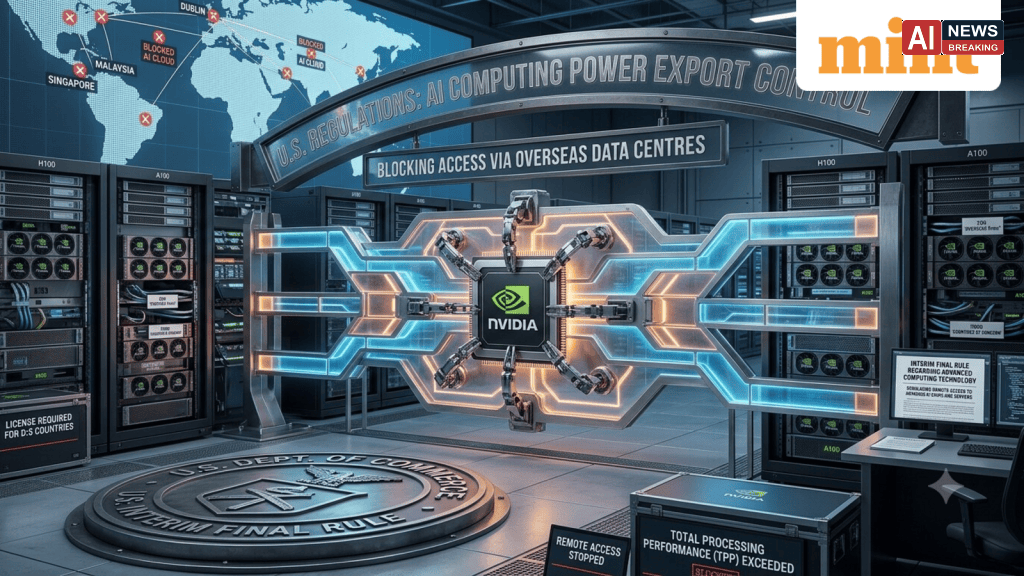
Nvidia chip row: US tightens AI chip export rules to restrict access through overseas data centres - AI News Breaking
nvidia chip tightens chip:
Nvidia’s high‑performance graphics processors have long been the backbone of the world’s artificial‑intelligence infrastructure, powering everything from cloud‑based machine‑learning services to sophisticated autonomous‑driving systems. In recent weeks, that reputation has become a flashpoint as the United States rolled out a sweeping set of export‑control measures aimed at curtailing the reach of American AI hardware abroad. The new rules, announced by the Office of the Director of National Intelligence and implemented by the Department of Commerce, tighten restrictions on the sale and transfer of advanced semiconductor devices, including Nvidia’s most powerful GPUs, to companies that operate data‑centre facilities overseas..
The policy shift comes amid growing concerns that such hardware could be diverted to bolster China’s burgeoning AI industry, an issue that has already sparked a high‑profile controversy over alleged smuggling of Nvidia‑powered servers into the Chinese market.The announcement follows a series of investigations that uncovered a network of shell companies and complex supply‑chain arrangements allegedly used to route Nvidia chips into Chinese data‑centres without proper licensing. According to documents released by the Department of Justice, the alleged smuggling scheme involved a chain of transactions that began with a U.S. distributor and ended at a Chinese cloud‑services provider that had no export‑clearance documentation on its receipts of the most advanced GPU models..
The findings, which the Justice Department described as “a sophisticated operation designed to circumvent export controls,” have prompted a reassessment of the existing regulatory framework governing semiconductor exports.Under the new rules, any entity that intends to ship Nvidia’s high‑end GPUs to an overseas data‑centre must now secure a license from the Bureau of Industry and Security (BIS), and the license process will include a rigorous assessment of the end‑user’s location, the potential for dual‑use applications, and the likelihood of the hardware being used for military or strategic purposes. In practice, this means that major cloud‑service providers such as Amazon Web Services, Google Cloud, and Microsoft Azure will be required to submit detailed reports on the geographic distribution of their GPU deployments. The policy also expands the definition of “dual‑use” equipment to encompass a broader range of AI hardware that could be repurposed for military applications, further tightening the net around Nvidia’s most powerful chips.The timing of the new export controls is significant, as it dovetails with a broader geopolitical effort by Washington to contain China’s technological rise..
The United States has long viewed China’s AI ambitions as a strategic threat, citing concerns over intellectual property theft, cyber espionage, and the potential for advanced AI to enhance China’s military capabilities. In a statement released by the White House, the administration highlighted the need to “protect national security while maintaining a competitive edge in the global technology market.” The new rules are intended to create a clearer boundary between civilian and military uses of AI hardware, thereby reducing the risk of dual‑use proliferation.Nvidia’s response to the tightened regulations has been cautious. The company’s spokesperson stated that it “remains fully compliant with all U.S..
export‑control laws” and that it has “robust internal procedures to monitor and manage compliance risks.” Nvidia, which has a long-standing partnership with the U.S. government on AI research, is also reportedly working closely with the Department of Commerce to streamline the licensing process for legitimate customers. The company’s chief technology officer emphasized that the firm is “committed to ensuring that our hardware is used responsibly while also supporting the global growth of AI technologies.” Nonetheless, industry analysts warn that the new rules could slow the deployment of Nvidia’s most advanced GPUs in key markets, potentially shifting the competitive balance toward Chinese manufacturers that can sidestep U.S..
export restrictions.The impact on the broader semiconductor supply chain is already being felt. Companies that rely on Nvidia GPUs for training large language models are reportedly revisiting their supply‑chain strategies, with some exploring alternative hardware platforms or establishing new data‑centre footprints within the United States. The policy has also prompted discussions among U.S..
policymakers and industry leaders about the need for a more coordinated approach to export controls that balances national security concerns with the economic realities of a globalized technology ecosystem. In a recent roundtable, representatives from major semiconductor firms and trade associations highlighted the risk of fragmentation in the market if export rules are applied unevenly across different regions.In response to these concerns, the U.S. Trade Representative’s office has indicated that it will explore bilateral agreements with allies that possess compatible security standards..
Such agreements would allow for a more nuanced licensing approach, potentially easing the burden on companies that operate data‑centres in countries deemed low risk. However, critics argue that any relaxation could undermine the integrity of the export‑control regime, particularly if it creates loopholes that could be exploited by state actors. The debate underscores a fundamental tension in U.S..
technology policy: the desire to maintain a competitive advantage while preventing the inadvertent transfer of sensitive capabilities to rival powers.China’s reaction to the new export restrictions has been measured. The Ministry of Commerce issued a statement expressing concern over what it described as a “discriminatory” approach that could harm Chinese firms operating in the global supply chain. Beijing also reiterated its commitment to developing indigenous AI capabilities, citing the country’s significant investment in domestic semiconductor research and development..
Chinese officials pointed out that the country has already established a robust domestic market for AI hardware, which could potentially reduce its reliance on U.S. Nevertheless, the export controls are likely to accelerate a strategic pivot toward alternative sources of high‑performance computing hardware, including domestic producers and partners in other countries such as Taiwan, Japan, and South Korea.The policy shift is part of a broader U.S. strategy that includes the recent launch of a dedicated “Semiconductor Manufacturing and Supply Chain Innovation Act,” which aims to bolster domestic chip production and reduce reliance on foreign suppliers..
In the context of AI, the act is designed to support research and development of next‑generation GPUs and other high‑performance computing components within the United States. The combined effect of tighter export controls and increased domestic investment could reshape the global AI hardware market over the coming years, creating a bifurcated landscape in which U.S.‑based companies dominate the high‑end segment while other players carve out niches in lower‑tier or specialized applications.The new restrictions also raise questions about the future of open‑source AI frameworks that rely on Nvidia hardware. Many open‑source projects, such as TensorFlow and PyTorch, depend heavily on GPU acceleration for training models..
If access to Nvidia GPUs becomes more restricted, developers and researchers might be compelled to adopt alternative architectures or collaborate with hardware vendors that can offer comparable performance without triggering export‑control scrutiny. Some academic institutions have already begun exploring the use of AMD’s GPUs or custom hardware accelerators as a mitigation strategy.
Updated: November 16, 2026
This development highlights evolving dynamics and may have broader implications in the near term.






