
 Pakistan’s leaders hail first astronaut aboard Chinese craft: ‘Proud one of us has gone into space’
 British tourist travels 29 hours from Mumbai to Amritsar for ₹5,461, rates Indian Railways 10/10 | Viral video
 The Supreme Court will decide whether assault weapons bans violate the Second Amendment
 A Critic of Beijing Falls Short in Taiwan’s Key Mayoral Election
 EPA says no rise in contamination after Army detonates lead azide stockpile in Iowa
President Trump Starts Asia Trip With Quick Manila Stopover
**
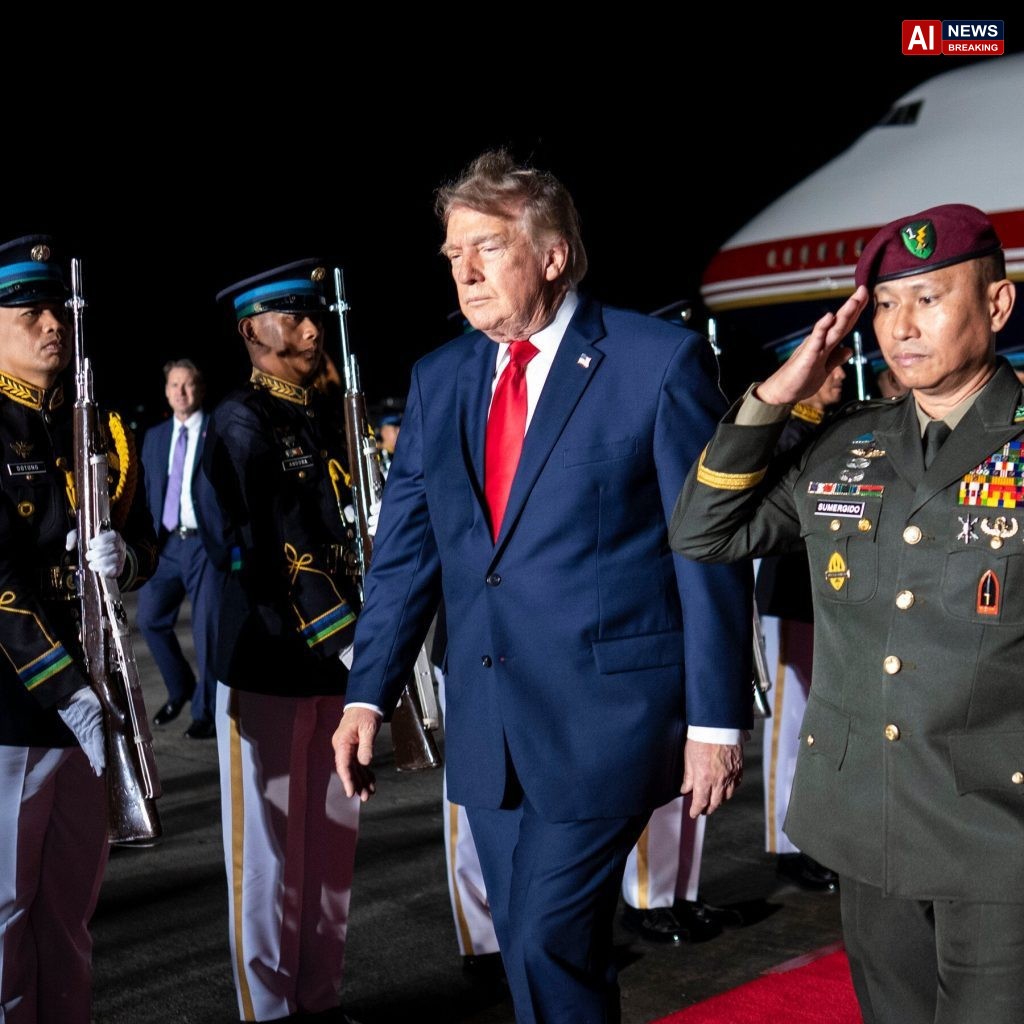
President Trump Starts Asia Trip With Quick Manila Stopover - AI News Breaking
President Donald Trump began his Asian tour on Monday with a brief stopover in Manila, a move that analysts say underscores the symbolic rather than substantive nature of his foreign outreach. The 45‑year‑old former president arrived at Ninoy Aquino International Airport in the early hours, greeted by a small contingent of officials and a handful of journalists, before departing for his next destination within a matter of hours. The visit, which lasted less than four hours, featured a short press conference, a quick walk through the airport’s international arrivals hall and a brief meeting with Philippine President Ferdinand “Bongbong” Marcos Jr., but did not include any formal diplomatic ceremonies, joint statements or policy announcements.Trump’s itinerary in the Philippines was deliberately minimal..
After stepping off his private jet, he was escorted to a makeshift podium set up in the airport’s arrivals terminal, where he fielded questions from a mixed crowd of local reporters and foreign correspondents. When asked about the significance of the stop, the former president replied, “It’s life,” a remark that left many observers puzzled about his intent. The comment, delivered with a characteristic grin, seemed to emphasize the photo‑opportunity aspect of the visit rather than any concrete agenda..
No bilateral agreements were signed, and no formal discussions on trade, security or climate issues were reported.The lack of substantive engagement contrasts sharply with the expectations that often accompany a high‑profile visit from a former U.S. In recent years, Manila has hosted a succession of American leaders whose trips have resulted in concrete outcomes, ranging from defense cooperation agreements to joint statements on regional stability. By comparison, Trump’s fleeting presence offered little in the way of diplomatic leverage for either side..
Philippine officials, while courteous, appeared to recognize the visit’s limited scope, acknowledging the former president’s popularity among certain segments of the Filipino electorate but also noting the absence of any policy breakthroughs.Political analysts suggest that the stopover was designed more as a platform for Trump to maintain his relevance on the global stage than to advance any specific U.S. Since leaving office, he has sought to position himself as an influential voice in international affairs, often leveraging his personal brand to attract media attention. The Manila appearance, occurring just weeks before a major rally in the United States, fits this pattern, offering visual material for campaign messaging and reinforcing his narrative of continued engagement with allies, even if the engagement is superficial.Critics argue that the visit underscores a broader trend of former leaders using diplomatic venues for personal promotion..
“There’s a fine line between public diplomacy and self‑servicing,” said Dr. Lena Torres, a professor of political science at the University of the Philippines. “When a former president spends more time posing for cameras than discussing policy, it dilutes the seriousness of the diplomatic process and risks reducing complex international relationships to mere spectacle.” Torres added that the Philippines, a nation navigating a delicate balance between China’s rising influence and its long‑standing security partnership with Washington, could benefit from more substantive dialogue than a photo‑stop provides.The Philippine government, meanwhile, has been navigating its own strategic considerations..
President Marcos Jr., who has sought to deepen ties with the United States while also managing a pragmatic relationship with Beijing, used the brief encounter to reaffirm the enduring nature of the bilateral alliance. In a short statement, Marcos said the United States remains “a steadfast partner” in ensuring regional peace and stability. He did not elaborate on any new initiatives, but his remarks were consistent with a broader diplomatic script aimed at reassuring both domestic audiences and international partners of the Philippines’ commitment to existing security frameworks.Security arrangements for the visit were extensive, reflecting the high‑risk profile that any former U.S..
president carries, especially in a region where political volatility can quickly shift. The airport was placed under heightened alert, with additional police and military personnel deployed to secure the perimeter. A contingent of Philippine armed forces escorted Trump’s motorcade to a designated holding area, while U.S..
Service agents coordinated closely with local law enforcement. The heavy security presence, however, contrasted with the brevity of the program, leading some observers to question the proportionality of resources allocated to what amounted to a brief photo opportunity.Economic analysts note that the timing of the stopover coincided with ongoing negotiations over trade and investment between the two countries. While no agreements were signed, the presence of senior trade officials from both sides in Manila suggests that informal discussions may have taken place behind the scenes..
“Even a short visit can serve as a catalyst for deeper economic talks,” said Maria Santos, a senior analyst at the Asian Development Bank. “The symbolic value of a former U.S. president’s presence can open doors, but it cannot replace the need for detailed negotiations and concrete commitments.”The broader context of Trump’s Asian tour also merits attention..
Following Manila, he is scheduled to travel to South Korea and Japan, where he will meet current leaders and address audiences at think‑tanks and business forums. Critics warn that his itinerary, which emphasizes high‑visibility events over substantive policy dialogue, could send mixed signals to allies and adversaries alike. In a region where the United States is competing with China for influence, the tone and content of diplomatic engagements are closely scrutinized..
A series of brief, media‑driven stops may reinforce a perception of a less predictable American foreign policy posture.In Washington, the reaction among current U.S. The State Department released a brief statement acknowledging the former president’s “continued interest in supporting strong partnerships in the Indo‑Pacific,” without offering details or indicating any coordination with the current administration. Some members of Congress expressed concern that Trump’s independent diplomatic overtures could complicate ongoing efforts to present a united front on issues such as supply‑chain resilience and regional security..
“We need a coherent strategy that reflects the current administration’s priorities,” said Representative James Whitfield (R‑TX), emphasizing the importance of a coordinated approach.Public opinion in the Philippines appears divided. Polls conducted earlier this year indicated that a significant portion of the population holds a favorable view of Trump, largely driven by his perceived support for law‑and‑order policies and his vocal criticism of China’s activities in the South China Sea. Conversely, younger voters and urban professionals expressed skepticism, viewing the visit as a publicity stunt with little relevance to the country’s pressing challenges, including economic recovery, infrastructure development and climate resilience..
Social media reactions mirrored this split, with hashtags celebrating the “Trump in Manila” moment trending alongside commentary questioning the visit’s purpose.As Trump’s plane lifted off from Manila’s runway, the fleeting nature of his Asian engagement was evident. While the stopover provided ample material for television news cycles and campaign rallies back.
Updated: November 17, 2026
Trump’s Manila layover is less a diplomatic overture than a self‑branding sprint, using the Philippines’ strategic cachet to fuel his domestic campaign narrative. The spectacle underscores how former leaders can hijack ally‑hosted venues, turning nuanced regional security into a billboard for personal relevance.





