
 Pakistan’s leaders hail first astronaut aboard Chinese craft: ‘Proud one of us has gone into space’
 British tourist travels 29 hours from Mumbai to Amritsar for ₹5,461, rates Indian Railways 10/10 | Viral video
 The Supreme Court will decide whether assault weapons bans violate the Second Amendment
 A Critic of Beijing Falls Short in Taiwan’s Key Mayoral Election
 EPA says no rise in contamination after Army detonates lead azide stockpile in Iowa
Israeli tanks cross Gaza cease‑fire line into Rafah for limited raid.
**
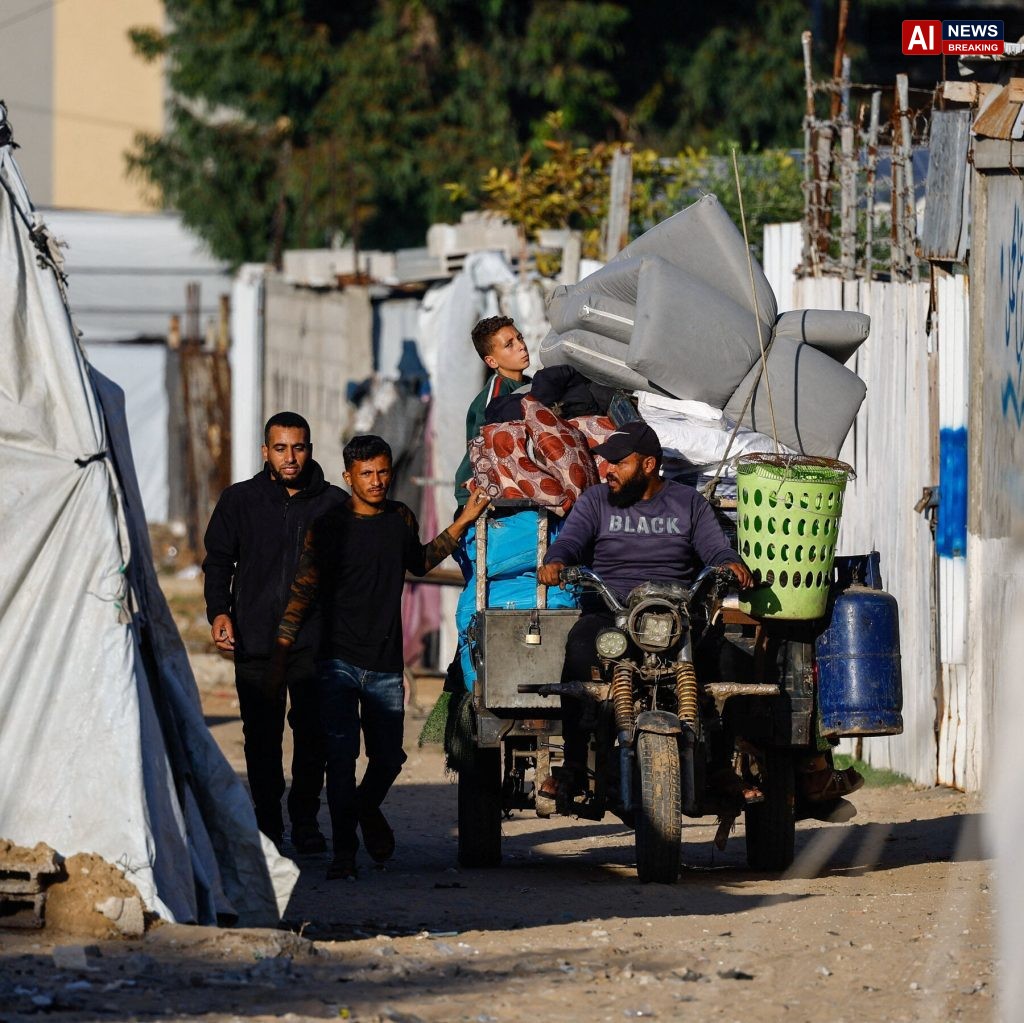
Israeli Tanks Advance Across Gaza Cease-Fire Line in Rare Incursion - AI News Breaking
Israeli Tanks Advance Across Gaza Cease-Fire Line in Rare Incursion A small column of Israeli Merkava tanks rolled across the internationally recognised cease‑fire line that separates Gaza from the Israeli‑controlled West Bank on Tuesday, sparking a sharp escalation in an area that has largely been calm since the last major fighting. The tanks, accompanied by infantry and unmanned aerial vehicles, moved into a block of residential homes in the Rafah region, a move that Israeli officials say is a “limited raid” aimed at neutralising an imminent threat. The operation, conducted at dawn, was executed with precision and without the heavy artillery that typically marks larger military offensives..
The Israeli military’s statement, released through a spokesperson in the capital, emphasised that the incursion was a defensive measure. Commanders said they had received credible intelligence that a group of militants had been assembling explosives near the border. According to the brief, the operation was intended to prevent a potential attack that could jeopardise the fragile cease‑fire brokered earlier that year..
The troops were reportedly briefed on a strict area‑control protocol to minimise civilian harm, though the presence of tanks in densely populated zones has long been a source of concern for human rights observers. In contrast, Hamas officials condemned the move as a blatant breach of the truce, accusing Israel of violating international law. A senior spokesperson for the militant group issued a statement on their social media channel, describing the tanks’ advance as “a war crime and a flagrant assault on the right to life of Gazans.” The statement urged the international community to intervene, arguing that the Israeli operation was part of a broader strategy to destabilise the region and suppress Palestinian self‑determination..
Hamas also claimed that the tanks had already entered civilian homes, causing significant damage to infrastructure. The United Nations has responded to the incident with urgent appeals for calm. In a brief statement, the UN ary‑General called the Israeli incursion “regrettable” and urged both parties to respect the cease‑fire agreement..
The UN’s Middle East peace envoy suggested that the international community should intervene with diplomatic pressure to prevent a return to full‑scale hostilities. The agency also called for a rapid, independent investigation into any alleged civilian casualties that may have arisen from the raid. Israel’s defense ministry said it had coordinated the operation with the United Nations Mission in Gaza to ensure that humanitarian corridors remained open..
The ministry’s spokesperson claimed that no civilians were harmed during the brief incursion, citing real‑time surveillance footage that reportedly showed the tanks moving in a straight line away from residential buildings. Despite these assurances, several local NGOs have reported damage to a number of homes, with residents citing debris and broken windows as evidence of a heavier impact than the military claims. International observers have long warned that any movement of heavy military equipment across the cease‑fire line risks reigniting a larger conflict..
Experts in the region point to the delicate balance that has kept the area relatively stable since the 2024 truce. They argue that the incursion, even if limited, undermines the trust that has been painstakingly built between the parties and could erode the effectiveness of future diplomatic efforts. The situation has also raised concerns among humanitarian agencies operating in the region, many of whom rely on the cease‑fire to deliver aid to civilians..
In the days that followed, the Israeli military announced that it would increase its intelligence‑gathering operations in the area, citing a need for “real‑time situational awareness” to prevent further incidents. The army’s chief of staff said that the tanks would remain in the sector for a brief period before withdrawing back across the line, but that they would be ready to re‑deploy if the threat level escalated. The statement was met with scepticism by Palestinian authorities, who demanded that Israel respect the agreed boundaries and refrain from unilateral military actions..
The United States, a key ally of Israel, issued a statement urging restraint on both sides. Washington’s State Department spokesperson said that the US remains committed to supporting a peaceful resolution and that it will engage diplomatically with all parties to ensure that the cease‑fire is upheld. The statement also highlighted the importance of protecting civilian lives and maintaining humanitarian access to Gaza, echoing concerns expressed by the European Union and other international partners..
Meanwhile, the European Union’s foreign policy chief called for an immediate review of the cease‑fire terms, suggesting that the current arrangement is “no longer sufficient” to address emerging security challenges. The EU has increased its monitoring presence in the region, deploying a joint team of observers to assess compliance with the truce. The team’s report, released a week after the incursion, highlighted instances of small arms fire along the border and noted that both sides had increased patrols in high‑risk areas..
Looking ahead, analysts predict that the incident could trigger a series of retaliatory actions if either side perceives the other’s move as a provocation. While the Israeli military has stated that the tanks will not be used in a broader offensive, the potential for escalation remains high, especially given the historical volatility of the region. The international community’s response will likely shape the trajectory of the conflict in the coming weeks, as both diplomatic and military actors weigh the risks of further destabilisation against the urgent need for a lasting peace agreement..
Updated: November 18, 2026
Israel’s brief armored incursion—presented as a defensive precaution—has already shattered the fragile trust that kept Gaza and the West Bank from spiralling back into war, turning a “limited raid” into a catalyst that could trigger a chain of retaliatory moves. The episode underscores how even calculated, short‑lived breaches of a cease‑fire can undermine diplomatic gains, forcing international actors to recalibrate their strategies between immediate restraint and long‑term peacebuilding.







