
 Pakistan’s leaders hail first astronaut aboard Chinese craft: ‘Proud one of us has gone into space’
 British tourist travels 29 hours from Mumbai to Amritsar for ₹5,461, rates Indian Railways 10/10 | Viral video
 The Supreme Court will decide whether assault weapons bans violate the Second Amendment
 A Critic of Beijing Falls Short in Taiwan’s Key Mayoral Election
 EPA says no rise in contamination after Army detonates lead azide stockpile in Iowa
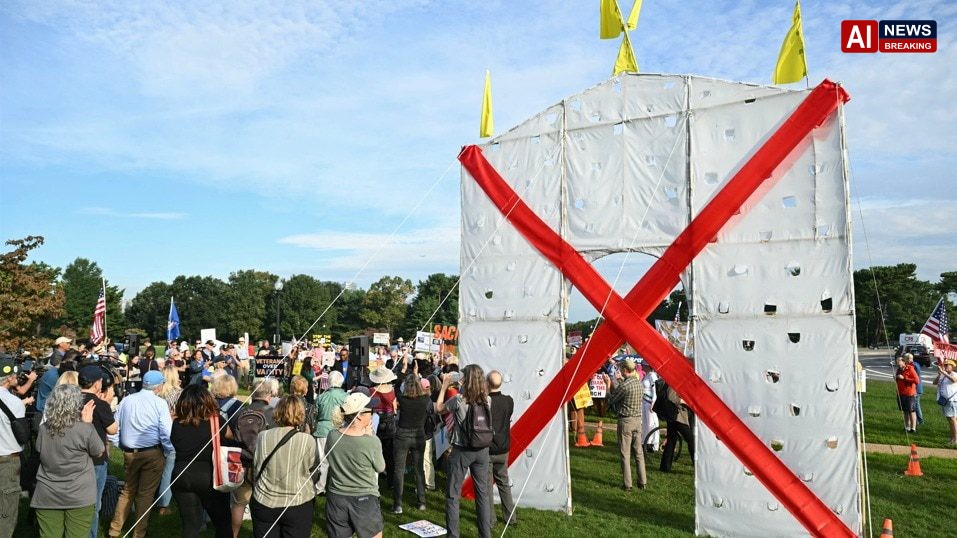
US judge extends block on construction of Trump’s 250-foot triumphal arch
**
US judge extends block on construction of Trump's 250-foot triumphal arch - AI News Breaking
judge extends block construction:
A federal judge in Washington, D.C., has issued an order extending a preliminary injunction that halts the construction of a 250‑foot “triumphal arch” proposed by former President Donald Trump on the grounds of his Mar-a‑Lotus estate in Palm Beach, Florida. The ruling, delivered on Tuesday, prolongs a legal moratorium that was first imposed in August after a coalition of environmental groups, local residents, and historic preservation advocates sued to block the project, arguing that it would cause irreversible damage to the coastal ecosystem and violate state and federal regulations.The case, formally titled Sierra Club v. Trump, centers on whether the proposed arch—intended to serve as a monument to Trump’s political legacy—requires a comprehensive environmental review under the National Environmental Policy Act (NEPA)..
The plaintiffs contend that the development would necessitate a shoreline stabilization permit, a wetland alteration permit, and a review of potential impacts on endangered species such as the West Indian manatee and several migratory bird populations. In their brief, the Sierra Club and associated NGOs argue that the Federal Aviation Administration’s environmental assessment was insufficient, failing to consider cumulative impacts on water quality, beach erosion, and the cultural landscape of the historic district surrounding Mar-a‑Lotus.Judge James F. Kessler, who presided over the original hearing, affirmed that the plaintiffs had demonstrated a “substantial likelihood of success on the merits” of their claim that the project violates NEPA and the Clean Water Act..
In his written order, Kessler noted that the government’s “premature approval” of construction permits without a full Environmental Impact Statement (EIS) undermines the procedural safeguards designed to protect vulnerable coastal habitats. He further emphasized that the injunction remains in place pending a full briefing on the merits, and that the parties are ordered to submit supplemental filings within 30 days outlining the scope of any additional environmental analyses that may be required.Trump’s legal team, led by veteran litigator Michael Cohen, argued that the arch falls under an exemption for “nationally significant” projects that are subject to a streamlined review process. Cohen asserted that the structure is a private memorial, not a public infrastructure project, and therefore does not trigger the same level of scrutiny as a commercial development..
The defense also cited a 2022 executive order that purportedly reduces regulatory burdens on private property owners seeking to erect monuments or memorials, suggesting that the injunction oversteps the court’s authority by imposing federal oversight on a matter they claim is primarily governed by state law.State officials from Florida’s Department of Environmental Protection (DEP) have expressed support for the injunction, stating that the agency has yet to receive a complete application for the required permits. DEP spokesperson Laura Martinez said the department “takes its responsibility to safeguard the state’s natural resources very seriously” and will cooperate fully with the federal court’s directives. The agency’s pending review, she added, will evaluate the arch’s potential to exacerbate coastal flooding, a concern that has grown in urgency as sea‑level rise accelerates along the Atlantic seaboard.The injunction’s extension also carries financial implications for the Trump Organization, which has already invested millions of dollars in preliminary site work, including soil testing, architectural modeling, and the procurement of construction materials..
In a brief filed on Thursday, the organization requested a stay of the injunction, arguing that the delay jeopardizes the viability of the project and could result in “substantial economic harm.” The court, however, declined to grant the stay, citing the “balance of equities” in favor of preserving the environment pending a full adjudication of the case.Local residents of Palm Beach have been vocal in their opposition, organizing town‑hall meetings and petition drives that have amassed over 15,000 signatures. Many residents fear that the arch will not only mar the historic aesthetic of the area but also increase traffic and strain public services. “We came here for a quiet, historic community, not a political spectacle,” said longtime homeowner Eleanor Whitaker during a recent community forum..
She added that the arch could set a precedent for other private developers to bypass local zoning rules in the name of personal commemoration.Legal analysts note that the outcome of this case could have broader ramifications for how NEPA is applied to private projects with potential public impact. Professor Amelia Torres of Georgetown Law highlighted that the “court’s willingness to extend the injunction underscores a growing judicial willingness to enforce rigorous environmental review, even when the project is ostensibly private.” She warned that a reversal could embolden other high‑profile individuals to pursue similar constructions without adequate scrutiny, potentially eroding the protective framework established over the past five decades.The Trump Organization has signaled that it remains committed to the arch, describing it as “a symbol of American resilience and a testament to the enduring legacy of the 45th President.” In a statement released on Friday, the organization claimed that the proposed design incorporates “state‑of‑the‑art engineering to mitigate any environmental impact.” It also pledged to work with environmental consultants to address the concerns raised by the plaintiffs, though no concrete mitigation plan has been disclosed.As the case proceeds, the court has scheduled a status conference for early next month, at which both sides will be required to present updated evidence and arguments regarding the necessity of a full EIS. Observers anticipate that the hearing could become a focal point for broader debates over the balance between private property rights, historic preservation, and environmental stewardship in an era of heightened climate awareness..
The final decision, expected later this year, will determine whether the 250‑foot arch will rise over the Atlantic shoreline or remain a halted vision, emblematic of the complex intersection of politics, law, and ecology in contemporary America..
Updated: November 18, 2026
By blocking Trump’s arch, the court signals that even high‑profile memorials can’t sidestep the rigorous checks that protect fragile coastlines—an echo of the wider tension between personal ambition and public good. It’s a reminder that nature’s safeguards still trump a single owner’s grand






