Pakistan’s leaders hail first astronaut aboard Chinese craft: ‘Proud one of us has gone into space’
 British tourist travels 29 hours from Mumbai to Amritsar for ₹5,461, rates Indian Railways 10/10 | Viral video
 The Supreme Court will decide whether assault weapons bans violate the Second Amendment
 A Critic of Beijing Falls Short in Taiwan’s Key Mayoral Election
 EPA says no rise in contamination after Army detonates lead azide stockpile in Iowa
Tamil Nadu hands over ten
**
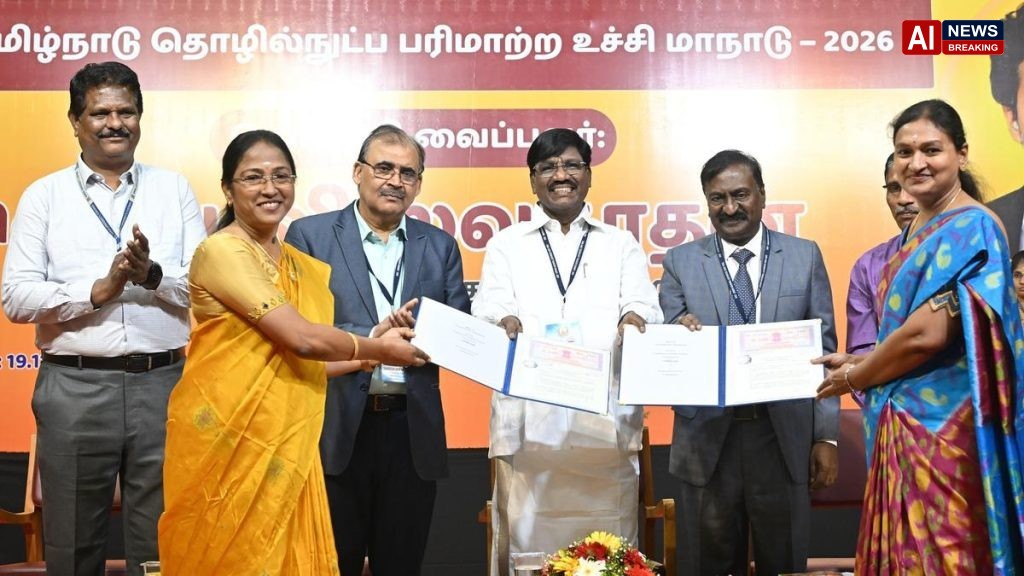
10 patented technologies handed over to various firms at T.N. Tech Transfer Summit - AI News Breaking
The Tamil Nadu Technology Transfer Summit, held this week in Chennai, concluded with the formal hand‑over of ten patented innovations to a diverse group of private firms, marking a significant step in the state’s drive to commercialise academic research. The ceremony, attended by senior government officials, university representatives and industry leaders, underscored the growing synergy between the public research ecosystem and the private sector, a relationship the state hopes to deepen through regular, city‑wide events. The transferred patents span fields as varied as renewable energy, agricultural biotechnology, medical devices and information technology, reflecting the breadth of research undertaken by Tamil Nadu’s universities and research institutes.Opening the summit, Higher Education Minister P..
Viswanathan announced that the event would become an annual fixture and would be replicated in other major cities across the state, including Coimbatore, Madurai and Tiruchirappalli. “Our vision is to create a vibrant corridor of innovation that connects our world‑class academic institutions with the entrepreneurial spirit of Tamil Nadu’s industry,” Viswanathan said, emphasizing the need for a structured platform that accelerates the journey from laboratory bench to market shelf. He added that the government would provide continued financial incentives, tax benefits and regulatory support to firms that adopt university‑originated technologies, aiming to foster a self‑sustaining innovation ecosystem.The first patented technology transferred is a low‑cost solar‑thermal collector developed by researchers at Anna University’s Department of Mechanical Engineering..
The collector, which integrates a novel heat‑transfer fluid with a lightweight, corrosion‑resistant coating, promises a 20 percent efficiency gain over existing models while cutting production costs by nearly a third. Green Energy Solutions Pvt Ltd, a Chennai‑based renewable‑energy startup, secured an exclusive licence to manufacture and market the device, planning a pilot rollout in rural electrification projects across the state.A second hand‑over involved a genetically modified strain of rice engineered to tolerate high salinity, the product of collaborative work between Tamil Nadu Agricultural University and the Indian Institute of Technology Madras. The strain, which maintains yield levels under saline irrigation, could prove vital for coastal farmers facing increasing soil degradation due to sea‑level rise..
AgriTech India Ltd, an agribusiness firm with a strong presence in the delta region, obtained the commercial rights and will begin field trials in the upcoming Kharif season, with a view to scaling up seed production pending regulatory clearance.The medical sector also featured prominently, with a patented portable electrocardiogram (ECG) device developed at the Institute of Medical Sciences, Madras. The device, weighing less than 150 grams and powered by a rechargeable battery, utilizes AI‑driven algorithms to detect arrhythmias in real time, transmitting data securely to remote cardiologists. CardioHealth Technologies, a health‑tech company based in Bangalore but with a manufacturing hub in Tamil Nadu, acquired the rights to commercialise the device, targeting remote clinics and telemedicine platforms across the country.In the realm of information technology, a team from the Centre for Artificial Intelligence and Robotics at Vellore Institute of Technology unveiled a patented framework for real‑time natural language processing in low‑resource languages..
The framework, which reduces computational load by 40 percent compared to existing models, is tailored for Indian languages with limited digital corpora. SoftTech Solutions, a Chennai software firm, secured a non‑exclusive licence to integrate the technology into voice‑assistant products aimed at rural and semi‑urban markets, where language barriers have historically hampered adoption.Another notable transfer was a patented water‑purification membrane developed by the Central Institute of Fisheries Technology. The membrane, composed of a biodegradable polymer blend, can remove heavy metals and pathogens from surface water without the need for chemical additives..
AquaPure Industries, a start‑up focusing on sustainable water solutions, obtained the licence and plans to deploy the technology in coastal villages prone to contamination from industrial runoff.The summit also saw the hand‑over of a patented biodegradable polymer for use in packaging, the result of collaborative research between the Indian Institute of Technology, Chennai and the Department of Chemical Engineering at Madras University. The polymer degrades within six months under ambient conditions, offering a potential alternative to conventional plastics in the fast‑moving consumer goods sector. GreenPack Enterprises, a Chennai‑based packaging manufacturer, will pilot the material in partnership with several multinational FMCG brands, aiming to meet emerging regulatory mandates on single‑use plastics.Among the ten technologies transferred, a patented low‑dose radiation therapy device for non‑invasive treatment of certain cancers was also highlighted..
Developed by the Cancer Research Institute at the Government Medical College, the device employs precise micro‑beam radiation to target tumour cells while sparing surrounding healthy tissue. OncoTech Labs, a medical device firm with a global footprint, secured exclusive commercial rights and is preparing for clinical trials in collaboration with leading oncology centres.The final two patents encompassed a smart irrigation controller that leverages soil‑moisture sensors and weather forecasts to optimise water usage, and an energy‑efficient refrigeration system using magnetocaloric technology. Both innovations emerged from interdisciplinary projects at the Tamil Nadu Council for Scientific and Industrial Research..
Regional agritech firm FarmSense and refrigeration specialist CoolTech Systems respectively acquired licences, signalling confidence in home‑grown solutions to address pressing climate and food‑security challenges.Overall, the summit’s outcomes illustrate Tamil Nadu’s commitment to bridging the gap between research and industry, a strategy that policymakers hope will translate into job creation, increased export potential and a stronger position in India’s knowledge‑economy race. By institutionalising the transfer of patents and providing a clear pathway for commercial exploitation, the state aims to replicate successful models seen in other Indian regions while tailoring them to local strengths. As the first of what is slated to become a traveling series of events, the Tamil Nadu Technology Transfer Summit may well set a benchmark for other states seeking to harness academic ingenuity for economic growth..
Updated: November 19, 2026
Tamil Nadu’s patent‑hand‑over could transform its research hubs into export‑ready factories, turning academic breakthroughs into tangible revenue streams rather than isolated papers.
If the state sustains incentives and replicates this model city‑wide, it may become India’s “Silicon Valley of applied science