
 Pakistan’s leaders hail first astronaut aboard Chinese craft: ‘Proud one of us has gone into space’
 British tourist travels 29 hours from Mumbai to Amritsar for ₹5,461, rates Indian Railways 10/10 | Viral video
 The Supreme Court will decide whether assault weapons bans violate the Second Amendment
 A Critic of Beijing Falls Short in Taiwan’s Key Mayoral Election
 EPA says no rise in contamination after Army detonates lead azide stockpile in Iowa
Trump urges reinstatement of Nvidia CEO Huang
Former President Donald Trump has privately lobbied Nvidia’s board to restore CEO Jensen Huang after a brief, controversial removal over alleged foreign‑intelligence ties, igniting a fierce discussion on the limits of political intervention in high‑tech companies critical to U.S. national security.
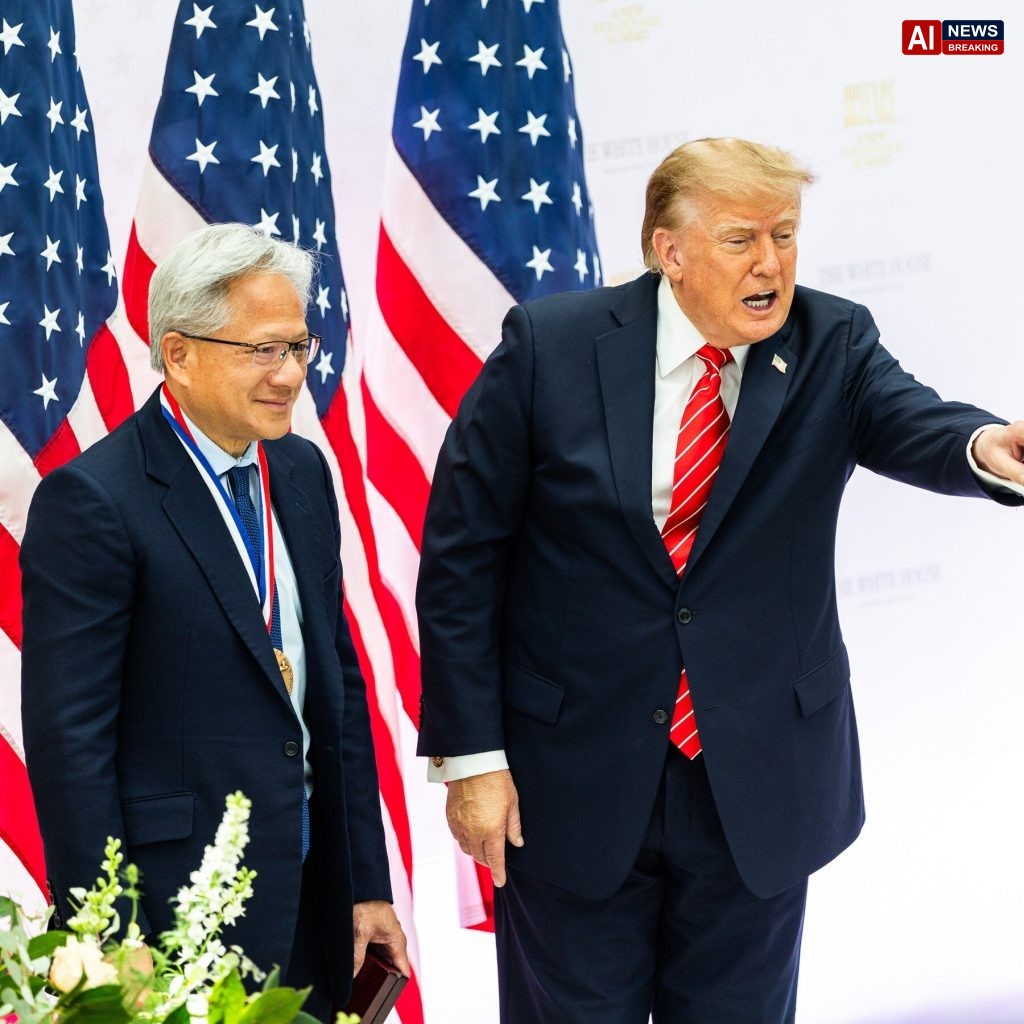
National Security vs. the Stock Market - AI News Breaking
trump urges reinstatement nvidia:
President Donald Trump’s recent intervention in the governance of Nvidia, the world’s leading designer of graphics processing units, has sparked a heated debate over the appropriate boundaries between national security considerations and corporate autonomy. In a series of private meetings with senior members of the company’s board, the former president urged the reinstatement of Jensen Huang, the firm’s co‑founder and chief executive, after a brief and controversial removal that was precipitated by concerns about alleged ties to foreign intelligence services. The episode, which unfolded against a backdrop of heightened geopolitical tension and an increasingly volatile stock market, has raised questions about the extent to which political leaders should involve themselves in the internal affairs of publicly listed companies, especially when those firms sit at the intersection of cutting‑edge technology and national defence.Nvidia’s significance to both the United States and its allies stems from the pivotal role its GPUs play in a range of strategic sectors..
Beyond powering the graphics of video games, the chips are integral to artificial‑intelligence workloads, high‑performance computing, and data‑centre infrastructure that underpins critical government operations. government has classified AI development as a matter of national security, prompting a series of export controls and investment restrictions aimed at preventing advanced semiconductor technology from falling into the hands of potential adversaries. This regulatory environment has placed companies such as Nvidia under intense scrutiny, with the Department of Commerce’s Bureau of Industry and Security routinely evaluating the risk profile of their supply chains and research collaborations.The controversy began in late April, when a small but vocal faction of Nvidia shareholders, supported by a handful of board members, called for an extraordinary meeting to discuss the possible removal of Huang..
Their concerns centred on a series of undisclosed meetings that Huang allegedly held with representatives of a foreign government’s intelligence agency during a technology conference in Singapore. While no formal evidence of wrongdoing was presented, the shareholders argued that the mere perception of compromised loyalty could erode confidence among investors and jeopardise the firm’s eligibility for certain government contracts. The board, citing a fiduciary duty to protect the company’s reputation, voted narrowly to place Huang on a temporary administrative leave pending an internal investigation.Trump’s involvement became public after a brief statement released by his office on May 2, in which the former president described the board’s decision as “short‑sighted” and “dangerous to America’s future.” According to sources familiar with the matter, Trump met with Nvidia’s chairman, a longtime Republican donor, and a senior adviser on technology policy to convey his belief that Huang’s leadership was essential for maintaining the United States’ edge in AI..
He reportedly warned that any disruption at the helm could trigger a “cascade of market instability” that would affect not only shareholders but also the broader tech ecosystem that relies on Nvidia’s roadmap. The former president’s outreach, while informal, was framed as a national‑security appeal rather than a purely commercial concern.The reaction from Wall Street was swift. Nvidia’s shares, which had been trading near record highs, fell 4.7 per cent on the day the news broke, wiping out roughly $120 billion in market value..
Analysts at major investment banks warned that the episode underscored the fragility of a market that is increasingly intertwined with geopolitical risk. “Investors are now forced to price in a new variable: political intervention at the board level,” said a senior equities strategist at a leading brokerage. The sell‑off was amplified by concerns that the company’s pending earnings report, due later in the month, could be delayed or clouded by the ongoing leadership dispute, potentially affecting the performance metrics of numerous technology‑focused exchange‑traded funds.Within the administration, the incident prompted a series of internal memos to the National Security Council and the Office of the Director of National Intelligence..
The memos emphasized that while the United States has a vested interest in safeguarding critical technology, the mechanisms for doing so must be transparent and consistent with existing statutes, such as the International Emergency Economic Powers Act and the Committee on Foreign Investment in the United States (CFIUS) framework. A senior official, speaking on condition of anonymity, noted that “the President’s personal lobbying of a corporate board, without the involvement of the usual inter‑agency review process, creates a precedent that could be difficult to manage in future cases where national‑security concerns intersect with corporate governance.”Legal scholars have weighed in on the potential ramifications for corporate law. Professor Elena Martínez of Harvard Law School argued that the episode could test the limits of the business judgment rule, which traditionally shields board decisions from judicial scrutiny if made in good faith and with reasonable care..
“If a former president’s informal pressure is deemed to have unduly influenced a board’s decision‑making, courts may be asked to assess whether the board breached its fiduciary duties by yielding to external political pressure rather than conducting an independent inquiry,” she explained. Conversely, other experts contend that the board’s original move to suspend Huang was itself a reaction to perceived security threats, and that the president’s intervention merely reflected a broader stakeholder interest that should be considered alongside shareholder rights.The broader policy implications extend beyond Nvidia. The United States is currently wrestling with a series of legislative proposals that would grant the executive branch greater authority to intervene in the management of companies deemed vital to national security..
A bill introduced in the Senate earlier this year would empower the ary of Commerce to issue binding directives to board members of firms involved in advanced semiconductor manufacturing, including the power to appoint temporary executives in cases of alleged security breaches. Proponents argue that such powers are necessary to close gaps that adversarial nations might exploit, while opponents warn that they could undermine the principle of private‑sector independence that has historically driven innovation in the tech industry.From an international perspective, allies have observed the United States’ handling of the Nvidia episode with a mixture of concern and caution. The European Union, which has its own strategic autonomy agenda for semiconductors, issued a statement emphasizing that “transparent, rule‑based processes are essential for maintaining confidence in global supply chains.” Meanwhile, the People’s Republic of China, a major purchaser of advanced computing hardware, denied any involvement in the alleged meetings and reiterated its commitment to “mutual respect and non‑interference” in corporate affairs..
The diplomatic undercurrents suggest that any perception of politicised corporate governance could reverberate through trade negotiations and potentially fuel further decoupling in the tech sector.In the days following Trump’s lobbying, Nvidia’s board convened an emergency session to review the situation. After a brief but intense deliberation, the board voted to reinstate Huang, citing the lack of concrete evidence linking him to any illicit activity and the need for stable leadership ahead of the upcoming earnings release. The decision was accompanied by a public statement affirming the board’s commitment to “upholding the highest.
Updated: November 25, 2026
Trump’s backstage lobbying blurs the line between national‑security prerogatives and shareholder governance, foreshadowing a future where corporate boards may answer to political agendas as often as to market pressures.
If unchecked, such interventions could erode the independent decision‑making that fuels tech innovation, while simultaneously entangling U.S. firms in a web of geopolitical risk‑pricing.





