Pakistan’s leaders hail first astronaut aboard Chinese craft: ‘Proud one of us has gone into space’
 British tourist travels 29 hours from Mumbai to Amritsar for ₹5,461, rates Indian Railways 10/10 | Viral video
 The Supreme Court will decide whether assault weapons bans violate the Second Amendment
 A Critic of Beijing Falls Short in Taiwan’s Key Mayoral Election
 EPA says no rise in contamination after Army detonates lead azide stockpile in Iowa
Asia shares drop on AI worries, echoing Wall Street’s decline
**
Asia shares drop on AI worries, echoing Wall Street's decline - AI News Breaking
asia shares drop worries:
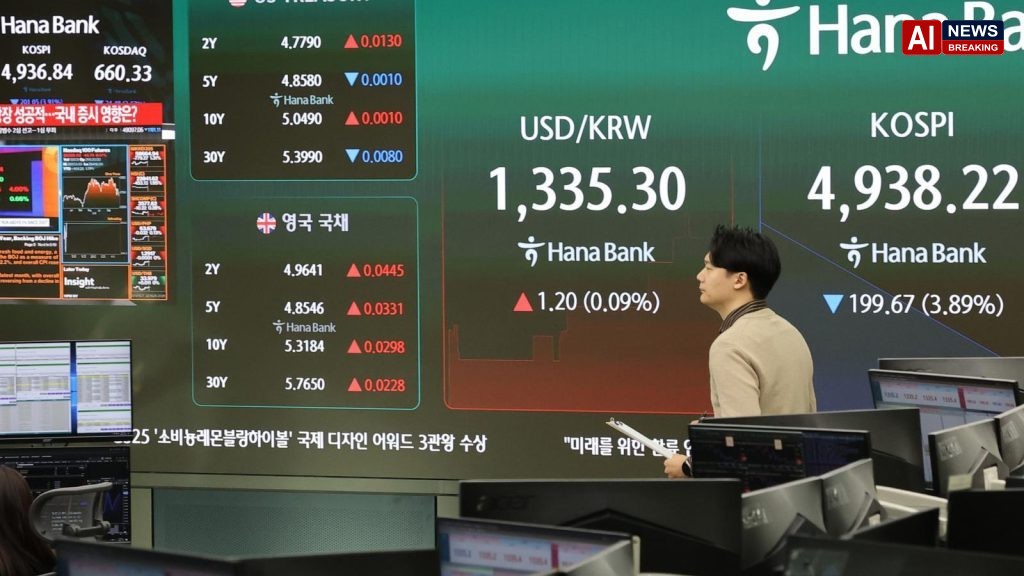
Asia shares drop on AI worries, echoing Wall Street’s decline Asian equity markets entered a broad sell‑off on Tuesday as investors pared back exposure to artificial‑intelligence‑linked stocks and semiconductor manufacturers. The Nikkei 225 slipped 1.3 percent, the Shanghai Composite fell 1.1 percent and Hong Kong’s Hang Seng lost 1.5 percent, mirroring a sharp pull‑back on U.S. exchanges where the S&P 500’s AI‑heavy indices fell more than 2 percent..
Market analysts said the move reflected heightened concern that the recent surge in AI hype may be overstated, prompting a reassessment of valuation multiples across the sector. The decline was led by a sharp tumble in shares of firms that supply the specialised chips needed for large‑language models and other generative‑AI applications. Taiwan Semiconductor Manufacturing Co (TSMC) saw its shares drop 2.4 percent, while South Korea’s Samsung Electronics fell 2.1 percent after a downgrade from a major brokerage..
Both companies have been central to the AI supply chain, but analysts warned that rising competition and potential overcapacity could pressure margins, especially as demand for high‑performance computing hardware stabilises after a period of rapid growth. In Japan, technology heavyweight SoftBank Group also felt the pressure, with its Vision Fund‑backed AI ventures seeing a collective 1.8 percent decline. The fund’s recent investments in start‑ups focused on natural‑language processing and computer vision have been lauded for their potential, yet investors appear wary of the timeline required to translate research breakthroughs into profitable revenue streams..
SoftBank’s own stock, which often acts as a bellwether for tech sentiment in the region, fell 1.4 percent, adding to the broader market gloom. China’s AI sector was not immune to the pull‑back, as leading internet conglomerate Baidu suffered a 2.3 percent slide after reporting a slowdown in its cloud AI services revenue. While Baidu remains a dominant player in China’s AI ecosystem, analysts noted that tighter regulatory scrutiny and a competitive landscape featuring domestic rivals such as Alibaba Cloud and Tencent Cloud could curb its growth prospects..
The broader Chinese market, already grappling with policy uncertainties, reacted negatively, with the CSI 300 index dropping 1.0 percent. Investors also took note of the performance of AI‑focused exchange‑traded funds (ETFs) that have surged in popularity over the past year. The Global X AI & Technology ETF, which tracks a basket of AI‑related equities, fell 1.9 percent, prompting some fund managers to reconsider allocation strategies..
Portfolio managers highlighted the need for diversification, emphasizing that a single sector’s rapid rise can create valuation bubbles that are vulnerable to sudden sentiment shifts. Meanwhile, on Wall Street, the Nasdaq Composite shed 2.1 percent, driven by a similar retreat from AI‑centric names such as Nvidia and AMD. The parallel movement across continents underscores the interconnected nature of modern capital markets, where investor sentiment can cascade quickly from one region to another..
Financial commentators suggested that the synchronized drop could signal a broader market correction rather than a temporary wobble limited to AI stocks. Macro‑economic data released earlier in the week added to the cautious tone, with U.S. consumer confidence slipping slightly and concerns growing over the Fed’s upcoming policy meeting..
Though the central bank’s interest‑rate trajectory remains a key driver for equity markets, the added layer of sector‑specific risk in AI and chips amplified the sell‑off. Analysts warned that if monetary policy tightens further, the combined effect could exacerbate volatility across tech‑heavy indices worldwide. In response to the market turbulence, several institutional investors issued statements urging a balanced approach..
A major sovereign wealth fund from the Gulf region emphasized the importance of maintaining a long‑term view, noting that short‑term price swings should not dictate strategic positioning in emerging technologies. Likewise, a prominent European pension fund highlighted its commitment to ESG criteria, stating that AI investments will be evaluated not only on financial returns but also on ethical considerations and societal impact. The sell‑off also revived discussions about the sustainability of AI hype cycles..
Critics argue that the rapid inflow of capital into AI startups and related hardware has inflated valuations beyond fundamentals, creating a risk of a “tech bubble” similar to the one seen in the late‑1990s. Proponents, however, contend that AI remains a transformative technology with the potential to drive productivity gains across multiple industries, and that temporary market corrections are a natural part of the maturation process. Looking ahead, market participants will watch upcoming earnings reports from key AI players for clues about demand trends..
Nvidia’s quarterly results, due later this month, are expected to provide insight into the health of the data‑center segment, while Intel’s upcoming launch of new AI‑optimized processors could either reinforce confidence or deepen doubts, depending on market reception. Analysts suggest that any deviation from forecasted revenue growth could trigger further volatility in both Asian and global markets. Despite the current dip, some investors remain optimistic about the long‑term prospects of AI and semiconductor sectors..
A leading Asian brokerage firm maintained its “buy” rating on several chipmakers, citing ongoing investments in advanced manufacturing processes and the strategic importance of AI in future economic growth. The firm warned, however, that investors should be prepared for short‑term price fluctuations as the market digests both macro‑economic.
Updated: November 20, 2026
Asian markets slumped as AI‑linked stocks and chipmakers fell sharply, mirroring a broader pull‑back on Wall Street amid concerns that AI hype has driven valuations beyond fundamentals. Analysts say the sell‑off reflects reassessment of AI demand and chip margins, warning of heightened volatility if monetary policy tightens.
Insight: The AI‑fueled rally appears to have reached its “hype‑plateau,” forcing investors to re‑examine whether the lofty valuations can survive a slowdown in demand and tighter competition. In a market already sensitive to monetary tightening, this correction may signal a broader tech pullback