
 Pakistan’s leaders hail first astronaut aboard Chinese craft: ‘Proud one of us has gone into space’
 British tourist travels 29 hours from Mumbai to Amritsar for ₹5,461, rates Indian Railways 10/10 | Viral video
 The Supreme Court will decide whether assault weapons bans violate the Second Amendment
 A Critic of Beijing Falls Short in Taiwan’s Key Mayoral Election
 EPA says no rise in contamination after Army detonates lead azide stockpile in Iowa
BJP-led Thiruvananthapuram Corporation denies permission for cultural event at Manaveeyam Veedhi
**
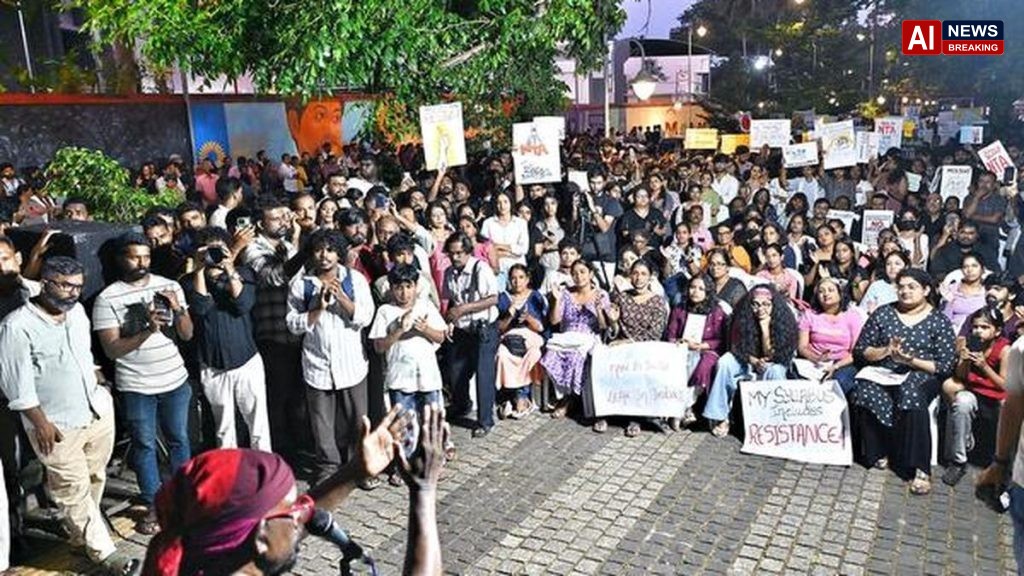
BJP-led Thiruvananthapuram Corporation denies permission for cultural event at Manaveeyam Veedhi - AI News Breaking
bjpled thiruvananthapuram corporation denies:
BJP‑led Thiruvananthapuram Corporation denies permission for cultural event at Manaveeyam Veedhi The Thiruvananthapuram Corporation, controlled by the Bharatiya Janata Party (BJP), has refused to grant a permit for a cultural programme slated for Manaveeyam Veedhi, a prominent public space traditionally used for artistic performances. The decision, announced on Thursday, has sparked a debate over the balance between municipal regulations and the right to artistic expression. Local officials cited procedural concerns, while opposition parties and civil society groups argue that the move reflects a broader pattern of curbing dissent in the state’s capital..
According to the event’s organisers, a formal application was submitted on 3 November, well before the planned date of the performance. The request sought permission for a concert featuring Pushpavathy, a well‑known Malayalam singer whose repertoire includes folk and classical pieces. The organisers contend that all required documents, including security arrangements and crowd‑management plans, were provided in accordance with municipal guidelines..
They maintain that the denial came without clear justification, prompting accusations of arbitrary decision‑making. In response, the corporation’s public relations office released a statement asserting that the application had been “meticulously examined” and found wanting on several technical grounds. The statement mentioned incomplete fire‑safety clearances, insufficient insurance coverage for attendees, and a lack of a detailed noise‑control plan as primary reasons for the rejection..
It added that the corporation remains committed to upholding public safety and ensuring that events at Manaveeyam Veedhi do not disrupt the daily flow of traffic or compromise the area’s heritage status. Opposition leaders, including senior members of the Indian National Congress and the Communist Party of India (Marxist), have seized on the episode to allege that the BJP‑led administration is stifling free speech. During a press conference, they quoted activists who described the denial as “a direct curtailment of artistic freedom” and warned that such actions could set a precedent for future cultural suppressions..
The political rhetoric has intensified ahead of the upcoming state assembly elections, where cultural policy and civil liberties feature prominently in campaign narratives. Activists on the ground have organised a peaceful protest outside the corporation’s headquarters, demanding that the permit be reinstated. They argue that the procedural shortcomings cited by the authorities can be remedied quickly, and that the refusal appears disproportionate given the event’s low‑risk profile..
The protestors also highlighted past instances where similar performances were allowed without the stringent conditions now being imposed, suggesting a selective application of rules. Legal experts consulted by the media note that municipal bodies do possess the authority to impose safety and logistical requirements on public gatherings. However, they caution that any denial must be based on objective criteria and not be influenced by political considerations..
“If the corporation cannot substantiate its decision with concrete evidence of non‑compliance, the affected parties have recourse to judicial review,” said one constitutional lawyer, referencing recent judgments that protect the right to peaceful assembly and expression under Article 19 of the Indian Constitution. The cultural community has expressed disappointment, fearing that the controversy could deter artists from using public spaces for performances. Manaveeyam Veedhi, historically a hub for street theatre, poetry readings, and music concerts, has been instrumental in nurturing Kerala’s vibrant artistic scene..
Residents recall numerous events that have taken place there over the years, often with minimal bureaucratic hurdles, and worry that a shift in policy could erode the city’s cultural fabric. Meanwhile, the corporation’s mayor, a senior BJP figure, defended the decision as “a necessary measure to maintain order and safety.” In an interview, he emphasised that the municipality is not “against any form of art” but must ensure that events comply with all statutory obligations. He also warned that granting the permit without addressing the raised concerns could set a “dangerous precedent” for future events that might overlook essential safety protocols..
The state’s Department of Culture has been approached for mediation, though officials have not yet issued an official response. Historically, the department has acted as an intermediary in disputes between artists and local authorities, often facilitating the issuance of permits after ensuring compliance with safety norms. Analysts suggest that the department’s involvement could either smooth over the impasse or further politicise the issue, depending on how it balances bureaucratic rigour with artistic freedom..
Public opinion, as gauged through social media platforms, appears divided. Some users praise the corporation for prioritising citizen safety, while others denounce what they perceive as an overreach of power. Hashtags calling for the event’s reinstatement have trended locally, with many users sharing past footage of Pushpavathy’s performances to underscore the cultural value of the proposed concert..
Conversely, a separate cohort of commenters have highlighted recent incidents of crowd‑related mishaps at other venues, arguing that stringent checks are justified. If the matter proceeds to court, the outcome could have broader implications for how cultural events are regulated across Kerala. A favourable ruling for the organisers could reinforce the principle that administrative bodies must act transparently and proportionally, especially when fundamental rights are at stake..
Conversely, a verdict upholding the corporation’s decision might embolden other municipalities to adopt stricter licensing regimes, potentially reshaping the landscape of public cultural expression in the state. As the deadline for the event approaches, both sides appear poised for.
Updated: November 14, 2026
The denial signals a tightening of municipal control that risks turning cultural hubs into gated‑off zones, echoing a national trend where safety rhetoric masks political gatekeeping. If upheld, it could set a precedent that forces smaller artists into private venues, eroding the public sphere that once fueled Kerala’s vibrant street‑






