
 Pakistan’s leaders hail first astronaut aboard Chinese craft: ‘Proud one of us has gone into space’
 British tourist travels 29 hours from Mumbai to Amritsar for ₹5,461, rates Indian Railways 10/10 | Viral video
 The Supreme Court will decide whether assault weapons bans violate the Second Amendment
 A Critic of Beijing Falls Short in Taiwan’s Key Mayoral Election
 EPA says no rise in contamination after Army detonates lead azide stockpile in Iowa
Bloomberg finds limited improvement in
**
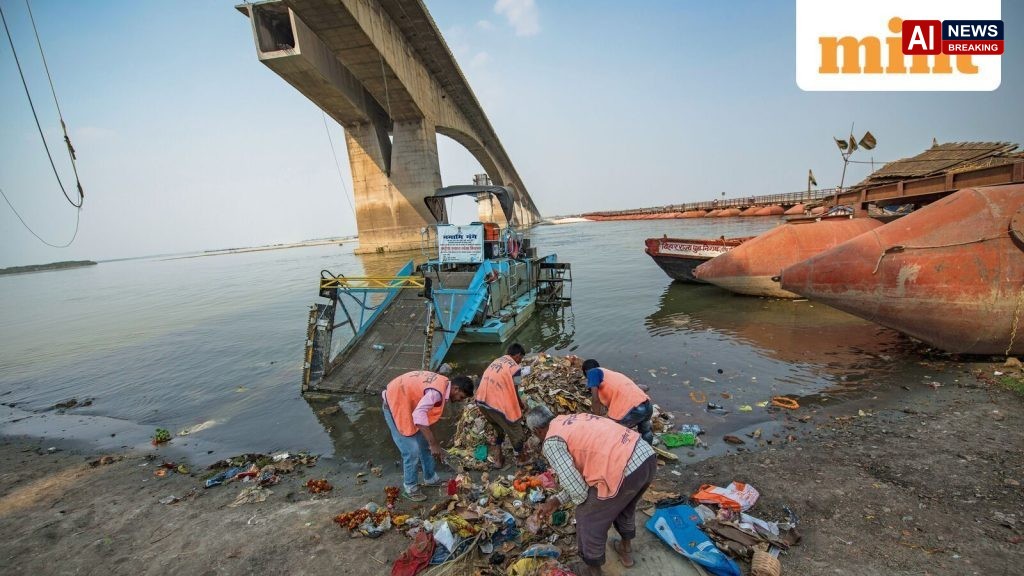
Bloomberg finds limited improvement in - AI News Breaking
The government’s flagship water‑conservation programme, Namami Gange, has entered its tenth year with a reported outlay of ₹43,060 crore, yet a recent Bloomberg investigation suggests that the river’s water quality has improved only marginally and that many stretches remain heavily polluted. The report, which examined satellite data, on‑site water‑testing and interviews with local residents, concluded that despite the massive financial commitment, the Ganga continues to carry high concentrations of untreated sewage, industrial effluents and agricultural runoff. The findings have sparked a fresh round of debate in New Delhi, with opposition parties and environmental groups calling for an urgent audit of the scheme’s implementation.The Bloomberg team cited data from the Central Pollution Control Board (CPCB) indicating that, as of 2023, more than 60 percent of the river’s 2,800 km length still failed to meet the “good” water‑quality standards set by the Indian Ministry of Environment, Forest and Climate Change..
In particular, the stretches downstream of major urban centres such as Varanasi, Patna and Kolkata were flagged for elevated levels of biochemical oxygen demand (BOD), faecal coliforms and heavy metals. The investigation also highlighted that several sewage‑treatment plants (STPs) commissioned under the scheme were either operating below capacity or had been abandoned altogether due to inadequate maintenance and power supply.The Ministry of Jal Shakti, which oversees Namami Gange, responded swiftly, disputing the report’s conclusions and pointing to a series of recent improvements. In a press briefing, the ministry’s spokesperson presented a dashboard that showed a rise in the number of functional STPs from 2,500 in 2015 to over 5,300 in 2023, translating to an additional 5.2 billion litres per day of treated wastewater being discharged into the river..
According to the ministry, the overall “river health index” – a composite metric that includes parameters such as dissolved oxygen, pH and coliform counts – had risen by 15 percent across the Ganga basin since the programme’s inception.Minister Gajendra Singh Shekhawat, who heads the Jal Shakti portfolio, highlighted specific success stories to illustrate the programme’s impact. He cited the rejuvenation of the Saptakund‑Mohanpur stretch in Uttarakhand, where a combination of afforestation, river‑bank cleaning and the installation of decentralized wastewater treatment units had reduced BOD levels by 30 percent over the past three years. He also mentioned the completion of the 1,500‑MW Baghpat‑Shamli sewage‑treatment corridor in Uttar Pradesh, which, he claimed, now treats 95 percent of the municipal waste generated by the two cities, diverting it away from the river.Critics, however, argue that such isolated examples do not reflect the broader picture..
A coalition of non‑governmental organisations, including the Centre for Science and Environment (CSE) and the Ganga Mahasabha, released a joint statement warning that the “average” water‑quality indicators have stagnated since 2019. Their analysis of CPCB data shows that while the number of STPs has risen, the proportion of those operating at full capacity remains below 50 percent, largely due to chronic power shortages, insufficient staffing and delayed procurement of critical spare parts. The NGOs also pointed to the continued discharge of untreated industrial effluents, particularly from textile and leather units in the eastern Gangetic belt, which are not covered by the current sewage‑treatment framework.The government’s defence rests heavily on the premise that the Ganga’s ecological recovery is a long‑term process that cannot be measured solely by short‑term water‑quality snapshots..
In a detailed response to Bloomberg, the Ministry of Jal Shakti referenced a 2022 study by the Indian Institute of Technology (IIT) Roorkee, which modelled the river’s flow dynamics and concluded that the cumulative effect of increased treatment capacity, combined with stricter enforcement of effluent standards, could yield a “significant” reduction in pollutant loads by 2030. The ministry also underscored the financial transparency of the programme, noting that the ₹43,060 crore outlay includes contributions from both central and state governments, as well as private‑sector participation through public‑private partnership models.Nevertheless, the debate over accountability extends beyond technical metrics. Parliamentary questions raised in the Lok Sabha this month highlighted concerns about the allocation of funds, with some members accusing the Ministry of “mis‑management” and “delayed disbursement” of grants to state‑run agencies..
In response, the ministry disclosed that over 70 percent of the allocated budget has been released and spent on infrastructure, capacity building and community‑engagement initiatives, while the remaining funds are earmarked for future phases, including the construction of 2,000 km of river‑front development and the establishment of a “Ganga river‑watch” digital monitoring platform.International observers have taken note of India’s massive investment in river restoration, viewing the Ganga as a bellwether for large‑scale water‑resource management in developing economies. The World Bank’s water‑sector specialist, Anjali Mehta, commented that “the scale of financial commitment is unprecedented, but success will hinge on institutional coordination, real‑time monitoring and the ability to enforce compliance across a fragmented industrial landscape.” She added that the integration of satellite‑based observation tools, which Bloomberg employed in its investigation, could become a valuable complement to ground‑based monitoring if embraced by Indian authorities.As the 2024‑25 financial year unfolds, both sides of the argument appear poised to present new data. The Ministry has announced that a comprehensive “Ganga Cleanliness Report” will be released in March, incorporating findings from independent auditors, citizen‑science platforms and the upcoming CPCB “National River Quality Survey.” Meanwhile, environmental watchdogs plan to file a petition with the National Green Tribunal, seeking a directive that mandates a minimum 30 percent reduction in BOD levels across all major tributaries by 2028..
The outcome of these parallel tracks will likely shape public perception of whether the ₹43,060 crore invested over the past decade has truly turned the tide against one of the world’s most iconic yet embattled rivers..
Updated: November 14, 2026
India’s flagship Namami Gange scheme, costing ₹43,060 crore, faces scrutiny after a Bloomberg probe shows only marginal water‑quality gains, with many river stretches still heavily polluted. The ministry counters, citing rising treatment capacity and a 15 percent overall health index, while opposition and NGOs demand a fresh audit and stricter enforcement to meet the programme’s long‑term goals.
Insight: The money poured into Namami Gange has turned the river into a high‑budget laboratory, yet the data suggest the science is still running on fumes: most STPs sit idle and pollution hotspots persist. This gap between headline figures and on‑the‑ground reality signals that without tighter enforcement and real






