
 The Supreme Court will decide whether assault weapons bans violate the Second Amendment
 A Critic of Beijing Falls Short in Taiwan’s Key Mayoral Election
 EPA says no rise in contamination after Army detonates lead azide stockpile in Iowa
 Israeli Strike Kills 2 Workers at Gaza Clinic, Doctors Without Borders Says
 McQueen Pre-Fall 2027
Canada’s Top Court Lets Quebec Use Controversial Measure for Secularism Law
**
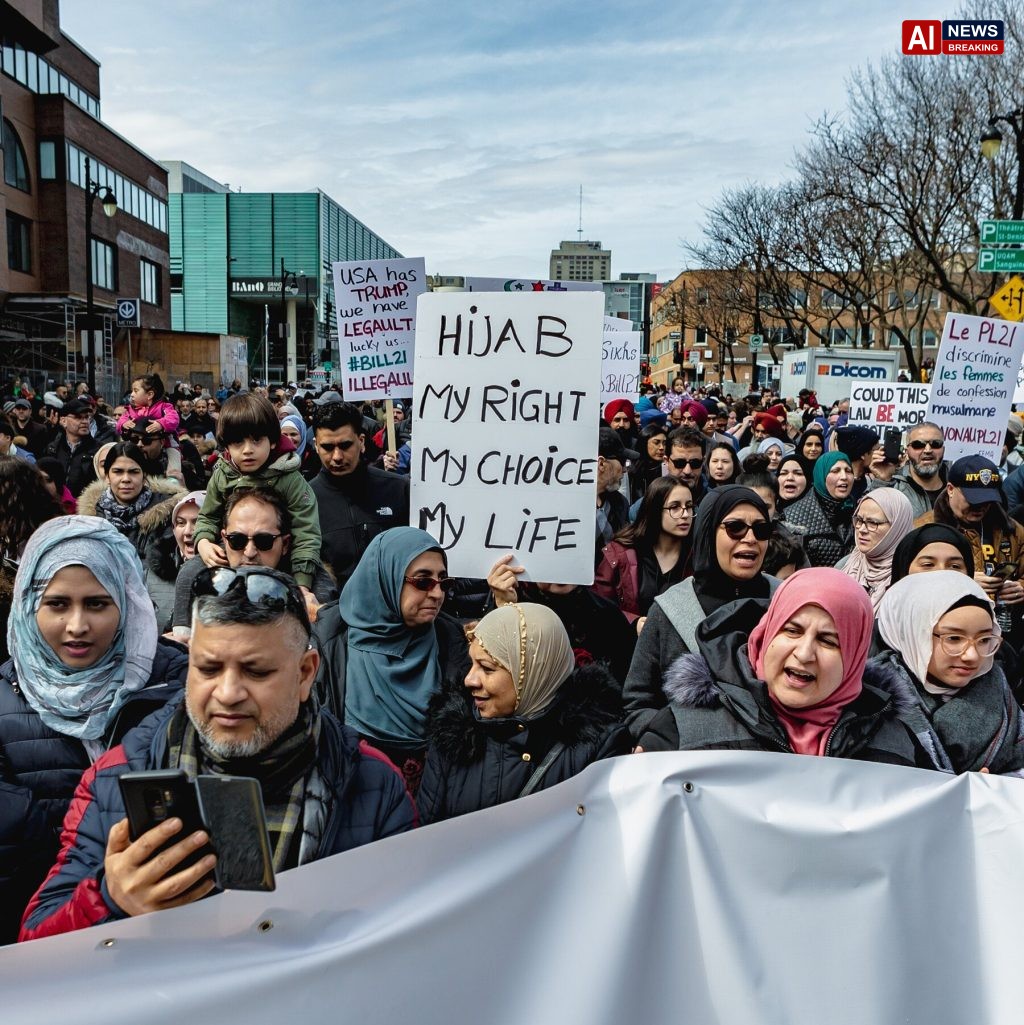
Canada’s Top Court Lets Quebec Use Controversial Measure for Secularism Law - AI News Breaking
canadas court lets quebec:
Canada’s Supreme Court has ruled that Quebec may continue to enforce its controversial secularism legislation, known as Bill 21, despite challenges that the law infringes on religious freedom and equality rights protected under the Canadian Charter of Rights and Freedoms. The decision, delivered by a narrow 5‑4 majority, confirms the province’s authority to impose a ban on the public display of religious symbols by certain employees, including teachers, police officers, judges and prison guards, when they are acting in the course of their duties. The ruling marks a significant moment in Canada’s ongoing debate over the balance between individual rights and collective values, and it is likely to shape the country’s approach to multiculturalism and secularism for years to come.The case before the Court originated in 2021, when a group of civil‑rights organisations and individual plaintiffs, led by the Canadian Civil Liberties Association and a Muslim schoolteacher from Quebec, sought a declaration that Bill 21 violated sections 2(a) and 15 of the Charter, which guarantee freedom of conscience and religion and prohibit discrimination on the basis of religion..
The plaintiffs argued that the law, which prohibits the wearing of overt religious symbols such as hijabs, turbans, kippahs and crosses while performing state‑mandated duties, amounted to a direct attack on religious minorities and was incompatible with Canada’s longstanding commitment to pluralism. The provincial government, meanwhile, maintained that the legislation was a legitimate measure to ensure state neutrality and to promote social cohesion in a province where debates over identity have intensified in recent years.In a series of hearings that stretched over several months, the justices examined a complex interplay of constitutional doctrine, provincial jurisdiction and international human‑rights obligations. Central to the Court’s deliberations was the doctrine of “reasonable limits” under section 1 of the Charter, which permits the government to enact laws that infringe on rights provided those limits can be demonstrably justified in a free and democratic society..
The majority concluded that the province had satisfied this test, noting that the law was aimed at preserving the perception of state neutrality, a value that, while not absolute, carries considerable weight in a diverse society. They also highlighted that the law applies only to a specific cadre of public servants whose roles involve direct interaction with the public, thereby limiting its reach.The dissenting judges, however, warned that the majority’s reasoning could open the door to broader exclusions on the basis of religion, arguing that the law’s blanket prohibition fails to accommodate the nuanced ways in which faith is expressed in everyday life. Justice Rosalie Abella, writing for the minority, underscored that the Charter’s protection of freedom of religion is “deeply rooted in Canadian constitutional tradition” and that any limitation must be narrowly tailored..
She pointed out that less restrictive alternatives – such as policies that require employees to remain neutral in the performance of their duties without banning religious attire altogether – were not adequately explored. The dissent also raised concerns about the potential chilling effect on the participation of religious minorities in public service, which could, in turn, undermine the very social cohesion the law purports to protect.The Court’s decision also touched upon the “notwithstanding clause” – section 33 of the Charter – which allows a legislature to expressly override certain Charter rights for a renewable five‑year period. Quebec had invoked this clause when it first enacted Bill 21 in 2019, thereby insulating the law from constitutional challenge on the basis of the Charter’s fundamental freedoms..
The justices affirmed that the use of the notwithstanding clause is constitutionally valid, emphasizing that it is a tool expressly provided for in the Charter to accommodate the political realities of a federal system where provinces possess considerable autonomy over matters of education, health and public order. The ruling thus reinforces the principle that the balance of power between Ottawa and the provinces includes the possibility for provinces to chart a distinct course on culturally sensitive issues, even if that course provokes national debate.Legal scholars have noted that the judgment may set a precedent for future provincial legislation that seeks to limit individual rights in the name of collective values. Michael Kinsella, a constitutional law professor at the University of Toronto, cautioned that “the Court’s endorsement of the notwithstanding clause in this context could embolden other provinces to adopt similarly restrictive measures, potentially leading to a patchwork of rights regimes across the country.” He added that while the decision does not overturn the Charter, it does signal a willingness by the judiciary to respect provincial experiments with social policy, provided they are framed within the procedural safeguards of the Charter’s limitation clause.Political reactions have been swift and polarized..
Quebec Premier François Legault hailed the ruling as a vindication of the province’s commitment to secularism and a reinforcement of the “values of neutrality that underpin public confidence in state institutions”. He promised to pursue a review of the law’s implementation to ensure that it is applied consistently and without discrimination. Conversely, the federal Liberal government, led by Prime Minister Justin Trudeau, expressed disappointment, stating that the decision “raises serious concerns about the protection of fundamental freedoms for Canadians of all faiths”..
The Prime Minister’s office signalled that the federal government would explore legislative options, including possible amendments to the Charter or the introduction of a national framework that would set limits on the use of the notwithstanding clause.Human‑rights groups have mobilised in response, organising protests in several major cities and filing new complaints with the United Nations Human Rights Committee, alleging that Quebec’s law contravenes the International Covenant on Civil and Political Rights, to which Canada is a signatory. The Canadian Civil Liberties Association announced plans to launch a public education campaign highlighting the potential impacts of the law on religious minorities, particularly women who wear headscarves as an expression of their faith. Meanwhile, supporters of the legislation argue that it has already contributed to a perception of impartiality in public services, citing surveys that suggest a majority of Quebecers feel more comfortable interacting with officials who do not display overt religious symbols.The economic implications of the ruling are also being debated..
Some analysts warn that the law could deter qualified professionals from relocating to Quebec, especially in fields where religious attire is common, such as nursing and education. A recent study by the Quebec Chamber of Commerce indicated that approximately 12 percent of prospective employees cited the secularism law as a factor in their decision to seek work elsewhere. On the other hand, business groups aligned with the provincial government argue that a neutral public sphere can foster a more predictable regulatory environment, which may ultimately benefit investment and tourism.Internationally, the decision has drawn attention as an example of how federations manage cultural diversity within constitutional frameworks..
Observers in Europe, where several countries have grappled with similar bans on religious symbols in public spaces,.
Quebec’s win legitimizes provincial use of the notwithstanding clause, foreshadowing a “rights‑by‑province” landscape that could fracture Canada’s uniform Charter protections.
The ruling also risks turning secularism into a recruitment liability, as marginalized faith groups may shun public‑service careers, undermining the very social cohesion the law seeks to secure.





