
 Pond heron found dead in Coimbatore tests positive for avian influenza
 Pakistan’s leaders hail first astronaut aboard Chinese craft: ‘Proud one of us has gone into space’
 British tourist travels 29 hours from Mumbai to Amritsar for ₹5,461, rates Indian Railways 10/10 | Viral video
 The Supreme Court will decide whether assault weapons bans violate the Second Amendment
 A Critic of Beijing Falls Short in Taiwan’s Key Mayoral Election
CII launches
**
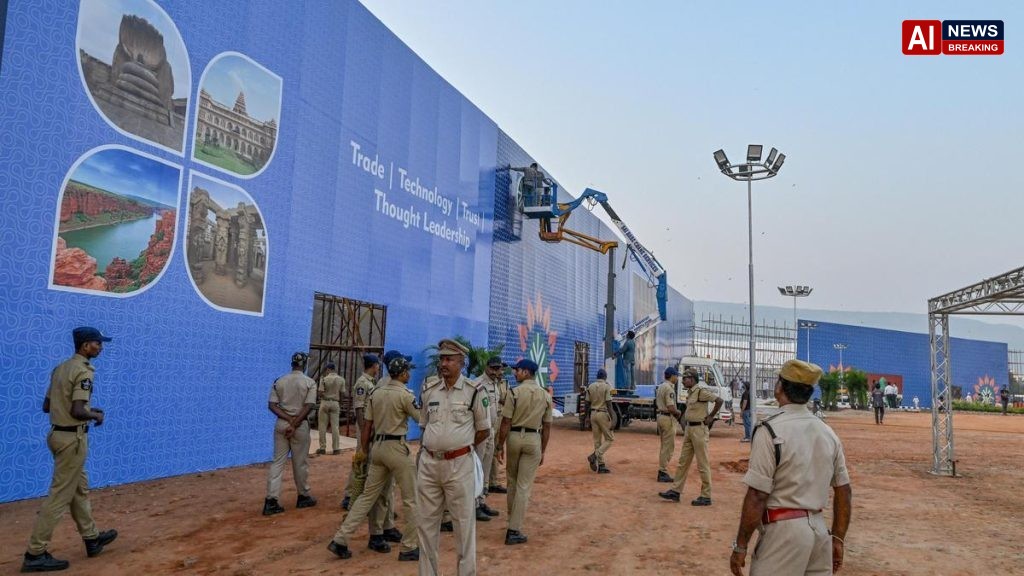
CII Partnership Summit begins in Visakhapatnam on November 12; Amit Shah to address inaugural session - AI News Breaking
The Confederation of Indian Industry (CII) has kicked off its annual Partnership Summit in Visakhapatnam, with the inaugural session set to be addressed by Union Home Minister Amit Shah on Monday, 12 November. The two‑day event, staged at the Andhra Pradesh Capital Region’s Convention Centre, is expected to draw more than 3,800 delegates from 59 countries, representing a cross‑section of industry, government, academia and civil society. Organisers describe the summit as a platform for “building partnerships that matter”, aiming to translate dialogue into concrete commercial and policy outcomes.The opening ceremony will be marked by a ceremonial lighting of the CII’s signature “Torch of Progress”, a symbolic gesture that underscores the theme of the summit – “Sustainable Growth through Collaborative Innovation”..
Minister Shah is slated to outline the government’s vision for a “new industrial era” that aligns with the Prime Minister’s emphasis on self‑reliance, or Atmanirbhar Bharat, while also addressing the imperatives of climate resilience, digital transformation and inclusive employment. His speech is expected to highlight recent policy initiatives such as the Production Linked Incentive (PLI) schemes, the recent reforms to the Foreign Direct Investment (FDI) framework, and the upcoming National Infrastructure Pipeline, all of which are designed to attract foreign capital and technology.Delegates will convene across a packed agenda that includes sectoral roundtables, B2B matchmaking sessions and high‑level panels on topics ranging from renewable energy and electric mobility to advanced manufacturing and agritech. According to CII officials, more than 160 memoranda of understanding (MoUs) have already been signed in pre‑summit negotiations, covering investments totalling approximately $12 billion..
Among the anticipated agreements are a $1.2 billion joint venture between an Indian auto parts manufacturer and a German engineering firm to produce battery components, a $500 million pledge by a Japanese conglomerate to set up a green hydrogen hub in the Eastern Ghats, and a series of collaborative research projects between Indian universities and European institutions focused on artificial intelligence and quantum computing.The host city, Visakhapatnam, has been positioned as a showcase of India’s emerging industrial corridors. Over the past three years, the state government has accelerated the development of the Kakinada Special Economic Zone, expanded the Vizag Port’s capacity, and launched a series of smart city initiatives that integrate Internet of Things (IoT) sensors for traffic management and waste reduction. State officials have pledged logistical support for the summit, including dedicated ferry services and a temporary “green corridor” that will prioritize electric buses and car‑pooling for delegates..
The choice of Visakhapatnam, they argue, reflects a strategic shift to decentralise major business events from the traditional hubs of Delhi, Mumbai and Bangalore, thereby promoting regional balance and tapping into the industrial potential of the eastern coast.International participation is robust, with delegations from the United States, United Kingdom, Japan, Germany, France, United Arab Emirates, Australia and several African and Latin American nations. The United States Trade and Development Agency (USTDA) will host a side event on “Supply Chain Diversification”, while the European Union’s Directorate‑General for Trade will present a framework for “Digital Trade Facilitation”. Representatives from the Gulf Cooperation Council are expected to discuss opportunities in petrochemical processing and maritime logistics, sectors where India is seeking to expand its export footprint..
In addition, a delegation from the African Union will explore collaborative pathways in renewable energy financing, leveraging the burgeoning green bond market.A notable feature of the summit is the “Innovation Lab”, an interactive space where start‑ups can pitch solutions to challenges posed by senior industry leaders. The lab, curated by CII’s Centre for Innovation and Entrepreneurship, will host over 120 start‑ups selected through a rigorous screening process. These firms will have the chance to secure seed funding, mentorship and potential corporate partnerships..
Among the highlighted pitches are a Bengaluru‑based firm developing low‑cost solar‑powered cold storage units for smallholder farmers, a Hyderabad start‑up offering AI‑driven predictive maintenance for heavy machinery, and a Chennai company that has created a biodegradable packaging material derived from seaweed.The summit also seeks to address the growing concern over climate change and the need for a just transition for workers in traditional sectors. A dedicated panel titled “Green Jobs and Skills for the Future” will bring together labour unions, training institutes and corporate representatives to map out reskilling pathways for workers displaced by automation and decarbonisation. The Ministry of Labour and Employment has pledged to allocate Rs 5,000 crore for skill development programmes aligned with the Green Skill Development Programme, a move that dovetails with the International Labour Organization’s guidelines on a “green and inclusive transition”.Critics, however, have raised questions about the efficacy of such large‑scale summits in delivering tangible outcomes beyond signed MoUs..
A coalition of think‑tanks and civil‑society groups released a joint statement earlier this week urging the government to ensure that the investments pledged are accompanied by stringent environmental safeguards and transparent procurement processes. They also called for greater participation of women entrepreneurs and marginalized communities in the matchmaking sessions, noting that gender parity remains a persistent gap in India’s corporate ecosystem. In response, CII’s ary General, Arun Kumar, affirmed that the summit’s “track‑record of converting dialogue into action” is reflected in the volume of agreements signed in previous editions, and pledged to release a post‑summit impact report detailing implementation timelines and compliance mechanisms.Beyond the formal sessions, the summit’s cultural programme showcases the region’s heritage..
An evening gala will feature performances by classical dancers from Andhra Pradesh, alongside a culinary showcase that highlights the coastal cuisine of the Bay of Bengal. Organisers hope that the cultural immersion will foster informal networking and deepen mutual appreciation among the international delegates and local stakeholders.As the first day draws to a close, anticipation builds for the second day’s focus on “Infrastructure and Connectivity”, where senior officials from the Ministry of Road Transport and Highways, the National Highways Authority of India and private infrastructure firms will unveil plans for a new network of green corridors linking major ports to inland logistics hubs. If the summit’s ambitious agenda translates into sustained investment and policy coherence, Visakhapatnam could emerge as a model for how regional cities can anchor India’s broader aspirations for inclusive, high‑tech, and environmentally responsible growth..
Updated: November 11, 2026
Visakhapatnam’s spotlight at the CII summit signals a deliberate pivot toward regional industrial hubs, foreshadowing a more geographically diversified growth model that could dilute the dominance of traditional metros while anchoring India’s Atmanirbhar ambitions in coastal corridors.
If the flood of MoUs materialises into enforceable projects and robust green‑skill frameworks, the event may become a catalyst for a new era of supply‑chain resilience and climate‑aligned manufacturing—yet without rigorous oversight,






