
 Pakistan’s leaders hail first astronaut aboard Chinese craft: ‘Proud one of us has gone into space’
 British tourist travels 29 hours from Mumbai to Amritsar for ₹5,461, rates Indian Railways 10/10 | Viral video
 The Supreme Court will decide whether assault weapons bans violate the Second Amendment
 A Critic of Beijing Falls Short in Taiwan’s Key Mayoral Election
 EPA says no rise in contamination after Army detonates lead azide stockpile in Iowa
Court blocks Pentagon from removing transgender service members
**
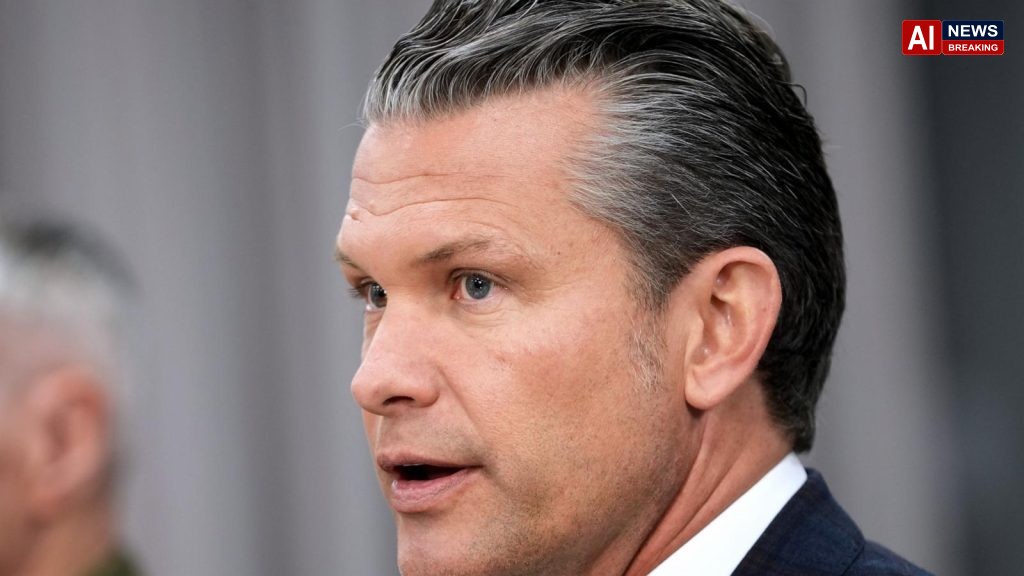
Divided appeals court blocks Pentagon from expelling several transgender troops from US military - AI News Breaking
court blocks pentagon removing:
The United States Court of Appeals for the District of Columbia Circuit issued a decisive ruling on Tuesday that halts the Pentagon’s efforts to remove a number of transgender service members from active duty, marking a significant legal setback for the Department of Defense’s attempt to enforce the former president’s policy barring transgender individuals from serving. The three‑judge panel found that the Trump administration’s directive, which sought to expel service members who had transitioned while in uniform, was issued without proper statutory authority and violated established constitutional protections, prompting the court to issue an injunction that stays the expulsions pending further litigation.The case, brought by a coalition of affected service members, advocacy groups and legal organizations, centers on the Department of Defense’s reliance on a 2018 presidential memorandum that instructed the military to “discontinue all policies that facilitate the integration of transgender service members.” The plaintiffs argued that the memorandum, and the subsequent Department of Defense directive that operationalised it, overstepped executive power by attempting to rewrite military personnel policy—an area traditionally governed by Congress and the Uniform Code of Military Justice—without congressional approval. In its opinion, the appellate judges cited the Administrative Procedure Act, noting that the Pentagon failed to provide a reasoned explanation for the policy shift and neglected to engage in the notice‑and‑comment process required for substantive changes to military regulations.Judge Karen L..
Henderson, writing for the majority, emphasized that while the President possesses broad authority over the armed forces, that authority is not unlimited. “The Constitution places clear limits on the executive’s power to alter the rights of individuals serving in the nation’s uniformed forces,” she wrote. “When the President seeks to impose a sweeping ban that effectively strips service members of their earned positions, the action must be grounded in statutory authority and must comply with due‑process requirements.” The opinion also referenced the Supreme Court’s 2020 decision in Department of Commerce v..
New York, which underscored the need for the executive to act within the bounds of the law when enacting policies that affect a protected class.The injunction applies to all service members who had been identified by the Pentagon as subject to removal under the policy, a group that includes active‑duty personnel across the Army, Navy, Air Force, Marine Corps and Coast Guard. The court’s order does not overturn the underlying policy itself; rather, it temporarily blocks its enforcement while the underlying legal challenges proceed through the federal courts. As a result, the affected service members can remain in their positions, receive the same benefits and retain their ranks pending a final resolution.The Pentagon, represented by Deputy ary of Defense Kathleen Hicks, expressed disappointment with the ruling but indicated that the department will comply with the court’s order..
In a statement released shortly after the decision, Hicks said, “The Department of Defense respects the judicial process and will continue to uphold the highest standards of readiness and cohesion in our armed forces while we work through the appropriate legal channels.” The statement also noted that the Department remains committed to ensuring that all service members meet the same medical, fitness and performance standards, regardless of gender identity, and that any future policy changes will be pursued in accordance with statutory authority.Advocacy groups hailed the decision as a victory for transgender rights and for the principle that military policy must be grounded in law rather than political expediency. The Human Rights Campaign issued a press release calling the ruling “a crucial affirmation that transgender Americans serving our nation cannot be arbitrarily dismissed.” Transgender veterans and active‑duty members, many of whom have spoken publicly about the personal and professional costs of the ban, described the injunction as a lifeline. Sergeant First Class Jordan Rivera, a 12‑year‑veteran of the Army who had been slated for discharge, said, “I joined the Army to serve my country, not to be forced out because of who I am..
This ruling gives me and my fellow service members a chance to keep serving and to be judged on our abilities, not our gender.”Legal analysts noted that the D.C. Circuit’s decision aligns with a broader judicial trend of scrutinising executive actions that target specific groups without clear legislative backing. Professor Emily Chen, a constitutional law scholar at Georgetown University, observed that the ruling “reinforces the judiciary’s role as a check on executive overreach, particularly in the realm of military personnel policy where the Constitution demands careful balancing of national security interests and individual rights.” Chen added that the case could set a precedent for future challenges to other executive orders that attempt to alter service‑member eligibility criteria without congressional consent.The case also revives a contentious debate within the military about the impact of transgender service members on unit cohesion and readiness—a debate that has been largely settled by a series of studies commissioned by the Pentagon under both Democratic and Republican administrations..
Those studies, released in 2016 and 2018, concluded that allowing transgender individuals to serve openly does not adversely affect military effectiveness, and that the costs associated with medical transition care are minimal. Critics of the ban have pointed to these findings as evidence that the policy was motivated more by political considerations than by any demonstrable operational necessity.In the wake of the ruling, lawmakers on both sides of the aisle have signalled their intent to address the policy through legislative means. Senate Armed Services Committee Chairman Jack Reed (D‑RI) called for a “comprehensive review” of military personnel policies to ensure they are consistent with both constitutional principles and the best available scientific evidence..
Meanwhile, Representative Jim Jordan (R‑OH), a vocal supporter of the original ban, warned that the court’s decision could “undermine the commander‑in‑chief’s authority to make swift decisions in matters of national security.” The bipartisan nature of the discussion underscores the complex interplay between civil rights, military readiness and the separation of powers.The Pentagon’s next steps will likely involve a renewed attempt to craft a policy that can withstand judicial scrutiny. Department of Defense officials have indicated that they are reviewing the court’s opinion to determine whether a revised rule, possibly framed as a medical‑fitness standard rather than a categorical ban, could be promulgated without violating the Administrative Procedure Act. Such a move would require a thorough rulemaking process, including a period for public comment and a detailed justification of how the policy aligns with statutory mandates.As the legal battle continues, the immediate effect of the injunction is that the transgender service members who had faced imminent discharge can now focus on their duties without the spectre of removal looming over them..
For many, the ruling offers more than just a procedural pause; it signals a broader affirmation that the military, as an institution, must operate within the confines of the law and respect the rights of all those who serve. The outcome of the pending appeal and any subsequent Supreme Court review will determine whether the temporary relief becomes permanent, but for now, the court’s decision stands as a notable check.
Updated: November 17, 2026
The injunction shows the court’s willingness to hold the executive line up to the Constitution, preventing a politically‑driven purge that would have undermined individual rights and unit cohesion. By stopping the expulsions, the ruling signals that military policy can’t be reshaped on a whim; it must be grounded in






