
 Pakistan’s leaders hail first astronaut aboard Chinese craft: ‘Proud one of us has gone into space’
 British tourist travels 29 hours from Mumbai to Amritsar for ₹5,461, rates Indian Railways 10/10 | Viral video
 The Supreme Court will decide whether assault weapons bans violate the Second Amendment
 A Critic of Beijing Falls Short in Taiwan’s Key Mayoral Election
 EPA says no rise in contamination after Army detonates lead azide stockpile in Iowa
Deadly Protests Erupt in Bangladesh Over Exiled Former Leader. What to Know.
**
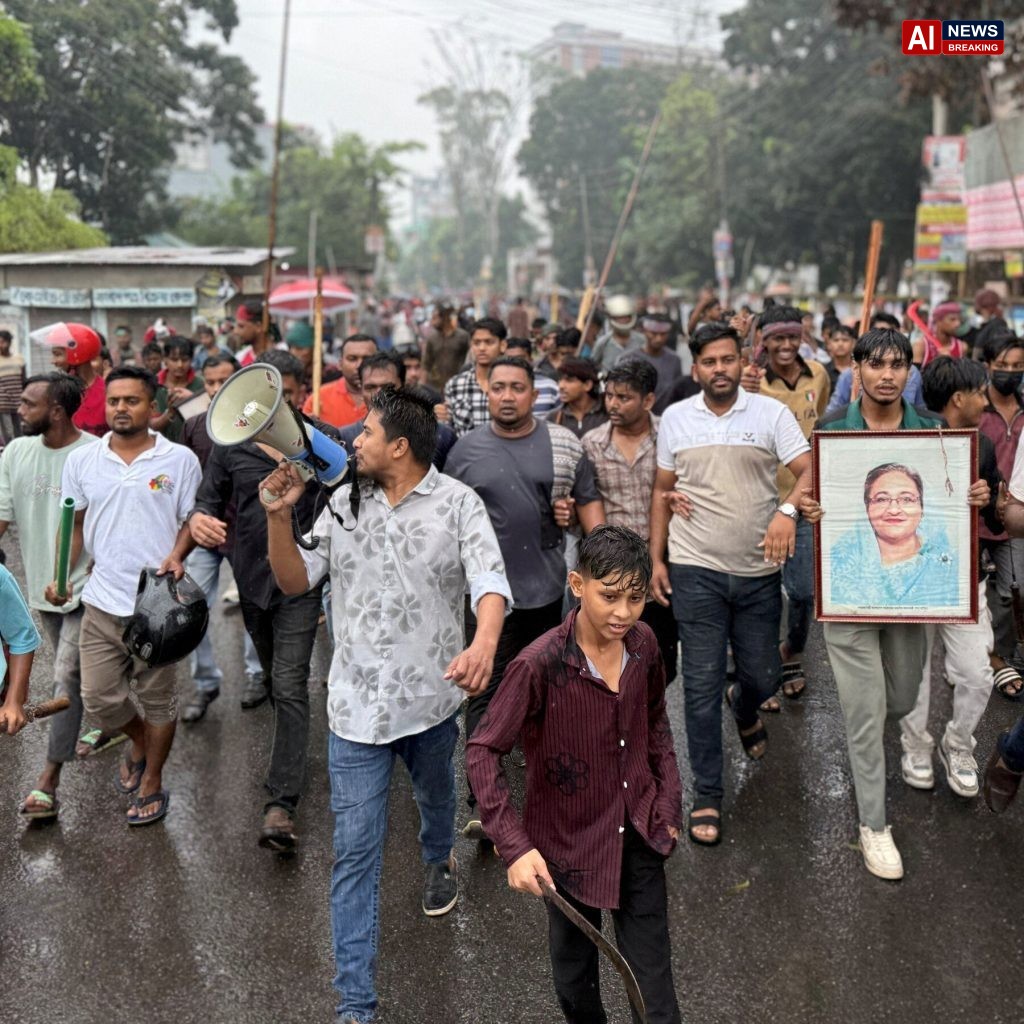
Deadly Protests Erupt in Bangladesh Over Exiled Former Leader. What to Know. - AI News Breaking
deadly protests erupt bangladesh:
The streets of Dhaka have been roiled by a sudden surge of violence as supporters of former prime minister Sheikh Hasina, who was sentenced to death in absentia by a military tribunal last month, launched coordinated attacks on government installations and public infrastructure. The unrest, which began late on Tuesday night, quickly spread to several districts, with stone‑throwing mobs, arson attacks on police outposts and road blockades that disrupted traffic across the capital. Authorities responded with a heavy police and military presence, deploying riot gear, tear‑gas canisters and, in some locations, live ammunition, leading to a growing death toll that officials now estimate at over two dozen civilians and several security personnel.Sheikh Hasira, who led the Bangladesh Nationalist Party (BNP) before being ousted in a disputed election two years ago, fled the country in early 2024 after a series of corruption investigations culminated in her arrest..
International human‑rights groups have repeatedly called for a fair trial, arguing that the charges against her – including alleged embezzlement of state funds and conspiracy to undermine national security – were politically motivated. Nevertheless, the military tribunal that tried her in absentia, convened under emergency powers granted after a series of bombings in 2023, issued a death sentence that has inflamed her supporters and drawn condemnation from several foreign governments.The first flashpoint occurred in the Gulshan area, where a group of BNP loyalists set fire to a police checkpoint and vandalised a nearby government office. Witnesses reported that the attackers, armed with crude weapons and makeshift shields, shouted slogans demanding the release of Hasira and the resignation of Prime Minister Abdul Khan..
Within an hour, police units arrived on the scene, clashing with the protesters. Video footage circulating on social media showed a chaotic melee, with both sides sustaining injuries. By dawn, the police had regained control, but not before a small number of protesters were taken into custody and at least three civilians were pronounced dead at a local clinic.In the northern city of Rajshahi, the unrest took a more organized turn..
A convoy of trucks, bearing the BNP’s emblem, blocked the main highway linking the city to the capital, halting the flow of goods and causing significant economic disruption. The blockade was accompanied by a series of coordinated attacks on telecommunications towers, leading to a temporary loss of mobile and internet services in the region. Government spokespeople described the actions as “a calculated attempt to destabilise the nation’s infrastructure” and warned that further disruptions could trigger a state of emergency.The response from the central government has been swift and uncompromising..
Prime Minister Abdul Khan, speaking from the presidential palace, condemned the violence as “a betrayal of the nation’s democratic aspirations” and announced that a special task force would be formed to investigate the incidents and prosecute those responsible. He also pledged to uphold the rule of law, emphasizing that the death sentence handed to Hasira was a lawful outcome of a transparent judicial process. Critics, however, argue that the tribunal’s procedures lacked the due‑process guarantees required under international law, a point the government has dismissed as “baseless interference in Bangladesh’s sovereign affairs.”International reactions have been mixed..
The United Nations’ Office of the High Commissioner for Human Rights issued a brief statement urging all parties to exercise restraint and to respect the right to peaceful assembly. The United States, while expressing concern over the escalation of violence, reiterated its call for a fair and transparent legal process for Hasira, noting that the death penalty remains a contentious issue under international human‑rights norms. Meanwhile, neighboring India has offered to mediate if both sides agree to dialogue, a proposal that the Bangladesh government has neither accepted nor rejected publicly.Amid the turmoil, ordinary citizens have borne the brunt of the unrest..
Market vendors in Dhaka’s bustling New Market reported a sharp decline in sales as shoppers stayed away, fearing further clashes. Hospital administrators in the capital said they are dealing with a surge of trauma patients, including many young men who were allegedly recruited by the insurgent groups. Human‑rights observers have warned that the government’s use of live ammunition could constitute excessive force, a claim that officials have countered by pointing to the “imminent threat” posed by armed militants.Political analysts suggest that the current crisis could have far‑reaching implications for Bangladesh’s fragile democratic institutions..
Since the 2022 constitutional amendment that expanded executive powers, the balance between civilian oversight and military influence has shifted, raising concerns about the potential for authoritarian consolidation. The insurgency, though limited in scale, demonstrates the depth of polarization within the country, with the BNP’s base feeling increasingly marginalized and resorting to violent protest as a last resort.Economists note that the unrest comes at a precarious moment for Bangladesh’s economy, which has been riding a wave of growth driven by garment exports and remittances. The temporary shutdown of transport routes and the damage to infrastructure could delay key development projects, while investor confidence may waver amid heightened security concerns..
The World Bank has warned that prolonged instability could erode the gains made in poverty reduction over the past decade, urging the government to pursue a political solution that restores calm without sacrificing accountability.In the days ahead, the trajectory of the crisis will likely hinge on whether dialogue can be opened between the government and opposition factions. Some senior BNP figures, currently operating from exile, have signalled a willingness to negotiate if the death sentence is commuted and political prisoners are released. The government, on its part, maintains that any concession would be perceived as weakness, potentially emboldening other dissenting groups..
As the nation watches, the balance between security measures and respect for civil liberties remains a contentious and unresolved dilemma.The situation continues to evolve, with nightly reports of sporadic clashes and a mounting humanitarian toll. While the immediate focus for authorities is to restore order, the underlying political grievances that have fueled the insurgency are unlikely to dissipate without a concerted effort to address demands for justice, transparency and inclusive governance. In a country that has long prided itself on democratic resilience, the coming weeks will test the capacity of Bangladesh’s institutions to manage conflict, uphold the rule of law and maintain the fragile peace that underpins its economic and social progress..
Updated: November 22, 2026
Bangladesh’s flashpoint shows how a death sentence handed down under emergency powers can convert political marginalisation into lethal street warfare, threatening the fragile democratic bargain that has underpinned its economic boom.
If the government continues to equate dissent with insurgency, the ensuing security‑driven clampdown may erode






