The Supreme Court will decide whether assault weapons bans violate the Second Amendment
 A Critic of Beijing Falls Short in Taiwan’s Key Mayoral Election
 EPA says no rise in contamination after Army detonates lead azide stockpile in Iowa
 Israeli Strike Kills 2 Workers at Gaza Clinic, Doctors Without Borders Says
 McQueen Pre-Fall 2027
ESA and JAXA launch probes
**
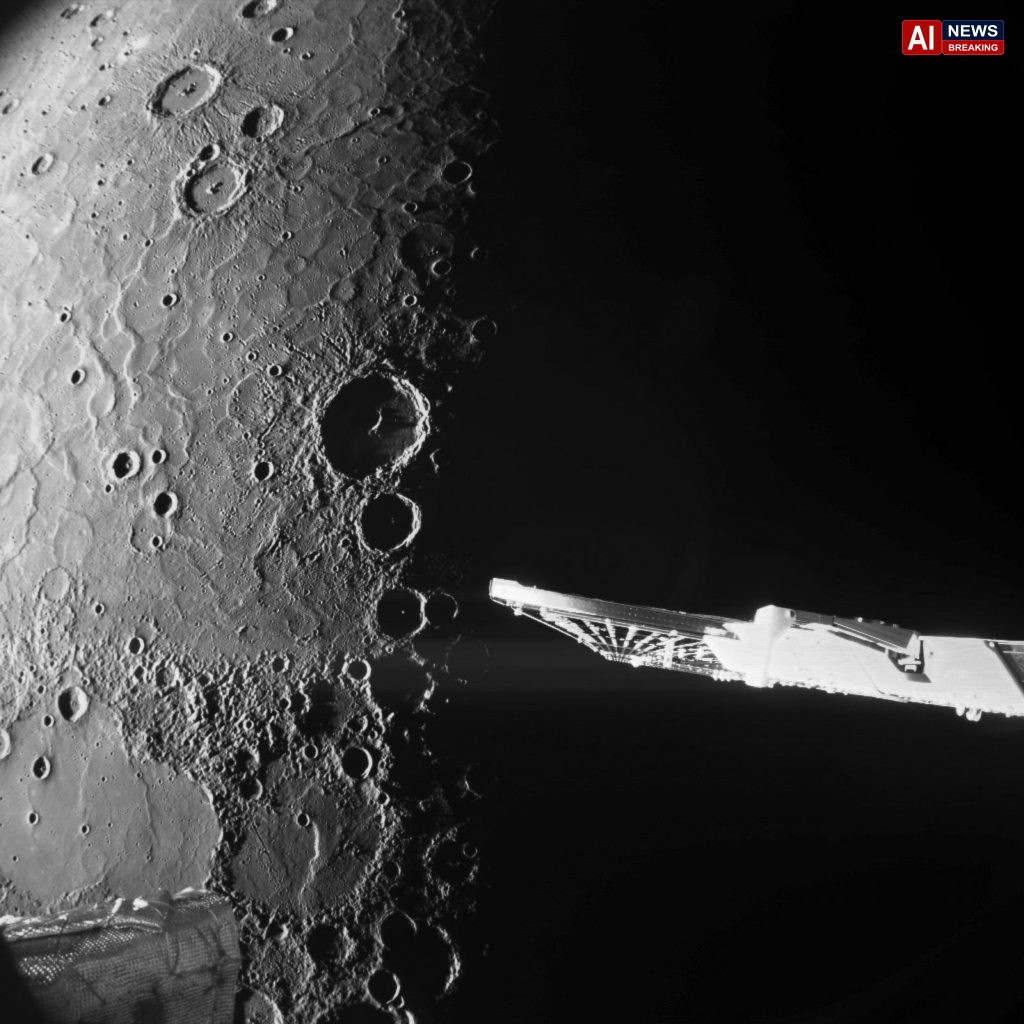
ESA and JAXA launch probes - AI News Breaking
A pair of spacecraft have finally reached Mercury after an eight‑year journey through the inner solar system, marking the first human‑made objects to enter orbit around the planet in more than a decade. The joint mission, a collaboration between the European Space Agency (ESA) and the Japan Aerospace Exploration Agency (JAXA), consists of the ESA’s BepiColombo Mercury Planetary Orbiter (MPO) and JAXA’s Mercury Magnetospheric Orbiter (MMO), also known as Mio. Both probes completed a series of complex gravitational assists, using Earth, Venus and Mercury itself to shed speed and settle into stable orbits around the Sun‑squeezed world.The orbit insertion manoeuvre, carried out on 5 October, required a precisely timed burn of the MPO’s main thrusters, lasting just over four minutes..
The burn reduced the spacecraft’s velocity by roughly 1.7 km s‑¹, allowing it to be captured by Mercury’s weak gravitational field. A second, smaller burn by the MMO followed a few hours later, placing the Japanese probe into a highly elliptical orbit that will be gradually circularised over the coming months. Engineers monitored the events from control centres in Darmstadt, Germany, and Tsukuba, Japan, confirming that all systems performed within expected parameters.BepiColombo’s primary scientific payload includes a suite of instruments designed to map Mercury’s surface composition, study its tenuous exosphere and probe its interior structure..
Among these, the Mercury Imaging X‑ray Spectrometer (MIXS) will soon begin scanning the planet’s crust for clues about its formation, while the Mercury Laser Altimeter (MLA) will generate high‑resolution topographic maps. The mission’s overarching goal is to test theories about why Mercury has such a large metallic core, comprising about 70 percent of its mass, and to investigate the planet’s magnetic field, which is surprisingly strong for a body of its size.The MMO, on the other hand, focuses on Mercury’s magnetosphere and its interaction with the solar wind. Equipped with magnetometers, particle detectors and plasma analyzers, Mio will measure the dynamics of the planet’s magnetic environment, which is compressed to within a few hundred kilometres of the surface by the Sun’s intense radiation..
These observations are expected to improve understanding of space weather processes that affect not only Mercury but also Earth and other planetary bodies to solar activity.Both spacecraft were launched together on 20 October 2018 aboard an Ariane 5 rocket from the Guiana Space Centre. Their eight‑year cruise was one of the most fuel‑efficient trajectories ever undertaken, making use of a series of resonant fly‑bys that slingshotted the probes closer to the Sun while conserving propellant. The journey included three Earth fly‑bys, two Venus encounters and a Mercury gravity‑assist in 2020 that set the stage for the final insertion..
The intricate navigation required constant updates to flight software and careful coordination between ESA and JAXA teams, who shared telemetry and orbital data in near real time.The arrival of BepiColombo and Mio comes at a time when interest in Mercury has been rekindled by recent findings from NASA’s MESSENGER mission, which ended in 2015 after a seven‑year orbital campaign. MESSENGER revealed that Mercury’s surface is peppered with hollows—shallow, bright depressions thought to result from volatile loss—and that its magnetic field is offset from the planet’s centre. However, many questions remain unanswered, particularly regarding the planet’s thermal evolution and the processes that led to its disproportionate iron core..
BepiColombo’s extended mission, planned to last at least one Mercurian year (88 Earth days), is expected to fill these gaps.Scientific teams worldwide are already preparing for the first data releases. Early results from MIXS and the Spectrometer for Planetary Exploration (SPE) are slated for publication later this year, with a focus on elemental abundances of magnesium, silicon and iron across Mercury’s northern hemisphere. Meanwhile, the MMO’s magnetometer data will be cross‑referenced with solar wind measurements from NASA’s Parker Solar Probe, which is currently making close passes to the Sun..
This collaborative approach aims to construct a comprehensive picture of how the planet’s magnetic shield responds to extreme solar conditions.The mission also carries a symbolic significance for international cooperation in space exploration. ESA and JAXA have jointly funded the development of the MPO and MMO, sharing expertise in propulsion, thermal protection and scientific instrumentation. The partnership reflects a broader trend of pooling resources to tackle complex, high‑cost planetary missions, especially as budgets tighten and the scientific community seeks to maximise return on investment..
The successful orbit insertion is being hailed by officials as a testament to the resilience and ingenuity of the teams involved.Public outreach programmes are being coordinated alongside the scientific work. ESA’s “Visit Mercury” initiative will provide educational materials, virtual reality tours of the planet’s surface and live streams of the spacecraft’s telemetry for schools across Europe. In Japan, JAXA is launching a series of interactive webinars featuring mission scientists, aiming to inspire the next generation of engineers and astronomers..
Both agencies hope that the excitement generated by the mission will translate into sustained public interest in planetary science.Looking ahead, the next phase of the mission will involve a series of orbital adjustments to bring the two spacecraft into complementary trajectories that enable simultaneous observations of Mercury’s surface and magnetosphere. This coordinated approach is expected to yield unprecedented insights into how the planet’s internal dynamo drives its magnetic field and how that field, in turn, shapes the exosphere and surface weathering processes. Over the coming years, the data returned by BepiColombo and Mio will be archived in public repositories, ensuring that researchers worldwide can continue to explore Mercury’s mysteries long after the primary mission concludes.The successful arrival of humanity’s newest ambassadors at Mercury underscores the growing capability of modern space agencies to conduct long‑duration, deep‑space missions with precision and reliability..
As the probes settle into their orbits and begin their scientific campaigns, the planet that has long eluded comprehensive study is finally set to reveal its s, offering fresh clues about planetary formation, solar‑planet interactions and the dynamic processes that continue to shape our solar system..
Updated: November 22, 2026
Summary: ESA and JAXA’s twin probes have entered Mercury’s orbit after an eight‑year, multi‑flyby cruise, positioning the BepiColombo and Mio spacecraft to begin detailed mapping of the planet’s surface and magnetic environment. The partnership aims to unravel Mercury’s oversized iron core, volatile‑rich hollows and magnetospheric dynamics, building on MESSENGER’s legacy and coordinating with NASA’s Parker Solar Probe.
BepiColombo’s arrival hints that Mercury’s iron‑rich heart may be a relic of chaotic early collisions rather than a quiet, slow‑cooling world, forcing us to rethink how planetary cores can form under extreme solar glare.
The joint ESA‑JAXA effort also