Pakistan’s leaders hail first astronaut aboard Chinese craft: ‘Proud one of us has gone into space’
 British tourist travels 29 hours from Mumbai to Amritsar for ₹5,461, rates Indian Railways 10/10 | Viral video
 The Supreme Court will decide whether assault weapons bans violate the Second Amendment
 A Critic of Beijing Falls Short in Taiwan’s Key Mayoral Election
 EPA says no rise in contamination after Army detonates lead azide stockpile in Iowa
Ethanol plant trainee charged in connection with bomb at Illinois facility
**
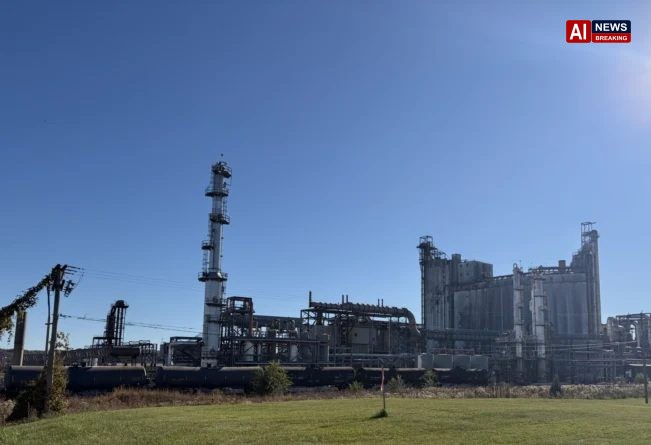
A federal grand jury in Illinois on Tuesday returned two felony counts against a 22‑year‑old trainee at the Peoria‑area Greenfield Ethanol Company after investigators linked him to an explosive device that was discovered in a storage building at the plant last month. The indictment, unsealed in the U.S. District Court for the Central District of Illinois, charges the man – identified only as Michael J..
Thompson – with illegal possession of an explosive and conspiracy to damage a federal facility. If convicted, the charges carry a maximum sentence of 15 years in federal prison. The case has reignited concerns over security at industrial sites that handle large volumes of flammable materials and has prompted a review of safety protocols across the state’s bio‑fuel sector.The incident that sparked the investigation occurred on 14 April, when a routine safety inspection at the Greenfield plant revealed a suspicious package hidden behind a stack of empty drums in a secondary storage area..
Plant personnel, following standard protocol, cordoned off the area and called the Peoria County Sheriff’s Office, which in turn summoned a bomb squad from the Illinois State Police. The device, described by investigators as a pipe‑bomb style improvised explosive, contained a modest amount of high‑explosive material and a timing mechanism that had been set to detonate in the early hours of the following morning. The bomb squad safely rendered the device inert, and the plant was evacuated as a precaution while the scene was examined.The evacuation, which lasted roughly six hours, affected more than 300 workers, many of whom were transported to a nearby high school that served as an emergency shelter..
No injuries were reported, and the plant resumed limited operations later that afternoon after thorough clearance by fire and hazardous‑materials teams. The swift response was praised by local officials, with Peoria Mayor Jim Ardis noting that “the coordinated effort between the plant, emergency services and law enforcement prevented what could have been a tragic outcome.”Federal agents from the Bureau of Alcohol, Tobacco, Firearms and Explosives (ATF) and the Federal Bureau of Investigation (FBI) were called to the site shortly after the bomb was neutralised. Over the ensuing weeks, detectives combed through surveillance footage, interviewed plant staff and examined the bomb’s components for forensic clues..
A key breakthrough came when a distinctive serial number on a circuit board within the device was cross‑referenced with a database of purchases made by local hobbyist electronics suppliers. The trail led investigators to a recent transaction recorded under Thompson’s name, who had been employed at the plant for just three months as a trainee in the maintenance division.According to the indictment, Thompson allegedly acquired the bomb‑making materials using a combination of cash purchases and online orders, attempting to conceal the intended use by listing the items as “model kits” and “electronic hobby supplies.” Prosecutors allege that he assembled the device in a vacant office space adjacent to the main production line, where he had access to both the tools needed for construction and the chemicals stored at the plant. The timing device, a digital alarm clock modified to trigger a blasting cap, was reportedly set to detonate at 0200 hours, a period when the facility would have been largely empty but when the plant’s ventilation system would have been operating at full capacity, potentially amplifying the blast.Plant management has expressed shock at the allegations, stating that the company had no prior knowledge of Thompson’s activities and that all employees undergo background checks and safety training..
In a statement released on Wednesday, Greenfield Ethanol’s spokesperson, Laura Mitchell, said, “We are fully cooperating with federal authorities and remain committed to the safety of our workforce and the surrounding community. The actions of one individual do not reflect the values or the rigorous safety culture we uphold.” Mitchell added that the company had already initiated an internal audit of its security measures, including stricter controls on access to sensitive areas and a review of the inventory of explosive‑precursor chemicals.The case has also drawn attention from lawmakers who have long advocated for tighter regulation of industrial sites handling volatile substances. Illinois State Senator Dale R..
DeVon, who chairs the Senate’s Energy and Public Utilities Committee, urged the Department of Commerce and Economic Opportunity to conduct a statewide assessment of security protocols at bio‑fuel facilities. “While this incident was thankfully averted, it underscores a vulnerability that could be exploited elsewhere,” DeVon said in a press briefing. He called for legislation that would require mandatory background checks for all personnel with access to high‑risk zones and for periodic, unannounced inspections by federal safety agencies.Security experts note that the growing popularity of ethanol as a renewable fuel has led to an expansion of processing plants across the Midwest, many of which are situated near residential communities..
Elena Martinez, a professor of industrial safety at the University of Illinois at Urbana‑Champaign, explained that the combination of large quantities of combustible feedstock, such as corn‑based mash, and the presence of storage tanks for volatile solvents creates a “high‑hazard environment” where even a small explosive device could cause catastrophic damage. “Facilities must adopt a layered security approach,” Martinez said. “This includes physical barriers, rigorous personnel screening, real‑time monitoring of chemical inventories and robust emergency response training for all staff.” She added that the incident at Greenfield could serve as a catalyst for broader industry reforms.In the legal arena, Thompson’s defense team, led by federal criminal attorney James L..
Whitaker, has filed a motion to dismiss the charges on the grounds that the evidence linking him to the bomb is circumstantial. Whitaker argues that the serial number on the circuit board could have been purchased by anyone and that there is no direct forensic evidence, such as fingerprints or DNA, tying Thompson to the device. The defense also contends that the indictment fails to prove intent to damage a federal facility, noting that the plant, while subject to federal environmental regulations, is privately owned..
Prosecutors, however, have indicated they possess additional surveillance footage showing Thompson entering the storage area on the night of the suspected assembly and a series of text messages in which he referenced “the project” and “timing it right.” The courtroom battle is expected to commence later this year, with both sides preparing extensive expert testimony.Meanwhile, the community around the plant has expressed a mixture of relief and lingering anxiety. Residents of the neighboring Northside district, many of whom work at the facility, gathered at a town‑hall meeting on Thursday to hear updates from local officials and plant representatives. While most attendees praised the rapid evacuation and praised first responders, several voiced concerns about the psychological impact of the threat and the need for ongoing communication about safety measures..
“We trust that the plant is safe, but we also need to know.
Updated: November 17, 2026
The indictment underscores a chilling gap between routine safety protocols and insider threats, revealing how quickly a well‑trained trainee can weaponize industrial chemicals. It signals to regulators that merely checking backgrounds isn’t enough—real‑time surveillance and strict access control must become the norm for bio‑fuel plants.