Pakistan’s leaders hail first astronaut aboard Chinese craft: ‘Proud one of us has gone into space’
 British tourist travels 29 hours from Mumbai to Amritsar for ₹5,461, rates Indian Railways 10/10 | Viral video
 The Supreme Court will decide whether assault weapons bans violate the Second Amendment
 A Critic of Beijing Falls Short in Taiwan’s Key Mayoral Election
 EPA says no rise in contamination after Army detonates lead azide stockpile in Iowa
Four men found guilty of assaulting Joanne Young in Manchester.
**
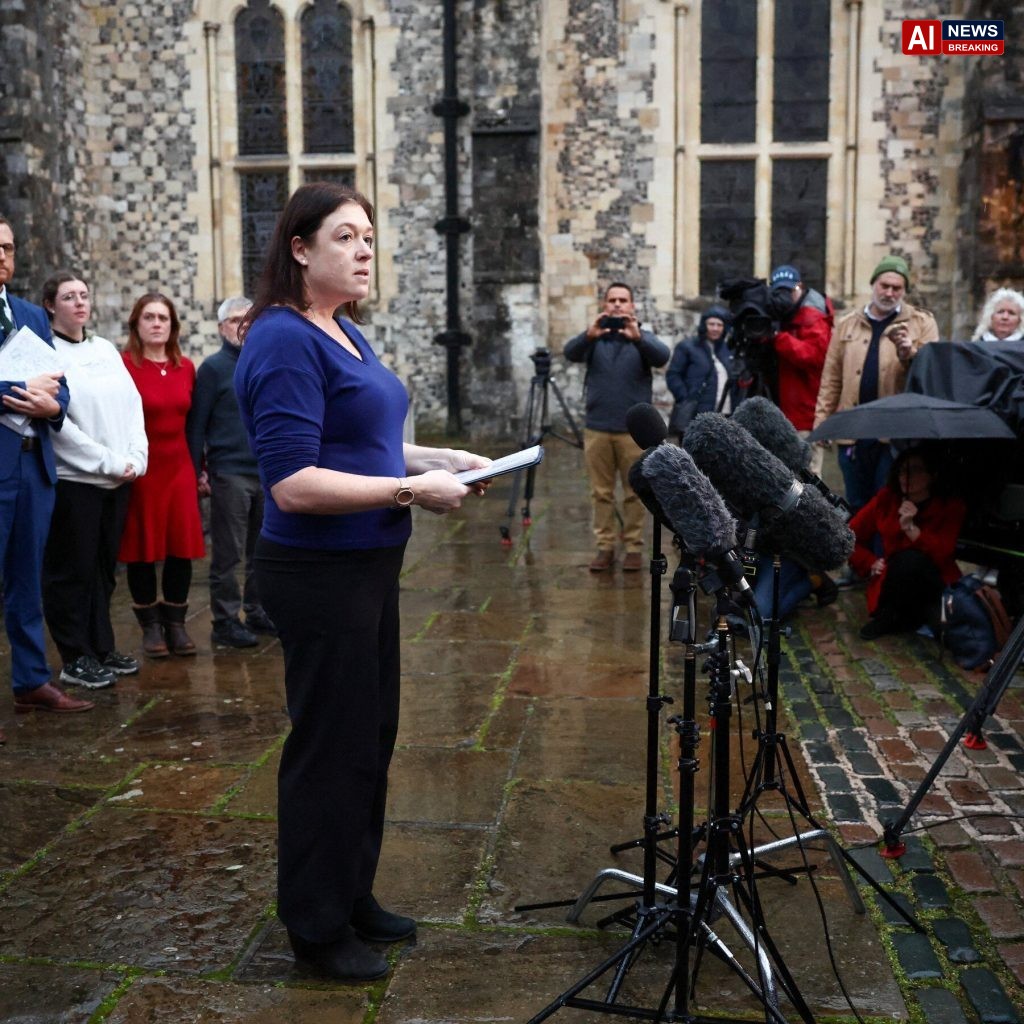
4 British Men Convicted of Sexually Assaulting Joanne Young - AI News Breaking
four found guilty assaulting:
A jury at Manchester Crown Court has found four British men guilty of sexually assaulting Joanne Young, a 28‑year‑old mother of two, after a trial that lasted three weeks. The verdict, delivered on Tuesday, concluded that the defendants could not rely on the claim that they had been given permission by Young’s husband, who had previously pleaded guilty to a separate rape charge involving his wife. The court heard that the men, all in their thirties, had repeatedly entered Young’s home under the pretext of delivering parcels, only to take advantage of her when she was alone.The prosecution’s case was built on a combination of forensic evidence, CCTV footage and the testimony of several witnesses who placed the men at the scene on multiple occasions..
DNA samples recovered from Young’s clothing matched those of three of the accused, while the fourth was linked through fingerprints found on a kitchen drawer where the assaults were alleged to have taken place. The Crown’s argument stressed that the assaults occurred over a period of six months, beginning in early 2023 and continuing until the summer of 2024, highlighting a pattern of predatory behaviour rather than an isolated incident.Defence counsel had argued that the men acted on the explicit assurance of consent given by Young’s husband, Michael Young, who had earlier admitted to raping his wife after a night of heavy drinking. The defence suggested that the men believed they were acting with the husband’s tacit approval, citing text messages in which the husband allegedly told a friend that “she’s okay with us helping out” when asked about the men’s presence in the house..
The jury, however, rejected this line of reasoning, finding the alleged consent to be both unsubstantiated and irrelevant to the charges of sexual assault.Judge Eleanor Thompson, who presided over the trial, instructed the jury that consent must be clear, informed and freely given, and that any assumption of permission based on a third party’s statements could not replace the victim’s own agency. In her summing‑up, she noted that the law does not permit a person to act on a belief that another individual has consented on their behalf, especially when the alleged consent is not communicated directly to the victim. “The autonomy of the victim is paramount,” she said, “and it is the prosecution’s burden to prove beyond reasonable doubt that consent was absent.”During the sentencing hearing, which took place later on the same day, each of the convicted men received custodial terms ranging from eight to twelve years, reflecting the severity of the offences and the impact on the victim’s life..
The court also ordered the defendants to pay compensation to Young, though the exact figure was not disclosed pending a further hearing. In addition, the men were placed on the Sex Offenders Register for life, with the requirement to notify the police of any change of address.Joanne Young, who appeared in court via video link due to ongoing medical treatment, gave a brief statement through her legal representative, expressing relief that “the truth finally came out” and that “the system worked.” Her husband, Michael Young, who is serving a fifteen‑year sentence for the rape charge, was not present at the sentencing but released a statement through his solicitor, apologising to his wife and acknowledging his own role in the chain of events that enabled the assaults.Legal experts have highlighted the case as a significant illustration of how the courts are increasingly unwilling to accept “implied consent” arguments in sexual assault trials. Professor Laura Whitaker of the University of Leeds, who specialises in criminal law, said the verdict sent a clear message to potential offenders: “The judiciary is drawing firm boundaries around what constitutes consent, and the notion that a partner’s word can substitute for a victim’s own consent is being dismantled.” She added that the case could set a precedent for future prosecutions where the defence attempts to shift responsibility onto another party.The trial also prompted a wider discussion about the safeguarding measures in place for vulnerable individuals who may be isolated or dependent on family members for support..
Advocacy groups such as Women’s Aid have called for better community awareness programmes and more robust reporting mechanisms for suspected abuse. In a press release, the charity urged local authorities to allocate additional resources to training police officers and social workers in recognising the signs of coerced sexual activity, especially in households where domestic abuse is already present.In response to the convictions, the Home Office issued a statement affirming its commitment to strengthening legislation around sexual offences. The department highlighted recent amendments to the Sexual Offences Act that broaden the definition of consent and increase penalties for repeat offenders..
A spokesperson noted that the government is also reviewing the effectiveness of existing support services for survivors, aiming to ensure that victims receive timely medical, psychological and legal assistance without unnecessary bureaucratic hurdles.The case has reignited public debate about the intersection of domestic violence and sexual assault, underscoring how perpetrators can exploit the dynamics of an abusive relationship to further harm their victims. While the convictions provide a measure of justice for Joanne Young, advocates stress that prevention must remain a priority. “We need to dismantle the culture of silence that often surrounds these crimes,” said Sarah Mitchell, director of the charity Survivors United..
“Only through education, robust legal frameworks and a supportive community can we hope to protect those most at risk.”Overall, the Manchester Crown Court’s decision reflects a broader trend within the British criminal justice system to hold perpetrators accountable, even when they attempt to deflect responsibility onto others. As the convicted men begin their sentences, the case stands as a stark reminder that consent cannot be presumed, and that the law will continue to evolve to safeguard the rights and dignity of all individuals..
Updated: November 20, 2026
Summary: Four men were convicted at Manchester Crown Court for repeatedly assaulting Joanne Young after a three‑week trial, with the jury rejecting the defence’s claim that the husband’s alleged consent justified the attacks. Sentences of eight to twelve years and lifelong registration as sex offenders underscore the court’s firm stance that consent must be explicit and cannot be inferred from a third party.
The verdict underscores a judicial shift: consent is no longer a negotiable gray‑area that can be outsourced to a partner’s “approval,” but a non‑negotiable, victim‑centered standard. This hardening stance may deter collusive abuse cycles, yet it also signals the urgent need