
 Pakistan’s leaders hail first astronaut aboard Chinese craft: ‘Proud one of us has gone into space’
 British tourist travels 29 hours from Mumbai to Amritsar for ₹5,461, rates Indian Railways 10/10 | Viral video
 The Supreme Court will decide whether assault weapons bans violate the Second Amendment
 A Critic of Beijing Falls Short in Taiwan’s Key Mayoral Election
 EPA says no rise in contamination after Army detonates lead azide stockpile in Iowa
From acid attacks to pellet wounds: Delhi-NCR dogs fight back for a second chance at life
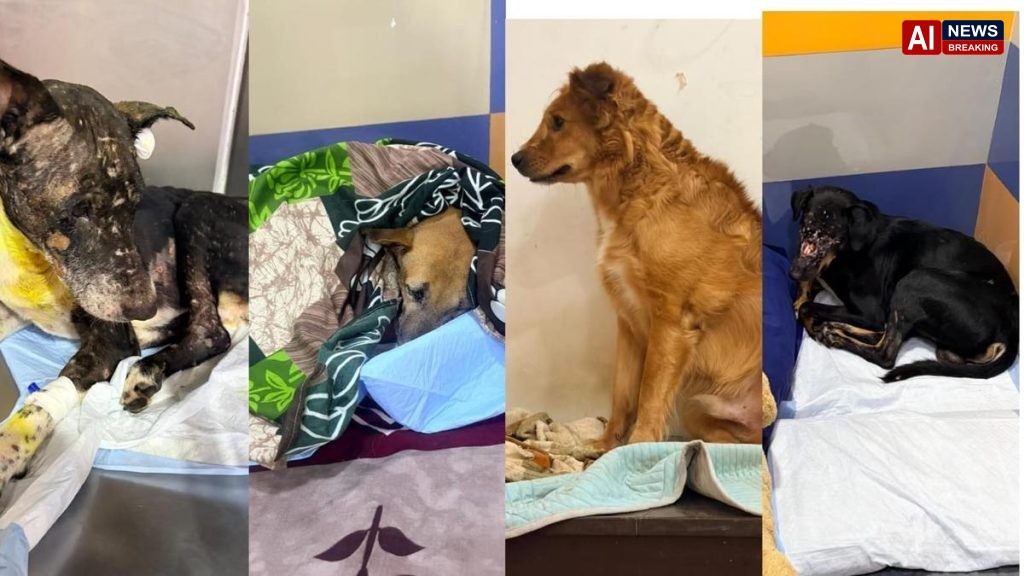
From acid attacks to pellet wounds: Delhi-NCR dogs fight back for a second chance at life - AI News Breaking
acid attacks pellet wounds:
In the sprawling outskirts of Delhi’s National Capital Region, four dogs have survived violence that many would have thought too severe to overcome. Two of them were struck by acid in an attack that left their faces charred and their mouths swollen, while the other two suffered deep wounds from rubber pellets fired at stray dogs during a government crackdown. Their survival, and the way they are now being cared for, has drawn attention to the gaps in law enforcement and the urgent need for stronger protections for animals that are often invisible to the public eye.The first of the dogs, a mixed-breed terrier named Rocky, was found half a kilometre from the village of Dehradun after his owner had been murdered in a revenge crime..
He lay in a shallow grave, his ears folded against his face, his eyes closed. A local veterinarian from the NGO Compassion for Animals, Dr. Anita Sharma, found him and took him to the organisation’s mobile clinic..
“I didn’t even think he would survive the burn,” she said. We had to act fast to stop infection and provide pain relief.” Rocky’s face was covered in thick, leathery scars, and he suffered from severe oral trauma that made eating difficult. With time, meticulous suturing, antibiotics and the use of a feeding tube, Rocky’s mouth began to heal.The second victim, a lanky greyhound named Luna, was found in the parking lot of a police station in Ghaziabad, her muzzle gouged by a blow of acid that had been thrown by an unknown assailant..
The police station, which prides itself on its anti-crime initiatives, had no evidence that the acid had come from a nearby chemical shop or that anyone had been caught. “It was an open crime,” said the deputy superintendent of police, Arjun Gupta. “We have no leads, and no one has come forward..
The dog’s owner, a single mother, has not yet been able to find a way forward.” Dr. Sharma’s team rescued Luna and carried out a series of treatments. The dog’s face was stitched and given a special ointment to help the skin regenerate..
A month after the incident, Luna was walking on all fours again, her confidence slowly returning.The third and fourth dogs, a pair of black Labrador Retrievers named Max and Milo, were shot at with rubber pellets by a group of law enforcement officers who were trying to curb the stray population in the suburbs of Noida. The dogs were part of a community petting event, where children were laughing and playing. As the police attempted to disperse the crowd, the dogs were accidentally struck by the rubber pellets fired from a short distance, causing deep lacerations in their necks and shoulders..
Max and Milo were found by volunteers from the Delhi Animal Welfare Society, who took them to a veterinary hospital. “The injuries were severe, but there were no signs of internal bleeding,” said Dr. Vikram Patel, the hospital’s head veterinarian..
“They required several surgeries and a long recovery period. Their wounds were cleaned, stitches removed and their bones were stabilized with plates and screws.”While the four dogs are now receiving ongoing care and support from a network of NGOs, their cases illustrate the deficiencies in the current system of police investigations into animal cruelty. In each incident, the authorities have either failed to secure evidence, failed to investigate thoroughly or failed to bring the perpetrators to justice..
The Delhi Police’s Animal Welfare Bureau has stated that it receives an average of 150 reports of animal cruelty each month, yet less than 10 percent result in a conviction. The bureau cites a lack of specialised training, limited forensic capabilities and a heavy reliance on community reports as the main obstacles. The three dog cases are no exception..
“We have no suspects, no CCTV footage, and no witnesses who have come forward,” Dr. “When you are dealing with a crime that is not a direct threat to human safety, it is easy for the system to overlook it.”The plight of Rocky, Luna, Max and Milo has also prompted a conversation about the lack of clear legal frameworks for animal cruelty. The Prevention of Cruelty to Animals Act of 1960 is often criticised for its vague wording and the fact that it does not define specific punishments for acts such as acid attacks..
“The law says the animal must be protected, but it does not give the police a clear mandate to investigate cruelty or to prosecute the perpetrators,” explained Dr. She has called for amendments that would make cruelty a separate offence with specified penalties, and for a special unit within the police force trained to handle animal-related crimes.In addition to the legal gaps, there are practical challenges in ensuring the welfare of animals that survive violent attacks. The four dogs have all been placed under the care of volunteers who run the “Paws for Life” program, which provides medical treatment, rehabilitation and eventual adoption..
The programme’s founder, Meera Patel, explained how the dogs have become a symbol of resilience. “They are not just patients; they are ambassadors,” she said. “Their stories help people understand that animals, too, suffer and need support.”The rehabilitation process for the dogs involves not only medical treatment but also behavioural conditioning..
Rocky, for example, was initially terrified of human contact, a reaction that can be expected after such a traumatic experience. “We use positive reinforcement and small, consistent interactions,” said Dr. “We have seen him slowly regain trust, and now he is even helping other animals in the clinic.” Luna, meanwhile, has shown remarkable improvement in her ability to chew and swallow..
“She was once unable to eat solid food, but now she enjoys her meals without pain,” Dr. Max and Milo have been engaged in physical therapy to restore full range of motion to their limbs, and they have shown an improvement in their gait and posture.The broader impact of these stories is felt throughout the Delhi-NCR region, where stray dogs are often considered a nuisance rather than a living being. The region’s policy on stray animals has historically focused on culling and sterilisation, but these four cases have prompted NGOs and animal lovers alike to push for a more humane approach..
In Delhi’s New Delhi district, the Municipal Corporation has launched a “Cuddle, Not Kill” campaign that encourages citizens to feed and adopt stray dogs instead of reporting them for culling. “We want to shift the narrative from fear to compassion,” said a spokesperson for the campaign.The response from the community has been encouraging. In the months following the rescue of Rocky, Luna, Max and Milo, a local high school organised a fundraiser that raised enough money for the dogs’ ongoing treatment..
Students who were initially sceptical about the relevance of animal welfare.
Updated: November 21, 2026
Four dogs in Delhi’s NCR survived brutal acid and rubber‑pellet attacks, sparking a debate over police indifference and weak animal‑cruelty law. Their recovery, led by NGOs, highlights gaps in enforcement and urges legal reforms to protect vulnerable animals.
Insight: These brutal attacks expose how animal cruelty slips through a legal blind spot, turning dogs into silent victims while the system treats their suffering as peripheral to human safety. The public outcry around Rocky, Luna, Max and Milo may finally force a shift from punitive stray‑control to a rights‑based framework that






