
 Pakistan’s leaders hail first astronaut aboard Chinese craft: ‘Proud one of us has gone into space’
 British tourist travels 29 hours from Mumbai to Amritsar for ₹5,461, rates Indian Railways 10/10 | Viral video
 The Supreme Court will decide whether assault weapons bans violate the Second Amendment
 A Critic of Beijing Falls Short in Taiwan’s Key Mayoral Election
 EPA says no rise in contamination after Army detonates lead azide stockpile in Iowa
Howard Lutnick Took Softer Line on Nvidia as Calls for Tougher Controls Grew
**
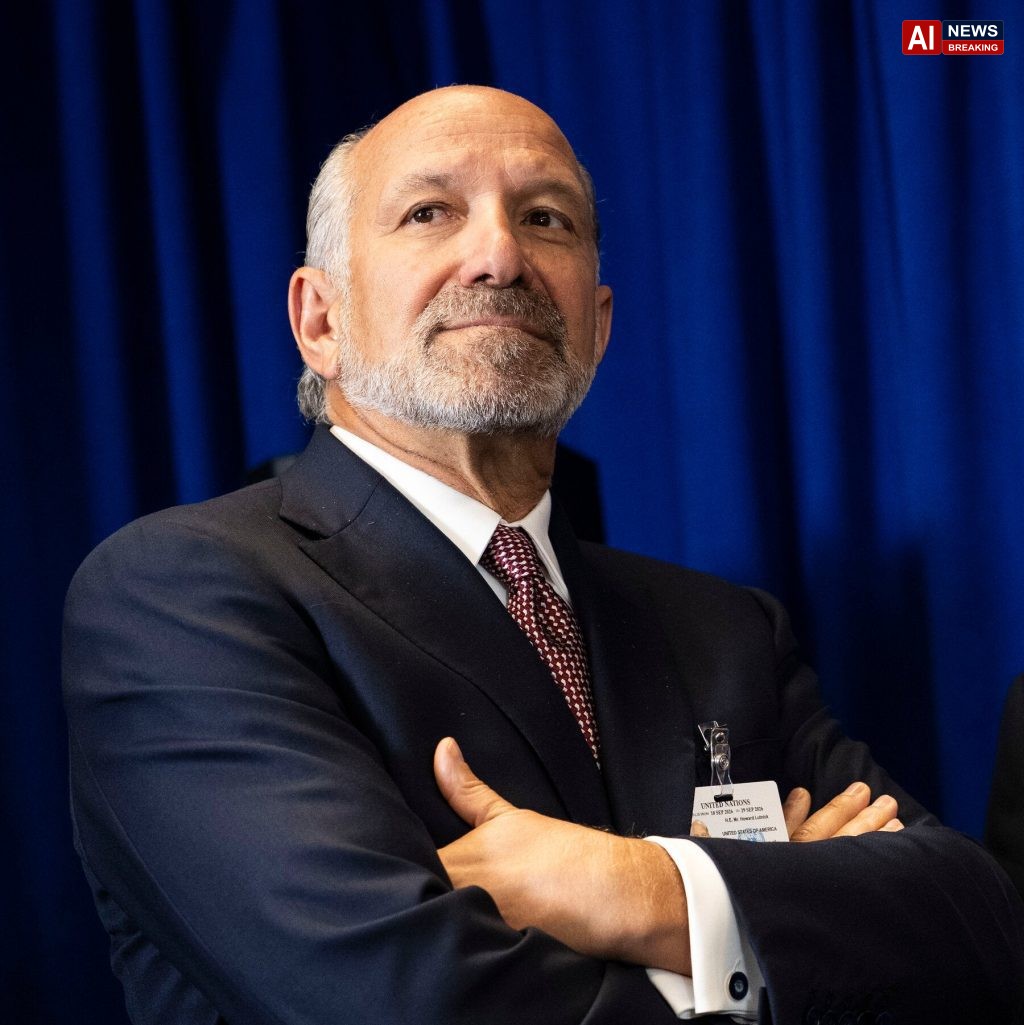
Howard Lutnick, the United Kingdom’s ary of State for Commerce, has faced mounting criticism over what many observers describe as a lenient regulatory approach toward Nvidia, the American semiconductor giant whose graphics processing units have become the backbone of artificial‑intelligence development. The debate intensified this week after a report from the European Trade Observatory highlighted a surge in Nvidia’s sales of high‑performance AI chips to a number of firms operating in jurisdictions with less stringent export controls, including the controversial Chinese startup Megaspeed Technologies. Critics argue that the Department for Commerce, under Lutnick’s leadership, has failed to apply sufficient scrutiny to these transactions, potentially enabling the rapid militarisation of AI capabilities abroad.The issue first entered the public domain when a whistleblower within the Department’s Export Controls Division submitted an internal memo to the Parliamentary Ethics Committee in early September..
The memo detailed a series of high‑value licences granted to Nvidia for the export of its A100 and H100 chips to Megaspeed, a company that, despite its claim of focusing on cloud‑based AI services, has been linked to a network of defence contractors in several Asian nations. The memo alleged that senior officials, including Lutnick’s chief of staff, had overridden standard risk‑assessment protocols, arguing that a “softer line” would preserve commercial ties and safeguard the UK’s position in the global AI supply chain.In response, the Department for Commerce released a statement on Tuesday asserting that all licences were issued in accordance with existing legislation and that the agency had conducted “rigorous due‑diligence checks” before granting approvals. The statement added that Nvidia’s technology “plays a vital role in the UK’s digital economy” and that “over‑regulation could stifle innovation and undermine the competitiveness of British businesses that rely on cutting‑edge AI hardware.” The department also highlighted a recent partnership with Nvidia on a national AI research hub, positioning the collaboration as a strategic asset for the country’s long‑term technological ambitions.Industry analysts, however, have expressed concern that the department’s emphasis on commercial interests may be blurring the line between economic policy and national security..
Dr Amelia Chen, a senior fellow at the Institute for Strategic Technology Studies, warned that “the rapid diffusion of advanced AI chips into markets with ambiguous end‑use controls raises the spectre of an arms race in autonomous weaponry.” She cited a recent United Nations report that identified AI‑enabled drones and autonomous naval systems as emerging threats, many of which rely on the same hardware that Nvidia produces. “If we do not tighten export controls now, we risk a future where our own technology is turned against us,” Chen said.The parliamentary debate that followed the whistleblower’s revelations was marked by sharp partisan divisions. Opposition MPs from the Labour and Green parties called for an immediate suspension of all Nvidia licences pending a comprehensive review, arguing that the government had “prioritised corporate profits over the safety of citizens.” They demanded that the Department for Commerce submit a detailed audit of all AI‑related export licences granted in the past twelve months..
In contrast, the ruling party’s spokesperson for commerce defended Lutnick’s approach, stating that “the UK cannot afford to fall behind in the AI race, and our policy reflects a balanced assessment of risk and reward.”Nvidia’s own response to the controversy has been measured. In a press briefing held in London on Friday, the company’s European vice‑president, Elena Rojas, reiterated that Nvidia complies with all export regulations in every jurisdiction it operates. “We work closely with government authorities to ensure that our products are used responsibly,” Rojas said..
She also pointed out that Nvidia has launched an internal “Responsible Use Initiative” that includes a set of guidelines for customers regarding the ethical deployment of AI models, though she declined to comment on the specifics of any licences granted to Megaspeed.The situation has also drawn the attention of allied governments, particularly the United States, which has been tightening its own export controls on AI hardware. In a joint statement issued earlier this month, the US Department of Commerce and the UK Department for Commerce announced a “coordinated review” of high‑performance computing exports to ensure alignment with the emerging “AI Export Control Framework.” The framework, still in draft form, proposes stricter licensing thresholds and mandatory end‑use verification for chips that can accelerate deep‑learning algorithms. While the statement was framed as a collaborative effort, insiders suggest that the US is pressuring the UK to adopt a firmer stance, citing concerns that lax policies could undermine broader transatlantic security objectives.Legal experts have weighed in on the potential ramifications of an investigation into the licences..
Professor Martin O’Donnell, a specialist in international trade law at the London School of Economics, noted that if the Parliamentary Ethics Committee finds evidence of procedural breaches, the department could be forced to refund licence fees and possibly face sanctions from the World Trade Organization. “There is a clear precedent for revoking licences when they are deemed to contravene export control regimes,” O’Donnell said. He added that “any punitive measures would need to be balanced against the economic impact on firms that rely on these chips for legitimate research and development.”Public opinion appears to be shifting as well..
A recent YouGov poll commissioned by the Transparency International UK charity indicated that 58 % of respondents believed the government should impose stricter controls on AI technology exports, up from 42 % six months earlier. The poll also revealed a growing awareness of AI’s dual‑use nature, with 71 % of participants acknowledging that the same chips that power medical imaging can also be used in autonomous weapons. These figures suggest that the issue is resonating beyond the corridors of power, tapping into broader anxieties about the pace of technological change.In light of the mounting pressure, Howard Lutnick announced on Saturday that he would convene an emergency meeting of the National Security Council to reassess the current export licensing framework..
While he stopped short of promising immediate policy changes, he affirmed his commitment to “ensuring that the UK remains a responsible steward of advanced technologies.” The meeting, scheduled for early next week, is expected to include senior officials from the Ministry of Defence, the Office for National Statistics, and the British Intelligence Services, alongside representatives from the tech sector.The outcome of that meeting could set a precedent for how Western democracies balance innovation with security in the age of AI. If the department opts for tighter controls, it may signal a shift toward a more precautionary regulatory environment, potentially slowing the pace at which UK firms can adopt the latest AI hardware. Conversely, maintaining a softer line could preserve the country’s competitive edge but risk further criticism from allies and human‑rights organisations that argue the current approach inadequately addresses the threats posed by unregulated AI proliferation.For now.
UK officials are under fire for what critics say is a lax export regime that has let Nvidia ship high‑performance AI chips to companies in countries with weak controls, including the Chinese start‑up Megaspeed. The Department for Commerce, led by Howard Lutnick, defends its licensing decisions as compliant and commercially necessary, even as Parliament and the US press for tighter scrutiny.
By softening export checks, the UK risks turning its own AI chips into a covert arms‑stockpile for rival states. The current “innovation‑over‑security” stance may keep Britain ahead of the curve—only if it doesn’t backfire by eroding trust with allies and inviting stricter international





