
 Pakistan’s leaders hail first astronaut aboard Chinese craft: ‘Proud one of us has gone into space’
 British tourist travels 29 hours from Mumbai to Amritsar for ₹5,461, rates Indian Railways 10/10 | Viral video
 The Supreme Court will decide whether assault weapons bans violate the Second Amendment
 A Critic of Beijing Falls Short in Taiwan’s Key Mayoral Election
 EPA says no rise in contamination after Army detonates lead azide stockpile in Iowa
HPV vaccination: one crore doses administered in nine months
**
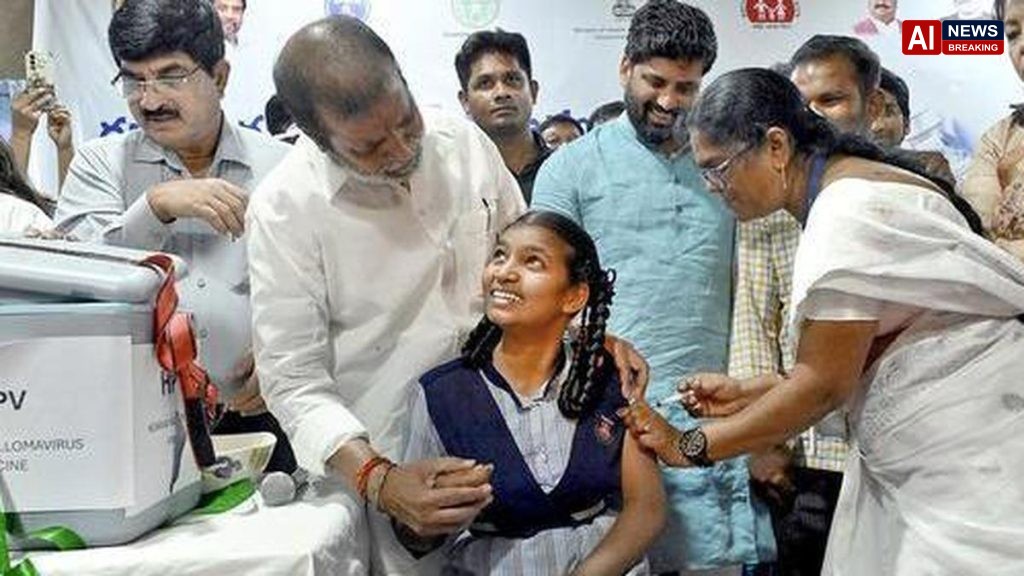
HPV vaccination: one crore doses administered in nine months - AI News Breaking
vaccination crore doses administered:
HPV vaccination: one crore doses administered in nine months The Ministry of Health and Family Welfare announced on Monday that more than one crore doses of the human papillomavirus (HPV) vaccine have been administered to 14‑year‑old girls across India in the first nine months of the national cervical cancer prevention campaign. The figure represents 87 percent of the annual target cohort, a milestone that health officials say underscores the programme’s rapid scaling and the growing acceptance of preventive health measures among adolescents and their families. The campaign, launched in early 2023, aims to vaccinate all 14‑year‑old girls against the two high‑risk HPV strains that cause the majority of cervical cancer cases..
The government’s goal is to achieve 100 percent coverage within three years, aligning with the World Health Organization’s call for 90 percent of girls to be fully immunised by age 15. The latest data indicate that the country is on track to meet these ambitious targets, with a cumulative administration of 1.02 crore doses recorded up to the end of September. Uttar Pradesh emerged as the leading state in the drive, having administered more than 29.33 lakh doses to girls in its schools and health centres..
The state’s extensive network of school health programs, combined with robust community outreach, has facilitated the large‑scale rollout. Officials in Lucknow highlighted that coordination between the education department and primary health centres was pivotal in reaching remote villages where school attendance is sporadic. Bihar follows as the second‑largest contributor, with 13.70 lakh doses delivered to adolescent girls..
The state government attributed its progress to a series of awareness campaigns that addressed myths surrounding the vaccine and highlighted its safety profile. Mobile vaccination units were deployed to hard‑to‑reach districts, and local NGOs were engaged to mobilise parents and teachers, resulting in a noticeable uptick in consent forms. Gujarat recorded 7.75 lakh doses administered, placing it third among the top‑performing states..
Health authorities in Ahmedabad noted that the state’s digital health infrastructure, which tracks individual vaccination records, helped streamline the logistics and reduce wastage. The Gujarat model, which integrates real‑time data sharing between schools and health officials, is being considered for replication in other regions seeking to improve efficiency. Overall, the programme has benefitted from a multi‑sectoral approach that leverages the strengths of the education system, primary health care, and civil society..
The Ministry’s policy brief outlines that school‑based vaccination sessions accounted for 62 percent of total doses, while community‑based outreach covered the remainder. This dual strategy has been essential in ensuring that girls who are out of school are not left behind. Despite the encouraging numbers, health experts caution that the remaining 13 percent of the target cohort still faces barriers to access..
In some tribal and conflict‑affected areas, logistical challenges, cultural resistance, and limited health infrastructure continue to impede full coverage. The Ministry has announced additional funding to deploy more mobile clinics and to train community health workers in culturally sensitive communication techniques. International partners have lauded India’s progress, with the World Health Organization noting that the country’s vaccination rate is among the highest in the world for a nation of its size..
WHO representatives in New Delhi praised the government’s commitment to gender‑focused health interventions and highlighted the potential long‑term impact on reducing cervical cancer mortality, which currently claims over 120 000 lives annually in India. Economists point out that the investment in HPV vaccination could yield substantial savings for the health system. A study by the Indian Council of Medical Research estimates that every crore rupees spent on the vaccine could prevent up to 150 deaths from cervical cancer over the next three decades, translating into significant reductions in treatment costs and productivity losses..
The campaign also aligns with India’s broader adolescent health agenda, which includes nutrition, mental health, and reproductive education. By integrating HPV vaccination into existing school health programmes, the government aims to create a holistic platform that addresses multiple determinants of health for young people. Critics, however, argue that the focus on vaccination should not eclipse the need for comprehensive screening and treatment services for older women..
Looking ahead, the Ministry has outlined a roadmap to achieve full coverage by 2026. Plans include expanding the vaccine supply chain, enhancing cold‑chain capacity, and introducing digital reminders for second‑dose appointments. A new public‑private partnership model is under discussion to leverage pharmaceutical expertise while maintaining the vaccine’s affordability for the public sector..
As the programme enters its final quarter of the first year, officials remain optimistic but vigilant. Regular monitoring and independent audits will be conducted to ensure data integrity and to identify any gaps in delivery. The success of the HPV vaccination drive is poised to become a benchmark for large‑scale preventive health initiatives in low‑ and middle‑income countries..
Updated: November 21, 2026
India’s HPV drive has administered just over one crore doses to 14‑year‑old girls in nine months, hitting 87 % of its target and putting the nation on track for full coverage by 2026. Uttar Pradesh leads the effort, while school‑based sessions and community outreach together aim to bridge the remaining gaps in hard‑to‑reach areas.
Insight: India’s rapid HPV rollout shows that when schools, health workers and digital tools sync, a high‑risk disease can be tackled faster than most multi‑year plans. Yet the remaining 13 % gap warns that technology alone can’t replace culturally tuned outreach in hard‑to‑reach pockets.






