
 Pakistan’s leaders hail first astronaut aboard Chinese craft: ‘Proud one of us has gone into space’
 British tourist travels 29 hours from Mumbai to Amritsar for ₹5,461, rates Indian Railways 10/10 | Viral video
 The Supreme Court will decide whether assault weapons bans violate the Second Amendment
 A Critic of Beijing Falls Short in Taiwan’s Key Mayoral Election
 EPA says no rise in contamination after Army detonates lead azide stockpile in Iowa
Live Updates: Trump’s Whirlwind Asia Trip Begins in the Philippines
**
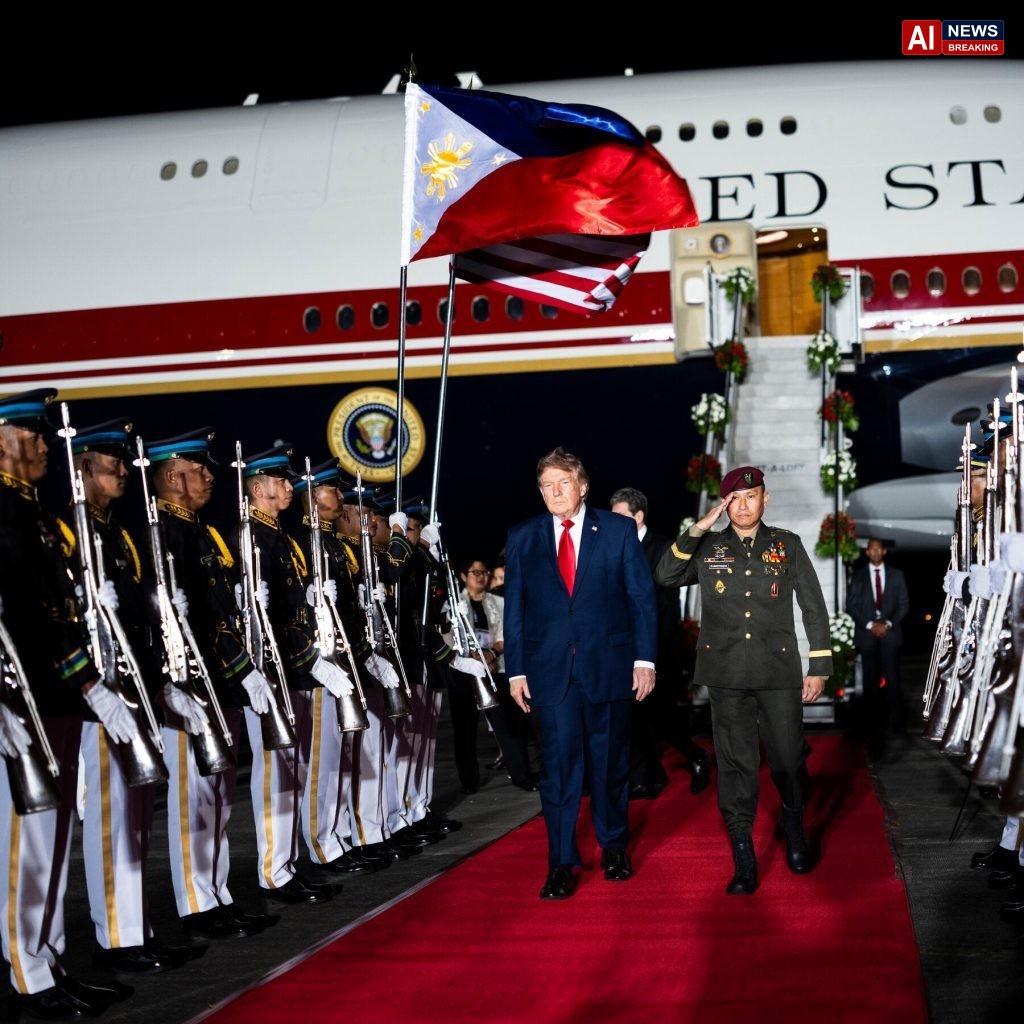
Live Updates: Trump’s Whirlwind Asia Trip Begins in the Philippines - AI News Breaking
updates trumps whirlwind asia:
President Donald Trump arrived in Manila on Thursday morning, marking the commencement of a tightly scheduled 48‑hour diplomatic tour of Asia that is set to span three countries and involve meetings with senior regional leaders. The United States president, accompanied by a delegation of senior officials and advisers, was welcomed at the Ninoy Aquino International Airport by Philippine President Ferdinand Marcos Jr. and other government dignitaries..
The visit, billed by the White House as an effort to reinforce “strategic partnerships” and “shared prosperity” across the Indo‑Pacific, follows a series of high‑profile engagements in Europe and the Middle East earlier this month.In the first official engagement of the trip, Trump and Marcos Jr. convened a bilateral meeting inside the Malacañang Palace, focusing on trade, security cooperation and climate resilience. Both leaders highlighted the Philippines’ role in the United States’ broader Indo‑Pacific strategy, with Trump emphasizing the importance of “free and open seas” and the need to counter “coercive actions” that threaten regional stability..
The two heads of state signed a memorandum of understanding on joint naval exercises, a move that will see U.S. and Philippine vessels conducting coordinated drills in the South China Sea later this year.Following the bilateral talks, a multilateral summit was held at the newly opened Philippine International Convention Center, gathering leaders from Indonesia, Malaysia, Singapore, Thailand and Vietnam. The gathering, described by organizers as the “Manila Summit on Regional Cooperation”, addressed a range of issues from supply‑chain diversification to pandemic preparedness..
While the leaders expressed optimism about deepening economic ties, the discussion was dominated by concerns over maritime disputes and the growing influence of China in the South China Sea. Trump, in a press briefing after the summit, reiterated his administration’s commitment to “protecting the rules‑based order” and promised “more concrete steps” to assist partner nations with maritime surveillance.The Philippine leg of the itinerary concluded with a visit to the Subic Bay Freeport Zone, where Trump toured a U.S. Navy maintenance facility and met with veterans’ groups..
naval base turned commercial hub, was highlighted as a symbol of the long‑standing defense relationship between the two nations. In remarks to a mixed audience of military personnel and local business owners, the president underscored the “mutual benefits of a strong alliance” and pledged to explore further opportunities for joint investment in infrastructure and technology.On Friday, Trump departed Manila aboard Air Force One, heading for Shenzhen, China, a city that has emerged as a key financial and manufacturing centre in the southern part of the country. The stop in Shenzhen is scheduled to include a high‑level meeting with Chinese President Xi Jinping at the city’s civic center, as well as a separate session with Russian President Vladimir Putin at a venue within the Shenzhen International Trade and Exhibition Centre..
Both meetings are expected to run on a tight timeline, reflecting the condensed nature of the president’s Asian tour.The Trump‑Xi meeting is set to focus on three core themes: trade balance, technology transfer and regional security. trade officials have prepared a package of proposals aimed at addressing what they describe as “unfair practices” in sectors ranging from semiconductors to renewable energy. At the same time, the two leaders are expected to discuss cooperation on climate initiatives, with particular reference to the joint development of low‑carbon technologies..
Analysts note that the diplomatic tone will likely be measured, given the broader context of heightened U.S.–China competition and recent tensions over Taiwan.In the separate encounter with Putin, the agenda is anticipated to centre on nuclear arms control, energy cooperation and the ongoing conflict in Ukraine. The United States has signalled a willingness to engage Moscow on the extension of the New START treaty, while also pressing for “clear steps” toward de‑escalation in Eastern Europe. Energy discussions are expected to address Russia’s role as a major supplier of natural gas to the Asian market, an issue that has gained prominence after European demand for Russian fuel has waned..
Observers say the Trump‑Putin dialogue will test the president’s capacity to balance geopolitical concerns with commercial interests in a rapidly shifting global environment.Security experts have highlighted the strategic significance of the Shenzhen stop, noting that the city is home to the China‑Singapore Suzhou Industrial Park and a number of high‑tech research zones. The presence of both Chinese and Russian leaders in the same venue underscores a rare convergence of the three major powers in a single Asian city, a scenario not seen since the early 2000s. Diplomats from allied nations are closely monitoring the outcomes, especially any statements that might affect the United States’ commitments to its regional allies, including Japan, South Korea and Australia.Back in Washington, the White House has released a brief statement affirming that the president’s Asia trip “reinforces America’s unwavering dedication to a free and prosperous Indo‑Pacific”..
The administration also indicated that a senior foreign‑policy adviser will travel to Singapore later this week to brief the National Security Council on the substantive outcomes of the meetings. Meanwhile, opposition leaders in the United States have criticised the rapid pace of the itinerary, arguing that the short duration does not allow for in‑depth negotiation on complex issues such as intellectual‑property protection and human‑rights concerns.As the 48‑hour whirlwind draws to a close, the final leg of Trump’s itinerary will see him return to the United States via a scheduled stop in Seoul, South Korea, where a separate bilateral meeting with President Yoon Suk‑yeol is slated. The Seoul engagement is expected to focus on joint defense drills and the supply of advanced missile systems, reinforcing a security umbrella that has been a cornerstone of U.S..
With the Asia tour set to finish just before the upcoming mid‑term election cycle, political analysts will be watching closely to gauge how the president’s diplomatic overtures translate into domestic political capital and whether the trip will reshape the United States’ strategic posture in a region marked by rising great‑power rivalry..
Updated: November 17, 2026
Insight: This development highlights evolving dynamics and may have broader implications in the near term.






