
 Pakistan’s leaders hail first astronaut aboard Chinese craft: ‘Proud one of us has gone into space’
 British tourist travels 29 hours from Mumbai to Amritsar for ₹5,461, rates Indian Railways 10/10 | Viral video
 The Supreme Court will decide whether assault weapons bans violate the Second Amendment
 A Critic of Beijing Falls Short in Taiwan’s Key Mayoral Election
 EPA says no rise in contamination after Army detonates lead azide stockpile in Iowa
Meta meets Indian Congress on content‑moderation concerns in New York.
**
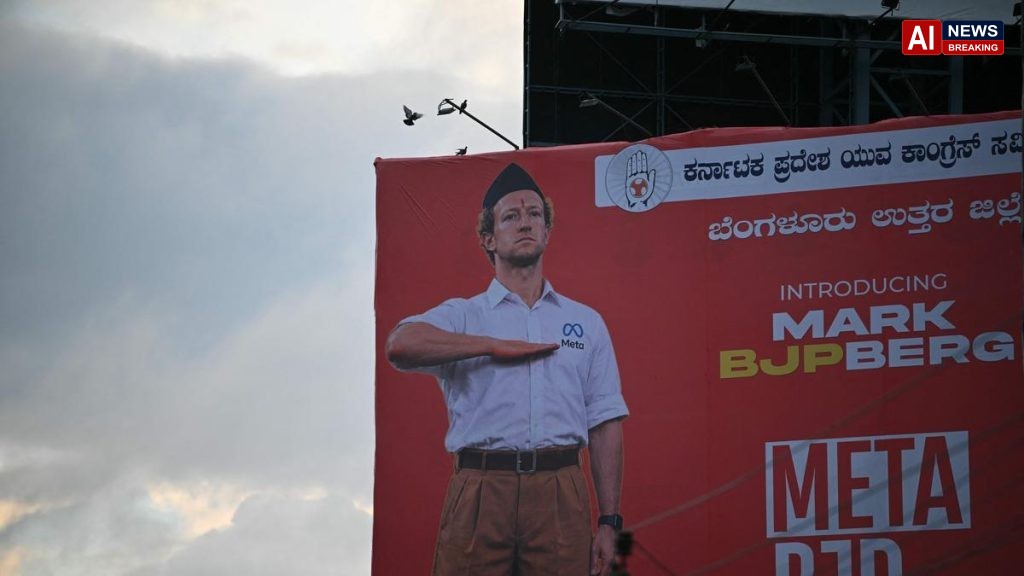
Meta officials meet Congress leaders amid allegations of bias in content moderation - AI News Breaking
Meta Platforms Inc., the parent company of Facebook, Instagram and WhatsApp, sent senior executives to New York this week for a high‑profile meeting with senior members of the Indian National Congress, the country’s main opposition party. The gathering, held at the United Nations headquarters on Thursday, brought together Aman Jain, Meta’s head of public policy for South Asia, and Natasha Jog, the firm’s senior director of global policy and public affairs, with Congress leader Supriya Shrinate, who heads the party’s parliamentary committee on media and information technology. The talks, which lasted just over an hour, were framed as an effort to address a series of recent allegations that Meta’s content‑moderation practices have been biased against political actors and viewpoints aligned with the Congress.The meeting was convened against a backdrop of mounting pressure on the tech giant from multiple quarters in India..
In the past six months, the Congress has lodged several formal complaints with India’s Ministry of Electronics and Information Technology, accusing Meta of disproportionately removing or demonetising posts that support its political agenda while allowing similar content from rival parties to remain online. In parallel, a coalition of civil‑society organisations and media watchdogs has called for an independent audit of Meta’s algorithms, arguing that opaque moderation policies have contributed to an uneven digital public sphere. The company, for its part, has repeatedly denied any systematic bias, asserting that its policies are applied uniformly and that any removal of content is the result of violations of its community standards.During the New York encounter, Jain and Jog sought to clarify Meta’s stance on the contentious issues raised by the Congress..
They highlighted the company’s investment of more than $2 billion in India since 2019, noting the rollout of new safety tools, the expansion of local content‑review teams, and the launch of a “Transparency Hub” that provides aggregated data on content removal requests. The executives also pointed to the recent establishment of a third‑party oversight board, which, they said, offers an avenue for users to appeal decisions and for the company to receive external scrutiny. “We are committed to a fair and open digital ecosystem,” Jog said, emphasizing that Meta’s policies are designed to protect users from hate speech, misinformation and coordinated inauthentic behaviour, irrespective of political affiliation.Shrinate, however, remained skeptical, reiterating the Congress’s concerns about the lack of granular data that would enable a detailed assessment of alleged bias..
She argued that the transparency reports released by Meta are insufficient, as they aggregate removals across the entire platform without distinguishing between political and non‑political content. “Without disaggregated data, we cannot ascertain whether certain voices are being silenced more than others,” Shrinate told the journalists present. She also pressed the executives on the speed and consistency of the appeal process, noting that several high‑profile Congress leaders have reportedly faced repeated takedowns of live‑stream videos during election campaigns, sometimes after only a brief review by automated systems.The dialogue turned to the role of artificial intelligence in content moderation, a point of contention that has attracted scrutiny worldwide..
Jain explained that Meta uses a combination of machine learning models and human reviewers to flag potentially harmful material, and that the company continually retrains its algorithms to reduce false positives. He acknowledged, however, that AI is not infallible and that biases can inadvertently be introduced if training data reflects existing societal prejudices. To mitigate this risk, Meta has instituted a “bias‑mitigation task force” that conducts regular audits of its models, a detail he offered as evidence of the company’s proactive approach.In response, Shrinate cited a recent study by the Centre for Internet and Society, which found that, during the last general election, posts from opposition parties were removed at a rate 1.8 times higher than those from the ruling coalition..
She demanded that Meta provide the raw data underpinning its aggregated statistics, allowing independent researchers to verify the findings. The Congress leader also raised the issue of coordinated inauthentic activity, alleging that the platform had allowed networks of fake accounts to amplify pro‑government narratives while suppressing dissenting voices. Meta’s representatives countered that they have taken down thousands of such accounts in the past year, often in collaboration with Indian law‑enforcement agencies, and that they remain vigilant against coordinated manipulation.The meeting concluded without a formal agreement, but both sides expressed a willingness to continue the conversation..
Jain pledged that Meta would submit a detailed response to the Congress’s specific queries within the next fortnight, including a breakdown of removal statistics by political affiliation, language and content type. Jog added that Meta would explore the possibility of establishing a joint working group with the Congress’s media committee to develop best‑practice guidelines for political content moderation in India. Shrinate, while noting that the outcomes fell short of the party’s expectations, welcomed the gesture and urged her colleagues to monitor the implementation of any promises made.Outside the conference room, analysts observed that the encounter marked a rare instance of direct engagement between a major U.S..
tech firm and a leading Indian opposition party. “It signals that Meta recognises the political sensitivity of its operations in a democracy as vibrant and contested as India’s,” said Dr Ranjit Singh, a senior fellow at the Indian Institute of Public Policy. “The company is walking a tightrope, needing to balance the imperatives of safety and compliance with local laws while preserving a perception of neutrality that is essential for its global brand.”The meeting also comes at a time when Meta faces regulatory scrutiny in other jurisdictions..
In the European Union, the firm is under investigation for alleged breaches of the Digital Services Act, while in the United States, lawmakers have called for more robust oversight of algorithmic decision‑making. Observers suggest that the Indian episode could become a template for how Meta negotiates political pressures elsewhere, especially as governments worldwide grapple with the influence of social media on public discourse.For the Congress, the engagement with Meta is part of a broader strategy to challenge what it perceives as an uneven playing field in the digital arena. Party spokespersons have announced plans to file a petition in the Supreme Court of India seeking a judicial review of the platform’s moderation policies, arguing that they infringe on the constitutional right to free expression..
The legal route, they say, complements the diplomatic overtures made through meetings such as the one in New York, aiming to compel Meta to adopt more transparent and accountable practices.Meta, meanwhile, has indicated that it will continue to cooperate with Indian authorities and civil‑society groups to refine its moderation frameworks. In a statement released after the meeting, the company affirmed its commitment to “enhancing openness, ensuring fairness, and protecting the rights of all users.” It.
Updated: November 25, 2026
Meta’s New York dialogue with the Congress signals a strategic pivot: the company is shifting from defensive denials to a quasi‑consultative posture, offering data‑breakdowns and joint task‑forces to placate political watchdogs while safeguarding its global brand. If successful, this model could set a precedent for how tech






