
 Pakistan’s leaders hail first astronaut aboard Chinese craft: ‘Proud one of us has gone into space’
 British tourist travels 29 hours from Mumbai to Amritsar for ₹5,461, rates Indian Railways 10/10 | Viral video
 The Supreme Court will decide whether assault weapons bans violate the Second Amendment
 A Critic of Beijing Falls Short in Taiwan’s Key Mayoral Election
 EPA says no rise in contamination after Army detonates lead azide stockpile in Iowa
Presidential turkey pardon continues as televised tradition
**
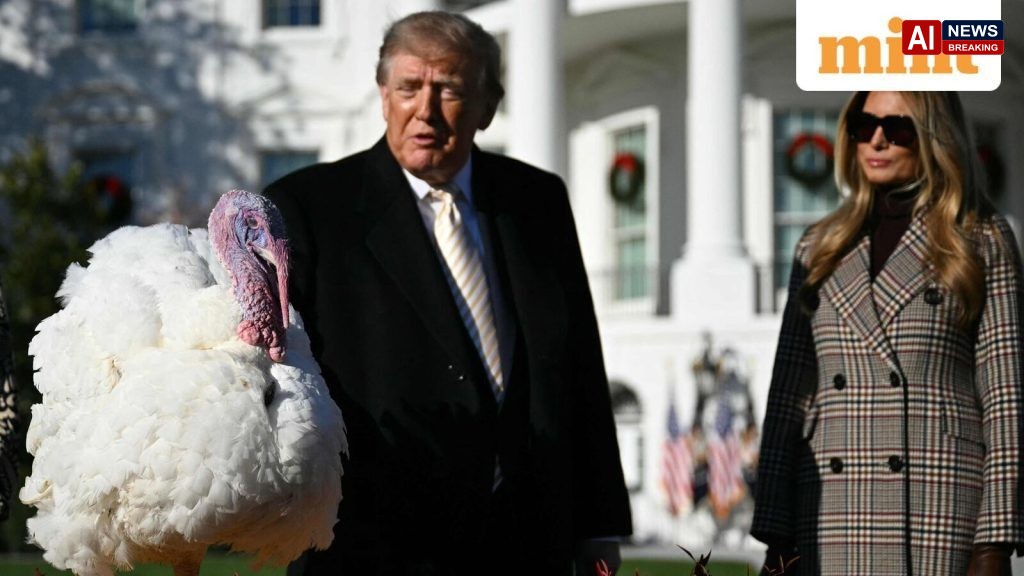
Explained: Trump spares turkeys Freedom, Feathers from Thanksgiving dinner — The unusual tradition US Presidents follow - AI News Breaking
The annual ceremony in which the President of the United States spares a turkey from the Thanksgiving table has become a fixture of American political folklore, yet its origins are more modest than the pomp of modern media coverage suggests. The first recorded instance of a president intervening on behalf of a turkey dates back to the Civil War era, when Abraham Lincoln is said to have halted a Christmas‑time dinner plan after his youngest son, Tad, begged for the bird’s life. Although contemporary reports are scarce, the anecdote has been repeated in biographies of the Lincoln family and is widely cited as the seed of a tradition that would evolve over the next century and a half.For many decades the practice remained informal, with presidents occasionally receiving live turkeys as gifts from farmers or agricultural groups..
In the early twentieth century, President Calvin Coolidge is reported to have taken a turkey home, only to find the bird too large for his household. He later gave the bird to a friend, an act that was noted in newspaper columns but did not yet carry the ceremonial weight it would later acquire. It was not until the post‑World War II era that the pardon began to assume a public, televised dimension, reflecting the growing role of television in shaping political ritual.The modern incarnation of the turkey pardon was inaugurated by President Harry S..
Truman in 1947, when he officially “pardoned” a turkey presented by the National Turkey Federation. Truman’s brief remarks, recorded in a radio broadcast, framed the gesture as a light‑hearted respite from the rigours of post‑war governance. The event was covered by newspapers but lacked the visual spectacle that would later define it..
The following year, President Dwight D. Eisenhower received a turkey, yet the administration chose to keep the bird for a family meal rather than issue a formal pardon, indicating that the ceremony was still fluid in its early years.It was under President John F. Kennedy that the turkey pardon began to acquire a more structured format..
In 1963, the White House invited a turkey to the press gallery, and Kennedy’s witty comment that the bird would be “saved for a later meal” hinted at a growing public interest. The press coverage that followed set a precedent for media engagement, turning a simple agricultural gift into a moment of national attention. By the time President Richard Nixon took office, the ceremony had become an expected part of the Thanksgiving calendar, with the turkey’s name announced weeks in advance and the animal’s fate discussed in editorial columns.The 1980s saw the turkey pardon become a televised event, first on network news and later on the President’s own broadcast platforms..
President Ronald Reagan, a former actor, embraced the theatricality of the occasion, delivering a brief speech that highlighted themes of gratitude and American abundance. The turkey, named “Liberty,” was presented on a stage set reminiscent of a barn, complete with a cornucopia backdrop. The ceremony attracted millions of viewers, and the turkey’s name and pedigree were publicised in advance, signalling a shift from spontaneous gesture to orchestrated spectacle.President George H..
Bush continued the trend, adding a charitable dimension by donating the pardoned bird to a farm where it would live out its days. The press release emphasised the administration’s commitment to animal welfare, reflecting a broader societal concern for humane treatment of livestock. The subsequent administration under Bill Clinton introduced a humorous element, with the turkey’s “pardon” accompanied by a short, tongue‑in‑cheek speech that referenced the holiday’s historical roots..
Clinton’s turkey, “Liberty,” was later sent to a farm in Pennsylvania, where it became a local attraction, illustrating how the ritual now intersected with regional tourism.In the twenty‑first century, the turkey pardon has become a predictable highlight of the presidential calendar, complete with a live audience, a pre‑recorded segment, and a social‑media rollout. President Barack Obama’s 2009 pardon featured a turkey named “Mickey,” and the ceremony was streamed online, allowing a global audience to witness the moment. The administration’s website provided a brief history of the tradition, acknowledging Lincoln’s alleged involvement while noting the evolution of the practice..
This digital outreach marked a departure from earlier, solely broadcast‑based coverage, aligning the event with contemporary media consumption habits.When Donald Trump assumed office, the turkey pardon took on a more overtly political tone. The 2017 ceremony featured a turkey named “Peanut,” and the President’s remarks included references to trade policies affecting American farmers. Critics noted the juxtaposition of a light‑hearted ritual with a politically charged agenda, yet the event maintained its status as a media staple..
The turkey’s subsequent fate—being sent to a farm in Pennsylvania—was confirmed in a press release, reinforcing the post‑pardon protocol that has been standardised over the past decades.President Joe Biden’s 2021 ceremony introduced a modest environmental message, with the President highlighting sustainable farming practices and the importance of supporting family‑owned farms. The pardoned turkey, “Freedom,” was later moved to a sanctuary in Pennsylvania, where it would be cared for by a non‑profit organization dedicated to animal rescue. The administration’s communication strategy emphasised transparency, providing details about the turkey’s health, diet, and living conditions, a level of detail not previously common in the ritual’s coverage.The turkey pardon, while often dismissed as a whimsical footnote to the Thanksgiving holiday, offers insight into how presidential customs adapt to shifting cultural, technological, and political landscapes..
From a solitary act of paternal mercy in 1863 to a meticulously choreographed event broadcast to millions, the tradition reflects America’s penchant for ritualising moments of national unity. It also underscores the role of media in amplifying and reshaping political gestures, turning a farmyard bird into a symbol of presidential clemency, agricultural advocacy, and, occasionally, policy messaging. As each administration adds its own nuances, the ceremony continues to evolve, ensuring that the spared turkey remains a living reminder of the intertwining of tradition and the ever‑changing theatre of the White House..
Updated: November 25, 2026
From Lincoln’s humble act of mercy during the Civil War to a televised, socially‑mediated spectacle, the presidential turkey pardon has morphed into a ritual that mirrors shifting media and political priorities. Each administration now uses the spared bird not only as a nod to tradition but also to highlight policy themes, animal welfare, or environmental stewardship, ensuring the ceremony stays relevant to contemporary audiences.






