The Supreme Court will decide whether assault weapons bans violate the Second Amendment
 A Critic of Beijing Falls Short in Taiwan’s Key Mayoral Election
 EPA says no rise in contamination after Army detonates lead azide stockpile in Iowa
 Israeli Strike Kills 2 Workers at Gaza Clinic, Doctors Without Borders Says
 McQueen Pre-Fall 2027
Myanmar military and Buddhist mobs attack Rohingya villages in 201
**
The Rohingya Crisis Over the Years - AI News Breaking
myanmar military buddhist mobs:
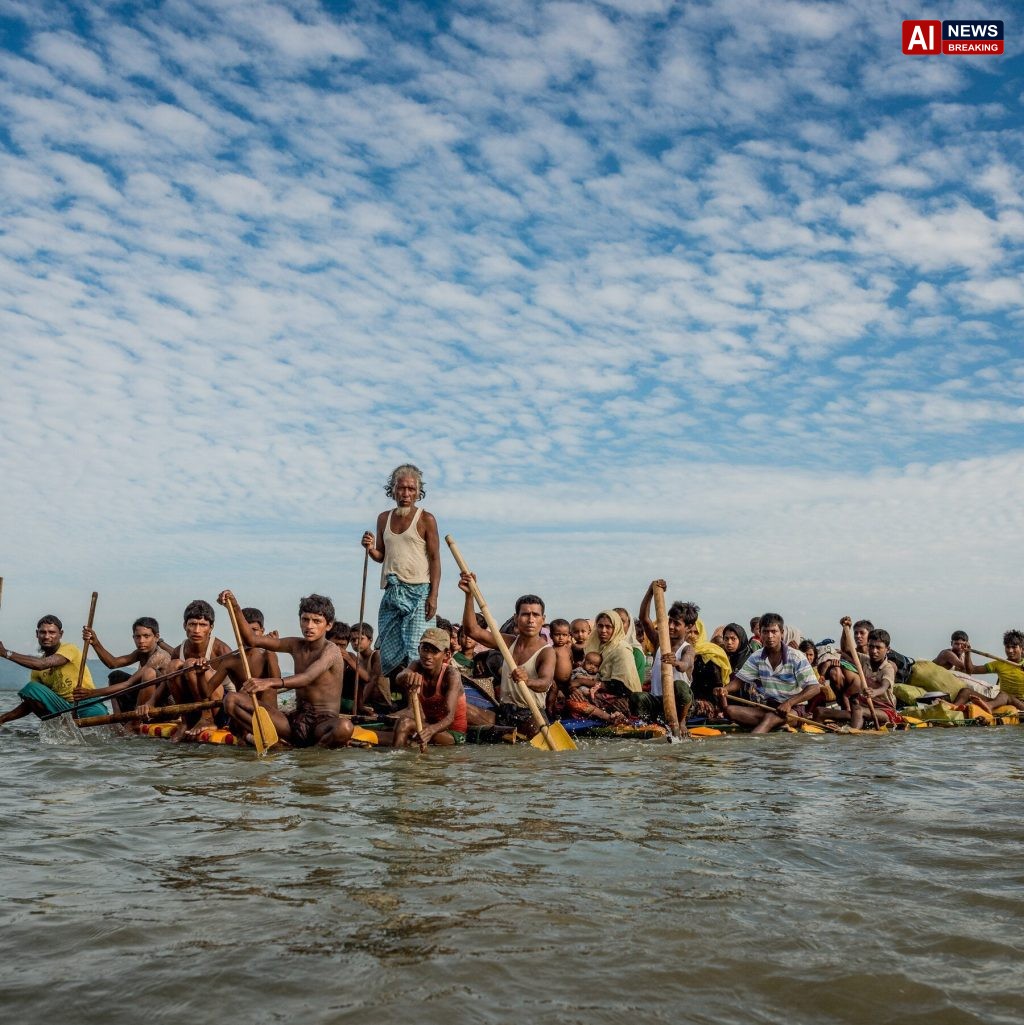
The violence that erupted in Myanmar’s Rakhine State in August 2017 marked a dramatic escalation in a crisis that has haunted the region for decades. In the span of a few weeks, Myanmar’s military, known as the Tatmadaw, and local Buddhist mobs launched coordinated attacks on villages inhabited by the Rohingya, a Muslim minority denied citizenship under the country’s 1982 nationality law. Satellite imagery and eyewitness testimony documented the systematic burning of homes, the destruction of mosques and the use of heavy weapons against civilians..
The United Nations later described the actions as a “clear case of ethnic cleansing,” prompting an exodus of more than 700,000 Rohingya across the border into Bangladesh’s sprawling Cox’s Bazar camp, the world’s largest settlement of forcibly displaced people.The roots of the Rohingya’s marginalisation stretch back to the colonial era, when British administrators encouraged migration from present‑day Bangladesh into the then‑province of Arakan to work on plantations. After independence in 1948, successive Burmese governments pursued policies of assimilation and, in 1982, codified a hierarchy of citizenship that excluded the Rohingya, labeling them “Bengalis” and rendering them stateless. Decades of denial of basic rights—restrictions on movement, education and employment—created a fragile existence that was repeatedly punctuated by bouts of communal violence, notably the 2012 clashes that left hundreds dead and displaced tens of thousands.In the years preceding 2017, the Rohingya’s plight attracted intermittent international attention, but diplomatic engagement remained limited..
The United Nations and a handful of humanitarian organisations documented human rights violations, yet the Myanmar government, under the quasi‑civilian leadership of Aung San Suu Kyi, consistently rejected accusations of ethnic persecution, framing the conflict as a counter‑insurgency against the Arakan Rohingya Salvation Army (ARSA), an armed group that had carried out attacks on police posts in 2016 and 2017. This narrative allowed the government to justify a sweeping security operation that, according to later investigations, targeted civilians indiscriminately.When the August 2017 offensive began, the scale of displacement overwhelmed the already strained infrastructure of Bangladesh’s southeastern district. The Bangladeshi authorities, led by Prime Minister Sheikh Hasina, responded by opening the border and establishing makeshift shelters, later expanding them into a semi‑permanent camp system that housed over a million Rohingya by 2020..
International donors pledged billions of dollars for relief, and agencies such as UNHCR, UNICEF and the World Food Programme coordinated food distribution, health services and education programmes. Yet the sheer density of the camps, combined with monsoonal flooding and the COVID‑19 pandemic, chronic vulnerabilities in water, sanitation and disease control.Legal recourse for the Rohingya has been slow and contested. In November 2019, The Gambia filed a case against Myanmar at the International Court of Justice (ICJ), invoking the Genocide Convention..
The court ordered provisional measures requiring Myanmar to prevent genocide and preserve evidence, but enforcement mechanisms remain weak. Meanwhile, the International Criminal Court (ICC) opened a preliminary examination in 2020, focusing on alleged crimes committed in the border regions, though Myanmar is not a party to the Rome Statute, complicating jurisdictional claims. Human rights bodies have repeatedly called for the repatriation of refugees, but the conditions for safe, voluntary return—security guarantees, citizenship rights and restitution of property—remain unmet.Within Myanmar, the political landscape has shifted dramatically since the 2017 attacks..
The military retained considerable power, and in February 2021 it seized control in a coup that ousted the elected government, citing alleged electoral fraud. The coup intensified repression across the country and further isolated Myanmar on the diplomatic stage. International sanctions targeted military leaders and entities linked to the arms trade, yet the Tatmadaw continued to deny responsibility for the atrocities in Rakhine, framing them as necessary actions against terrorism..
The coup also stalled any potential dialogue on the Rohingya issue, as the civilian leadership that might have pursued reconciliation was removed from power.The regional response has been mixed. While Bangladesh has shouldered the humanitarian burden, neighboring India has expressed concern over the influx of refugees, occasionally tightening its own border controls. China, a major investor in Myanmar’s infrastructure projects, has maintained a policy of non‑interference, offering diplomatic support to the military junta while urging “stability.” ASEAN, of which Myanmar is a member, has been criticized for its principle of non‑intervention, though in 2022 the bloc agreed to a five‑point consensus on Myanmar, including provisions for humanitarian assistance, albeit without concrete mechanisms for Rohingya protection.Civil society initiatives have emerged both within the diaspora and among Burmese activists..
Rohingya NGOs, operating from exile, have documented testimonies, advocated for legal action and lobbied for resettlement opportunities in third countries. In the United Kingdom, Canada and the United States, refugee resettlement programmes have admitted several thousand Rohingya, citing the risk of persecution if they remain in Bangladesh indefinitely. However, the numbers are dwarfed by the overall displaced population, and many refugees remain trapped in camps where future prospects are uncertain.Environmental factors have added another layer of complexity..
Cox’s Bazar is situated on a fragile coastal plain, vulnerable to sea‑level rise and extreme weather events. The rapid expansion of the camps has put pressure on mangrove forests and the local ecosystem, leading to conflicts over natural resources between Rohingya residents and host communities. Studies published in 2023 highlighted rising incidences of water‑borne diseases, exacerbated by inadequate sanitation infrastructure, and warned that climate‑induced displacement could further strain the already precarious humanitarian situation.Looking ahead, the prospects for a durable solution appear dim without concerted international effort..
The UN’s 2024 “Rohingya Global Compact” calls for a phased approach: immediate humanitarian assistance, protection of human rights, pathways to durable residency in Bangladesh, and, ultimately, safe repatriation under UN‑monitored conditions. Implementation, however, hinges on political will from Myanmar’s military rulers, who have shown little inclination to grant citizenship or allow return. In the absence of progress, the Rohingya risk becoming a protracted stateless community, their plight emblematic of broader challenges in addressing ethnic persecution, forced displacement and the limits of international law in the twenty‑first century..
Updated: November 19, 2026
Myanmar’s 2017 military crackdown on Rohingya villages sparked a mass exodus of over 700,000 people into Bangladesh, where sprawling camps now strain resources amid flooding, disease and climate risks. Ongoing legal battles, a stalled coup‑ruled government and tepid regional responses leave the prospect of safe repatriation or lasting resettlement bleak.
The 2017 genocide cemented the Rohingya’s status as a geopolitical “leak”—a crisis that forces neighboring states to choose between humanitarian duty and the fear of a permanent, climate‑vulnerable refugee settlement.
Unless the military junta’s grip loosens, the Rohingya