
 Pond heron found dead in Coimbatore tests positive for avian influenza
 Pakistan’s leaders hail first astronaut aboard Chinese craft: ‘Proud one of us has gone into space’
 British tourist travels 29 hours from Mumbai to Amritsar for ₹5,461, rates Indian Railways 10/10 | Viral video
 The Supreme Court will decide whether assault weapons bans violate the Second Amendment
 A Critic of Beijing Falls Short in Taiwan’s Key Mayoral Election
Peanut the squirrel’s former owner has been detained by ICE and could be deported
**
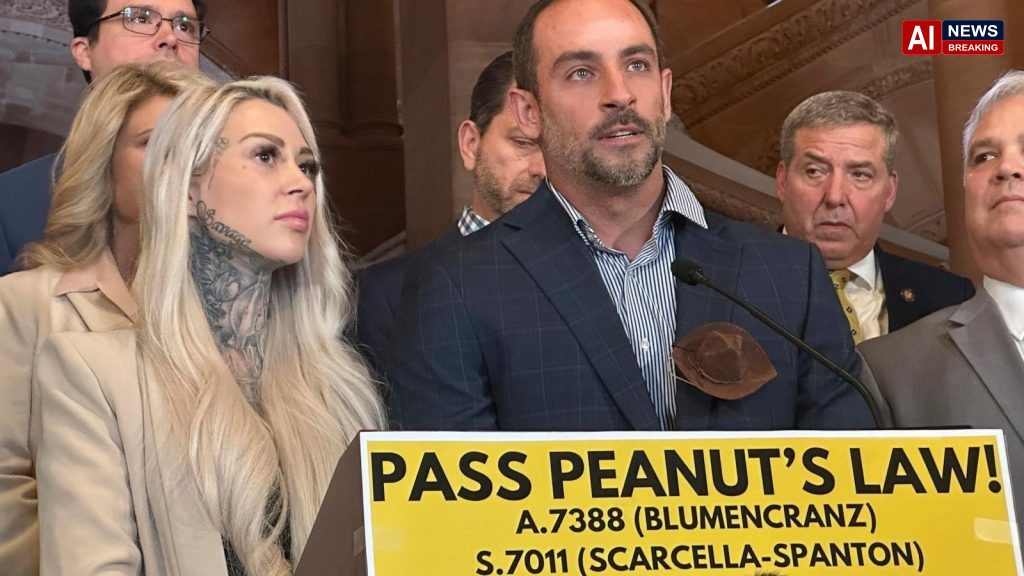
Peanut the squirrel's former owner has been detained by ICE and could be deported - AI News Breaking
peanut squirrels former owner:
New York’s wildlife authorities have become the centre of a political maelstrom after the euthanasia of a pet squirrel named Peanut, an incident that has now taken a dramatic turn with the detention of the animal’s former owner by U.S. Immigration and Customs Enforcement (ICE). The case, which began as a local dispute over wildlife regulations, has been seized upon by national politicians, particularly members of the Republican Party, who are framing it as evidence of governmental overreach..
The involvement of immigration officials adds a further layer of complexity, raising questions about the intersection of wildlife law, property rights, and immigration policy.The saga began in the spring of 2022, when wildlife officers from the New York State Department of Environmental Conservation (DEC) entered the home of a couple in Queens, responding to a complaint that the couple was keeping a squirrel as a pet. Under state law, wild animals may not be kept as domestic companions without a special permit, a rule intended to protect both the animals and the public from potential health hazards. DEC officials determined that Peanut, a grey‑squirrel that had been rescued as a juvenile and subsequently cared for by the couple, was being kept in contravention of these regulations..
After a brief assessment, the officers decided to euthanize the animal, citing concerns that the squirrel could suffer from stress and disease if it were released back into the wild.The decision ignited an immediate outcry among animal‑rights activists and local residents, who argued that Peanut had been treated humanely and that the couple had provided a safe environment for the creature. A petition circulated on social media, gathering more than 30,000 signatures, demanding an investigation into the DEC’s handling of the case. The couple, who declined to be named for safety reasons, maintained that they had not been aware of the specific legal prohibitions and had acted in good faith, believing that the squirrel was unable to survive on its own.In the weeks that followed, the incident attracted national attention..
Several Republican senators and representatives, including Ohio senator JD Vance, issued statements condemning the euthanasia as an example of “government overreach” and “excessive regulation.” Vance, who has positioned himself as a vocal critic of what he terms “big government,” argued that the case illustrated a broader pattern of bureaucratic interference in everyday life. He called for a review of the wildlife statutes that govern the possession of native species, suggesting that the laws be amended to allow for more discretion in cases where animals are rescued and cared for responsibly.The political dimension of the controversy was amplified when, in early May, ICE officials detained the former owner of Peanut, a 28‑year‑old immigrant from Honduras who had entered the United States on a temporary work visa. According to court documents obtained by the press, the individual was taken into custody while awaiting a hearing on a pending removal order..
The immigration case, unrelated to the squirrel incident, was reportedly triggered by an alleged violation of visa conditions, though details remain sparse. ICE spokespersons declined to comment on the timing of the detention, emphasizing that it was part of an ongoing enforcement operation.Critics argue that the juxtaposition of the wildlife case with an immigration proceeding is a calculated political maneuver. “It’s a classic example of using a local story to further a broader agenda,” said Dr..
Maya Patel, a professor of sociology at Columbia University who studies the politicisation of law enforcement. “When you have a high‑profile animal welfare issue and you link it to immigration enforcement, you create a narrative that can be weaponised by both sides of the aisle.” Patel noted that while the two matters are legally distinct, the public’s perception can be shaped by the way they are presented in the media and by political actors.Legal experts point out that the DEC’s authority to intervene in cases involving wild animals is well‑established. The New York State Environmental Conservation Law grants the agency the power to enforce regulations designed to protect wildlife and public health..
In similar cases, the agency has either relocated animals to rehabilitation centres or, where deemed necessary, euthanised them to prevent suffering. “The decision to euthanise was made according to standard protocols,” said Alan Green, a former wildlife officer now serving as a consultant on animal‑law matters. “The primary concern is the welfare of the animal; if a squirrel cannot survive in the wild and is kept in an artificial environment, humane euthanasia is often the most compassionate option.”The couple’s legal counsel, however, maintains that the DEC acted precipitously and failed to explore alternative solutions, such as transfer to a licensed sanctuary..
“There was a clear lack of due process,” argued attorney Lisa Martinez, who represents the former owner. “The officers did not provide a reasonable period for the owners to secure a permit or to seek a rescue organisation’s assistance. Instead, they opted for a swift lethal outcome.” Martinez has filed a formal complaint with the New York State Office of Administrative Hearings, seeking a review of the agency’s actions and alleging that the officers violated procedural safeguards.Meanwhile, the immigration aspect of the story has drawn criticism from civil‑rights groups..
The American Civil Liberties Union (ACLU) of New York released a statement expressing concern that the detention could be perceived as punitive retaliation linked to the high‑profile wildlife case. “While the ICE operation is ostensibly unrelated, the optics are troubling,” said ACLU spokesperson Jamal Edwards. “Detaining an individual in the midst of a highly publicised controversy risks sending a chilling message to immigrant communities about the precariousness of their status, especially when they are already under scrutiny for unrelated matters.” The ACLU has indicated that it may consider legal action if it determines that the detention was influenced by the political fallout from the squirrel incident.Public reaction has been divided..
Some New Yorkers, particularly those with strong ties to wildlife conservation, defend the DEC’s mandate, arguing that allowing private individuals to keep wild animals sets a dangerous precedent. “We have to respect the ecosystems we share,” said Rachel Liu, a member of a local bird‑watching club. “If every person could adopt a squirrel, we would see a rise in disease transmission, stress on animal populations, and an erosion of natural behaviours essential for survival.” Others, however, view the incident as emblematic of an over‑regulation culture that fails to account for compassionate human‑animal relationships..
“Peanut was part of a family,” said one protester at a rally outside the DEC office. “The system treated him as a nuisance rather than a living being that was being cared for.”The political reverberations have also reached the state legislature. A bipartisan group of legislators has introduced a bill that would create a “rescued wildlife” exemption, allowing individuals.
Updated: November 11, 2026







