Pakistan’s leaders hail first astronaut aboard Chinese craft: ‘Proud one of us has gone into space’
 British tourist travels 29 hours from Mumbai to Amritsar for ₹5,461, rates Indian Railways 10/10 | Viral video
 The Supreme Court will decide whether assault weapons bans violate the Second Amendment
 A Critic of Beijing Falls Short in Taiwan’s Key Mayoral Election
 EPA says no rise in contamination after Army detonates lead azide stockpile in Iowa
Prosecutor declines to charge white officer who fatally shot Black man in Wisconsin
**
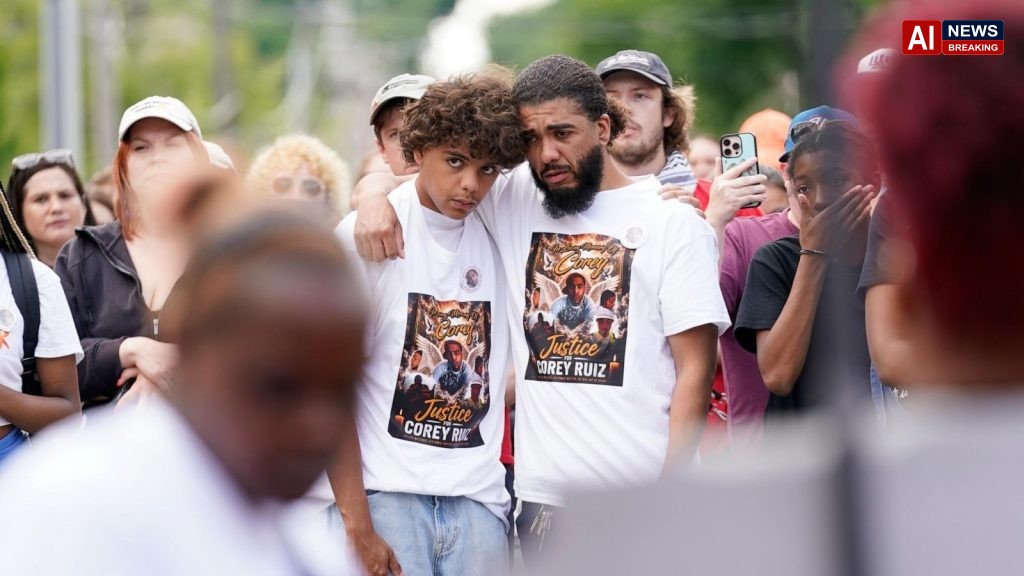
Prosecutor declines to charge white officer who fatally shot Black man in Wisconsin - AI News Breaking
prosecutor declines charge white:
A Dane County prosecutor has announced that no criminal charges will be filed against the Madison police officer who shot and killed 38‑year‑old Michael Thomas in July, a decision that has reignited debate over police accountability and racial disparity in the criminal justice system. The move follows an extensive investigation by the Wisconsin Department of Justice’s Division of Criminal Investigation, which concluded that the officer, identified as Officer Daniel Ruiz, acted within the bounds of Wisconsin law. Taylor, cited the investigative report’s findings and the lack of sufficient evidence to prove criminal intent beyond a reasonable doubt as the primary reasons for declining to pursue a case.The incident occurred on the night of July 14, when Thomas, who was walking home from a local bar in the Capitol Square area, was approached by Officer Ruiz after a 911 call reported a “suspicious individual” carrying a large object..
According to the police report, Ruiz ordered Thomas to drop the object, which was later identified as a backpack. When Thomas allegedly failed to comply, the officer discharged his service weapon, striking Thomas in the chest and causing fatal injuries. Body‑camera footage released by the Madison Police Department shows a brief, grainy exchange that ends with the gunshot, leaving many observers to question what transpired in the seconds leading up to the shot.The Department of Justice investigation, spanning more than six months, involved forensic analysis of the scene, ballistics testing, interviews with witnesses, and a review of the officer’s prior conduct record..
The final report concluded that Ruiz’s use of lethal force was “objectively reasonable” under the circumstances, emphasizing that the officer reasonably feared for his life and the safety of others. The report also noted that Thomas had a prior criminal record, including a conviction for armed robbery, and that he had been carrying a concealed weapon at the time of the encounter, though this detail was not immediately disclosed to the public.Critics of the decision argue that the prosecutor’s reliance on the investigative report ignores broader systemic issues that often shield officers from accountability. Civil rights advocates, including the local chapter of the NAACP, have condemned the outcome as another example of the “law‑enforcement shield” that protects officers even when their actions result in the death of Black individuals..
“We have seen a pattern where the legal threshold for charging officers is set impossibly high,” said Jamal Reynolds, the NAACP’s Madison spokesperson. “The decision sends a message that the lives of Black residents are valued less than the careers of police officers.”Supporters of the prosecutor’s ruling point to the legal standards governing police use of force, which require proof of criminal intent or gross negligence to secure a conviction. Taylor emphasized that while the decision not to file charges may be unpopular, the office must adhere to the burden of proof required by state law..
“Our duty is to apply the law impartially, not to act as a surrogate for public opinion,” he said in a written statement. He added that the case could still be revisited if new evidence emerges, but as it stands, the evidence does not meet the statutory threshold for criminal prosecution.The ruling comes at a time when Madison, like many American cities, is grappling with calls for police reform. Earlier this year, the city council approved a series of measures aimed at increasing transparency, including expanding civilian oversight of police misconduct investigations and mandating de‑escalation training for all officers..
Yet, community activists argue that these reforms have been insufficient to address deep‑seated mistrust. “We need an independent body with the power to discipline officers, not just a department that reviews its own actions,” said Maria Hernandez, a local organizer with the Justice for Michael Thomas coalition. “The lack of criminal accountability only deepens the wound.”Legal experts note that the decision aligns with a broader national pattern in which prosecutors are hesitant to bring charges against officers involved in shootings..
A 2023 study by the Center for American Progress found that only 2 percent of police shootings resulted in criminal charges, and an even smaller fraction led to convictions. The study attributes this disparity to factors such as prosecutorial discretion, the “reasonable officer” defense, and the deference often given to law‑enforcement testimony. “Prosecutors operate within a legal framework that heavily favors the officer’s perspective, especially when the officer claims self‑defense,” said Dr..
Evelyn Chang, a criminal law professor at the University of Wisconsin‑Madison.In the wake of the announcement, the family of Michael Thomas released a statement expressing grief and disappointment. “We trusted the justice system to protect my brother’s memory,” said his sister, Angela Thomas. “Instead, we see another instance where the system fails to hold those in power accountable..
We will continue to seek justice, whether through civil avenues or public advocacy.” The family has indicated plans to file a wrongful‑death lawsuit against the city and the officer, a civil action that could bring additional scrutiny to the case and potentially result in monetary compensation, though it will not affect the criminal proceedings.The city’s police department has pledged to cooperate fully with any subsequent civil litigation and has reiterated its commitment to reviewing its policies on use of force. Chief Laura McIntyre, who took office earlier this year, said the department would use the incident as a learning opportunity to refine training protocols and improve communication with the community. “Our officers are trained to protect and serve, and we must ensure that those training standards are continuously evaluated and updated,” she said..
“We also recognize the pain this has caused and are dedicated to rebuilding trust.”As the legal battle concludes without criminal charges, the broader conversation about policing and racial equity in Madison is likely to persist. Local leaders, community groups, and policymakers are expected to convene in the coming weeks to discuss further reforms, including possible changes to the state’s use‑of‑force statutes and the establishment of an independent civilian review board with subpoena power. Whether these measures will satisfy a community that feels repeatedly let down by the criminal justice system remains to be seen, but the episode underscores the complex interplay between law, public perception, and the enduring demand for accountability in law enforcement..
Updated: November 19, 2026
The prosecutor’s refusal to file charges signals a systemic reluctance to meet the high evidentiary bar set for officers, effectively prioritizing institutional protection over the lived reality of Black victims. This decision, while legally defensible, deepens community distrust and underscores that legal standards alone cannot quell calls for meaningful reform