
 Pakistan’s leaders hail first astronaut aboard Chinese craft: ‘Proud one of us has gone into space’
 British tourist travels 29 hours from Mumbai to Amritsar for ₹5,461, rates Indian Railways 10/10 | Viral video
 The Supreme Court will decide whether assault weapons bans violate the Second Amendment
 A Critic of Beijing Falls Short in Taiwan’s Key Mayoral Election
 EPA says no rise in contamination after Army detonates lead azide stockpile in Iowa
Vaniyambadi protest demands new district court to reduce case backlog.
**
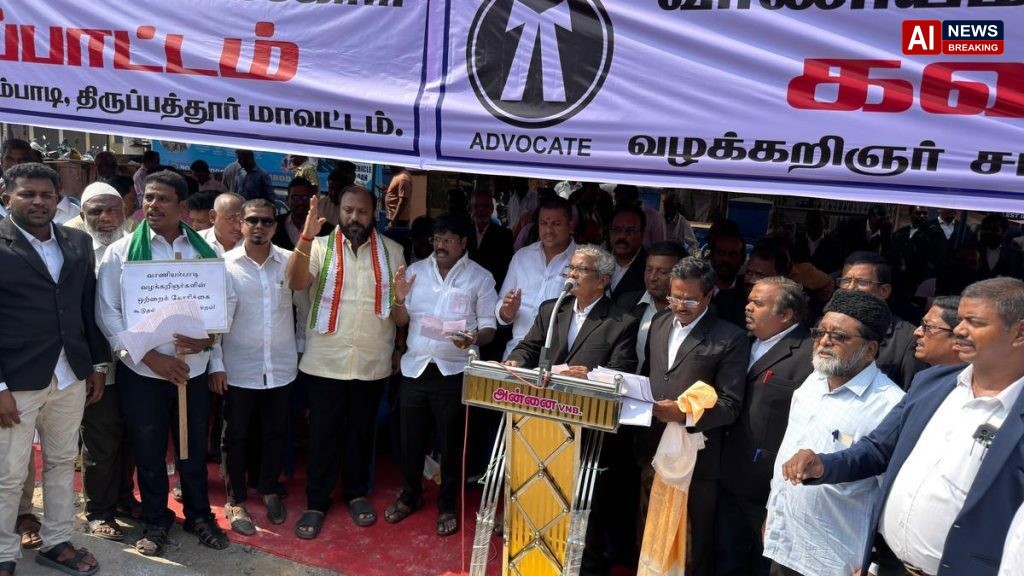
Advocates, traders protest in Vaniyambadi for additional district court - AI News Breaking
vaniyambadi protest demands district:
The small town of Vaniyambadi, a bustling hub in the northern reaches of Tamil Tamil Nadu, has become the focus of an increasingly vocal campaign as local advocates, traders and civil society groups staged a coordinated protest on Tuesday demanding the establishment of an additional district court. Organisers argue that the existing judicial infrastructure – three lower courts scattered across disparate parts of the town – is insufficient to handle the growing caseload, leading to protracted delays that affect everything from commercial disputes to criminal matters. The demonstration, which saw dozens of lawyers marching through the main thoroughfare and traders lining the streets with placards, was described by participants as a “peaceful yet urgent” appeal to state authorities to rectify what they term a systemic bottleneck.The three lower courts currently operating in Vaniyambadi – the Judicial Magistrate of First Class, the Sub‑Judge Court and the Munsiff Court – are located in the town’s north, central and southern quarters respectively..
While the spatial distribution was originally intended to improve accessibility, advocates contend that the sheer volume of pending cases, now numbering over 12,000 according to court records, overwhelms the limited judicial capacity. “We have a backlog that stretches beyond two years for certain civil matters,” said Advocate R. Subramanian, a senior member of the Vaniyambadi Bar Association, as he addressed the gathered crowd. “Our clients suffer not only financially but also emotionally, as justice is effectively denied by procedural inertia.”Traders, who form a significant portion of the town’s economic base, echoed the concerns of the legal fraternity, emphasizing the impact of delayed adjudication on commercial activity..
“When a dispute over a supply contract sits unresolved for months, it hampers cash flow and erodes trust among partners,” explained S. Kumar, owner of a textile wholesale firm that has been embroiled in a protracted case for the past 18 months. “The existing courts are simply stretched too thin. An additional district court would provide the necessary bandwidth to process cases more swiftly and restore confidence in the rule of law.” The protest’s banner, emblazoned with the slogan “Justice Delayed is Justice Denied,” captured the shared sentiment that the current judicial setup undermines both governance and commerce.Local officials, however, have cautioned that the establishment of a new district court is not a decision that can be taken unilaterally..
In a brief statement released after the protest, District Collector M. Raghavan noted that the creation of a district court falls under the purview of the state’s High Court and the Department of Law, which must evaluate criteria such as population density, case volume, and fiscal viability. “The administration is aware of the concerns raised by the legal community and traders,” the statement read. “We are in the process of gathering comprehensive data and will forward recommendations to the appropriate state bodies for consideration.” The collector’s remarks underscored the procedural hurdles that typically accompany judicial expansion, including the allocation of land, recruitment of personnel and the provisioning of ancillary services.The call for an additional district court in Vaniyambadi is not an isolated phenomenon..
Across Tamil Nadu, several mid‑size towns have reported similar strains on their lower courts, prompting the state’s judiciary to issue periodic reviews of court infrastructure. A 2022 report by the Tamil Nadu State Legal Services Authority highlighted that districts with populations exceeding 1.2 million, like Vaniyambadi’s surrounding region, often experience a mismatch between case inflow and judicial capacity. The report recommended a phased approach to augmenting court facilities, suggesting the establishment of “satellite” district courts in high‑need locales to decentralize workloads..
Advocates in Vaniyambadi have cited the report as a benchmark for their demands, arguing that the town meets the stipulated thresholds for such an expansion.In response to the protest, the Tamil Nadu High Court issued an advisory note on Wednesday, inviting submissions from stakeholders on the feasibility of a new district court in Vaniyambadi. The note, posted on the court’s official website, indicated that a “comprehensive impact assessment” would be undertaken, taking into account factors such as the average pendency period, the ratio of judges to cases, and the availability of suitable premises. Legal scholars anticipate that the assessment could take several months, given the need to coordinate between the judiciary, the state’s law department and the municipal authorities responsible for land allocation..
“While the timeline may appear protracted, it is essential to ensure that any new court is sustainable and fully equipped,” remarked Professor Anitha Ramesh of the National Law School, Chennai.Meanwhile, the protest itself remained largely peaceful, with participants observing a strict no‑violence policy and coordinating with local police to manage traffic flow. The demonstration concluded after a two‑hour rally, during which a petition bearing over 5,000 signatures was formally submitted to the district collector’s office. The petition outlines specific grievances, including the average waiting period for civil cases (currently 18 months), the shortage of magistrates (with only two full‑time judges available for the three lower courts), and the logistical challenges faced by litigants traveling from peripheral villages to attend hearings..
The signatories also called for the immediate appointment of additional judicial officers pending the establishment of a new court, to alleviate the most acute pressures.Economic analysts have pointed out that an efficient judicial system can act as a catalyst for regional development, particularly in areas where small and medium enterprises dominate. “When businesses have confidence that disputes will be resolved promptly, they are more likely to invest, expand operations and create jobs,” said Dr. V. Lakshmi, an economist with the Institute for Rural Development..
“Conversely, a backlog of cases can deter investment and exacerbate informal dispute resolution mechanisms, which may not always align with legal standards.” The traders’ involvement in the protest, therefore, reflects broader concerns that the judiciary’s capacity directly influences the town’s economic trajectory.The state government, for its part, has signaled willingness to explore the feasibility of expanding judicial infrastructure, but budgetary constraints remain a salient factor. In the recent state budget, a modest allocation was earmarked for the modernization of existing courts, including digitization of records and improvement of courtroom facilities. Critics argue that these upgrades, while valuable, do not address the core issue of insufficient judicial manpower and geographic coverage..
“Modern technology cannot substitute for the need for more judges and more courtrooms,” asserted Advocate Subramanian during a post‑protest interview..
Vaniyambadi’s traders and lawyers staged a peaceful rally demanding a new district court to curb a 12,000‑case backlog that is stalling commerce and justice. State officials said the proposal will be reviewed by the High Court and the Law Department, noting the need for data and budget approval before any expansion proceeds.
The rally reveals how a clogged judiciary can turn a town’s commerce into a cash‑flow nightmare—when cases linger, traders lose confidence and investors retreat. If the state finally opens a satellite court, it could transform Vaniyambadi from a bottleneck to a growth hub,






