 Local body ward bypolls in Keralam see 58.81% voter turnout
  Trump administration slashes fuel economy standards for cars, light trucks: Here’s what changes
  Trump announces $15 billion steel investment in Iowa.
  GoFundMe removes Texas couple’s cancer fundraiser after review
 Rajnath Singh Warns Pakistan: India Ready for ‘Every Kind of Strike’ Against Terrorism
Defence Minister Rajnath Singh has warned Pakistan that India is prepared to take “every kind of strike” against terrorism, signalling a firm response to any future terror threats. His remarks come amid heightened security concerns and continued tensions between the two neighbours.
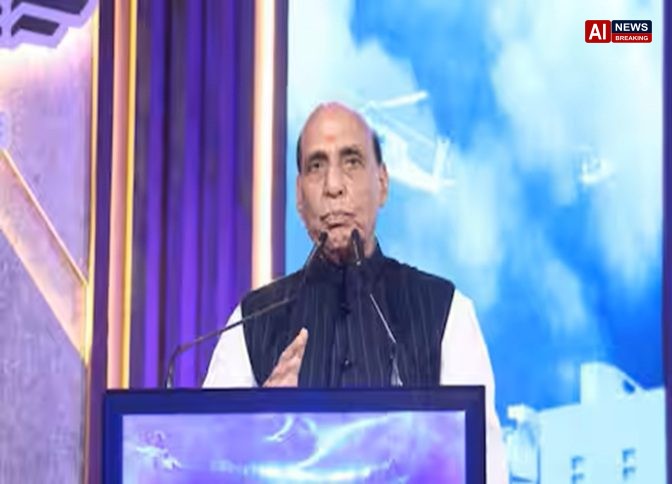
Rajnath Singh Warns Pakistan: India Ready for 'Every Kind of Strike' Against Terrorism - AI News Breaking
India’s defence minister, Rajnath Singh, used a high‑profile press briefing to underscore the country’s willingness to employ “every kind of strike” in response to what he described as Pakistan’s continued support for terrorism.
Speaking to a gathering of senior military officials and journalists in New Delhi, Singh said that while India “seeks peace and stability in the region,” it would not compromise on national security if Islamabad persisted in harbouring groups that threaten Indian territory. The minister’s remarks come amid a series of cross‑border incidents that have heightened tensions between the two nuclear‑armed neighbours, and they signal a potential shift in New Delhi’s strategic posture.In his statement, Singh referred to the recent spate of attacks on Indian soil that he attributed to militants operating from Pakistani territory..
He cited the killing of a senior police officer in Jammu and Kashmir, a grenade explosion in Punjab, and a series of low‑intensity assaults on security installations in the capital region as evidence of an “uninterrupted pattern” of hostile activity. While Indian officials have not publicly named the specific groups involved, they have consistently accused Pakistan‑based outfits such as Lashkar‑e‑Taiba, Jaish‑e‑Mohammed and Hizbul Mujahideen of orchestrating or facilitating such attacks. Islamabad, for its part, has denied any state sponsorship and has urged India to engage in dialogue rather than resort to force.Singh’s warning that India is prepared to launch “all types of strikes” was accompanied by a reference to the country’s expanding repertoire of precision‑guided weapons and its growing confidence in joint operations with allied forces..
He noted that the Indian armed forces have recently conducted successful drills involving the integration of air, land and cyber capabilities, and that these exercises have sharpened the military’s readiness to respond swiftly to any breach of Indian airspace or territory. The minister also highlighted the acquisition of new platforms, including the Rafale fighter jets, the S-400 air defence system and indigenous missile projects, as evidence of India’s “strategic depth” and its ability to project power across the sub‑continent.The remarks were delivered against the backdrop of a broader diplomatic overture by India to the United States and other Western partners. In recent weeks, New Delhi has sought to deepen security cooperation with Washington, citing shared concerns about extremist networks operating in South Asia..
The United States, while maintaining its “strategic partnership” with India, has repeatedly called for restraint and urged both sides to avoid escalation. In a separate statement, a senior U.S. official said that any unilateral military action by India would need to be proportionate, transparent and consistent with international law..
This diplomatic nuance adds complexity to Singh’s declaration, suggesting that while India may be prepared for a robust response, it will also have to navigate the expectations of its global partners.Pakistan’s foreign ministry responded to the Indian minister’s comments with a measured denial. In a brief statement, the Pakistani spokesperson dismissed the allegations of state‑sponsored terrorism as “baseless” and urged India to “focus on constructive engagement rather than threats of retaliation.” The statement also reiterated Islamabad’s commitment to the Lahore Declaration of 1999, which called for both countries to resolve disputes through dialogue. However, the diplomatic exchange has been marked by a noticeable hardening of language on both sides, reflecting a growing impatience that has been evident since the 2020 border skirmishes in the Line of Control.Analysts in New Delhi suggest that the minister’s forceful rhetoric may be intended to convey a domestic message as much as an international one..
Public opinion polls have shown an increase in Indian citizens’ concern over cross‑border terrorism, particularly in the wake of the recent attacks. By articulating a clear and uncompromising stance, the government appears to be addressing domestic expectations for a decisive response, while also signalling to the military establishment that political support for robust defence measures remains strong. Some commentators argue that the timing of the statement, coming just weeks before a scheduled parliamentary session on defence procurement, could be aimed at securing bipartisan backing for upcoming budget allocations.The strategic calculus underlying Singh’s warning is also shaped by the evolving security environment in the Indian Ocean region..
With China’s growing naval presence and its deepening defence ties with Pakistan, Indian officials have expressed concern that the maritime domain could become another front for proxy conflict. Singh referenced the need to protect “sea lanes of communication” and to deter any attempts to disrupt the flow of trade through the Arabian Sea. The Indian navy has recently expanded its fleet of anti‑submarine warfare assets and has increased patrols in the Indian Ocean Region, a move that aligns with broader efforts to counter potential encroachments by rival powers.International reaction to the minister’s remarks has been cautious..
The United Nations Security Council, which has convened intermittently to discuss South Asian security issues, has yet to issue a formal statement on the latest developments. However, several member states have called for a de‑escalation of rhetoric and a return to confidence‑building measures, such as the exchange of military liaison officers and the re‑establishment of hotlines between the two capitals. The European Union, in a recent policy brief, warned that any unilateral military action could destabilise an already fragile regional balance and urged both India and Pakistan to adhere to existing ceasefire agreements.The economic implications of heightened military tension cannot be ignored..
Both India and Pakistan rely heavily on trade routes that traverse contested zones, and any escalation could disrupt supply chains, affect commodity prices and deter foreign investment. The World Bank has noted that political instability in South Asia remains a key risk factor for economic growth in the region. In this context, Singh’s emphasis on “every kind of strike” may carry an implicit acknowledgement that any military response would need to be calibrated to minimise collateral damage and avoid broader economic fallout.In the coming weeks, the trajectory of India‑Pakistan relations will likely be influenced by a combination of diplomatic initiatives, intelligence assessments and the internal political calculations of both governments..
While Singh’s declaration underscores a readiness to act decisively, it also reflects the complexities of a security environment where conventional military force is increasingly intertwined with cyber operations, information warfare and proxy engagements. As both nations navigate these challenges, the international community will be watching closely to see whether deterrence through a show of force can coexist with the pursuit of lasting peace.The situation remains fluid, and the efficacy of any potential strike will depend on the accuracy of intelligence, the precision of weaponry and the diplomatic fallout that follows. For now, the defence minister’s message is clear: India will not hesitate to employ its full military capability if it perceives a direct threat to its sovereignty, but it will also seek to balance that resolve with.
Updated: September 27, 2026
India’s blaring threat is as much a domestic confidence‑boosting move—pressuring parliament to green‑light a bigger defence spend—as it is a signal to Pakistan that New Delhi is ready to wield its new high‑tech arsenal before Western powers can intervene.