
 Pakistan’s leaders hail first astronaut aboard Chinese craft: ‘Proud one of us has gone into space’
 British tourist travels 29 hours from Mumbai to Amritsar for ₹5,461, rates Indian Railways 10/10 | Viral video
 The Supreme Court will decide whether assault weapons bans violate the Second Amendment
 A Critic of Beijing Falls Short in Taiwan’s Key Mayoral Election
 EPA says no rise in contamination after Army detonates lead azide stockpile in Iowa
Robo-soldier startup backed by Eric Trump misses payroll, may collapse
**
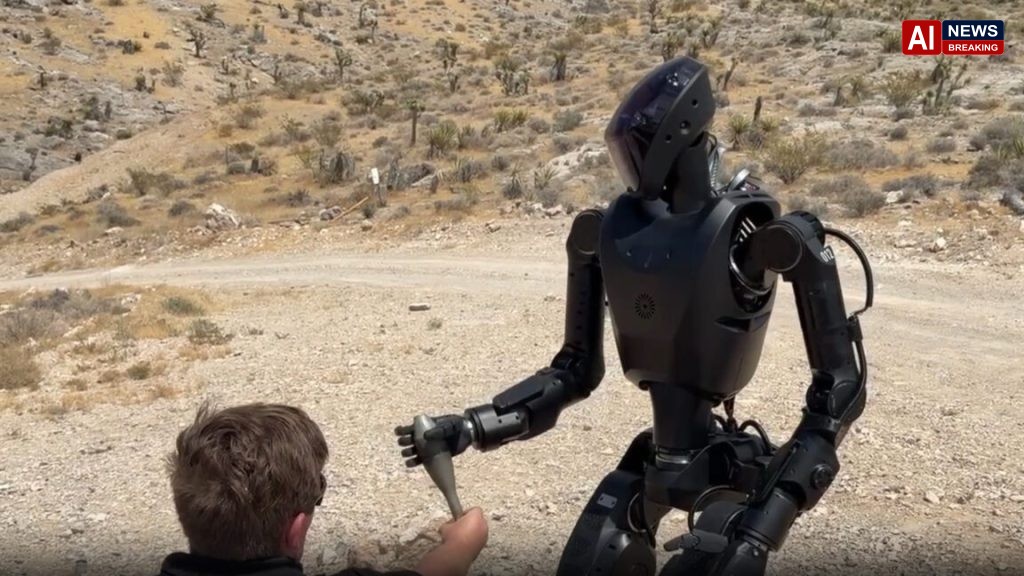
Robo-soldier startup backed by Eric Trump misses payroll, may collapse - AI News Breaking
robosoldier startup backed eric:
Robo‑soldier startup backed by Eric Trump misses payroll, may collapse Foundation Future Industries, a Silicon Valley venture that boasts a connection to President Donald Trump’s son, Eric Trump, has reportedly failed to pay its employees for the payroll cycle ending on 30 October. Sources told CNBC that workers have not received wages, sparking unrest across the company’s 120‑person workforce. The incident comes at a time when the firm is reportedly chasing a $3 billion valuation and scrambling to secure fresh capital..
The combination of leadership missteps and funding uncertainty suggests that the startup may be on the brink of collapse. Foundation Future Industries was launched in 2019 by a cohort of ex‑military engineers and robotics specialists. The company’s mission is to design humanoid robots that can perform a range of tasks on modern battlefields, from reconnaissance in Ukraine to logistics in Gaza..
By 2023, the firm claimed to have produced a prototype called “Sentinel‑A,” which it says can carry a 12‑kilogram weapon load and navigate rough terrain autonomously. Despite such bold claims, the firm has yet to demonstrate a fully operational system in the field. Eric Trump joined the venture as a strategic advisor and investor in early 2022, a move that drew attention from both the tech press and political commentators..
Trump, who has long been involved in various business pursuits, said he was “excited to be part of a company that could redefine modern warfare.” Foundation’s co‑founder and CEO, Sankaet Pathak, has cited the Trump connection as a key lever for raising capital, asserting that the endorsement had opened doors to senior defense officials. Critics, however, argue that the tie may be more a marketing ploy than a substantive partnership. According to the anonymous source quoted by CNBC, employees were scheduled to receive their October 30 payroll, but no payment was processed..
The source said the company’s accounting system was flagged for “severe discrepancies” and that the finance team was “in disarray.” Workers, many of whom are engineers and technicians, have expressed frustration through private Slack channels and a now‑public letter to the board. “We were promised a paycheck, not a mystery,” wrote one employee, a senior robotics technician, in a terse note that spread across internal forums. The root of the payroll failure, the source claims, is linked to a large cash outflow by CEO Pathak earlier this year..
Pathak allegedly withdrew $4.6 million from company accounts to purchase a luxury home overlooking San Francisco Bay. The purchase, which closed in late 2022, was reportedly financed through a personal loan rather than company funds. The company’s financial statements do not reflect the transaction, raising questions about transparency and fiduciary responsibility..
The board has yet to comment on the matter, and a formal audit is reportedly underway. Foundation’s leadership, meanwhile, remains determined to secure an additional $200 million in equity funding. According to a leaked pitch deck, the company projects that it will need to raise this sum to cover operational expenses for the next 12 months and accelerate product development..
The pitch outlines a planned $3 billion valuation, positioning the company as a potential “next‑gen” competitor to larger defense contractors such as Lockheed Martin and BAE Systems. The deck claims that once a combat‑ready robot is field‑tested, the firm could capture a significant share of the U.S. military’s future procurement budget..
However, the company’s prospects have been tempered by a series of setbacks. In February, a prototype of the “Sentinel‑A” suffered a hardware failure during a live‑fire test, causing a minor injury to a test engineer. The incident was widely covered in defense‑tech blogs, with analysts pointing out that the robot’s battery management system had not been fully vetted..
Foundation’s press releases claim the issue has been addressed, but independent reviews remain pending. The lack of an independent third‑party validation has further eroded investor confidence. The funding shortfall that led to the payroll issue is part of a larger pattern of cash flow problems..
In 2024, the company’s burn rate reportedly exceeded $15 million per month, a figure that eclipses the company’s current revenue from consulting contracts with a handful of defense contractors. The majority of the firm’s income comes from licensing agreements and small‑scale production contracts, which do not yet scale to the $200 million funding target. Analysts estimate that without an infusion of capital, Foundation will run out of money by mid‑2025..
The startup’s investors have responded with a mix of concern and cautious optimism. One unnamed venture capital firm said it was “closely monitoring the situation” and that the board had presented an emergency financial plan. The plan includes cost‑cutting measures such as staff reductions and temporary suspension of non‑critical research projects..
In a meeting held in June, the board reportedly agreed to a three‑month grace period, contingent on securing a bridge loan from a private equity partner. Yet no such loan has materialised to date. Meanwhile, Eric Trump’s involvement has attracted scrutiny from both political and corporate watchdogs..
A spokesperson for the Trump family denied any knowledge of the company’s internal financial mismanagement. The spokesperson said the family’s “sole interest” is to “support innovative defense technologies.” Despite this, the company’s association with the Trump name has become a double‑edged sword. Some potential investors, wary of political backlash.
Updated: November 16, 2026
Foundation Future Industries, backed by Eric Trump, has failed to pay its 120‑person payroll for October, sparking unrest and raising doubts about the startup’s liquidity. The company, seeking a $3 billion valuation, faces a looming cash‑flow crisis amid leadership missteps and an ongoing audit.
The payroll collapse exposes a startup still chasing a $3 billion fantasy while drowning in cash‑flow mismanagement, a reminder that political celebrity can inflate valuations but cannot substitute for solid governance. If Foundation’s leadership fails to secure a bridge loan, the venture’s failure will ripple through the defense‑tech supply chain, tightening the scrutiny on privately funded military innovation.






