
 Pakistan’s leaders hail first astronaut aboard Chinese craft: ‘Proud one of us has gone into space’
 British tourist travels 29 hours from Mumbai to Amritsar for ₹5,461, rates Indian Railways 10/10 | Viral video
 The Supreme Court will decide whether assault weapons bans violate the Second Amendment
 A Critic of Beijing Falls Short in Taiwan’s Key Mayoral Election
 EPA says no rise in contamination after Army detonates lead azide stockpile in Iowa
Samajwadi Party and Congress negotiate alliance for Uttar Pradesh elections
**
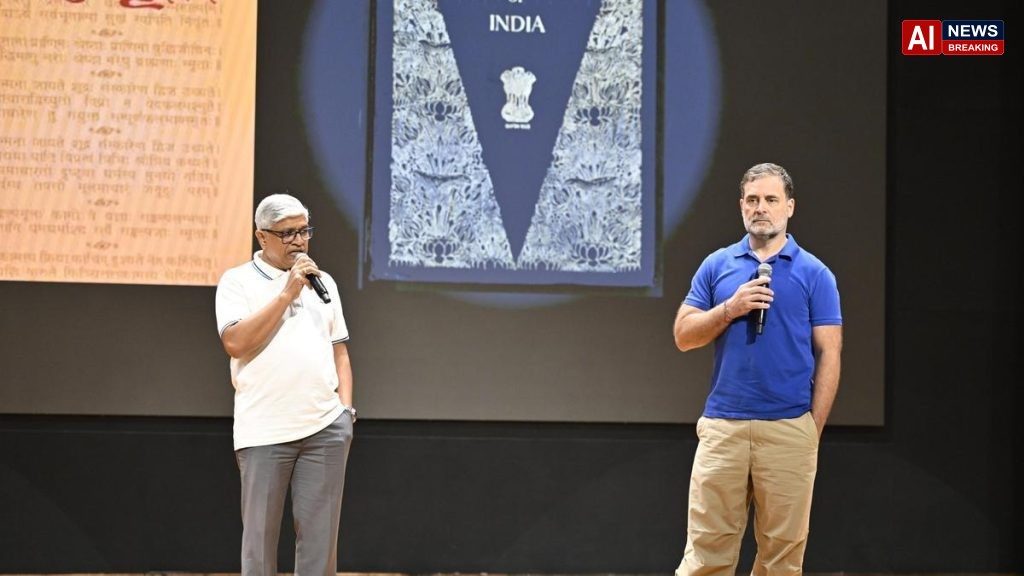
Congress hopeful of U.P. alliance with SP, seeks ‘respectable’ seat-sharing - AI News Breaking
samajwadi party congress negotiate:
The Uttar Pradesh political landscape is poised for a new configuration as the Samajwadi Party (SP) seeks to forge an alliance with the Congress ahead of the 2024 general elections, a development that could reshape the balance of power in India’s most populous state. Sources close to the negotiations say that the Congress, still reeling from a disappointing performance in the 2022 state assembly elections, is eager to secure a “respectable” share of seats in any partnership, while the SP, under the leadership of Akhilesh Yadav, appears willing to accommodate a junior ally if it strengthens its challenge to the ruling Bharatiya Janata Party (BJP).The talks have reportedly intensified over the past month, with senior leaders from both parties meeting in Delhi and Lucknow to hash out the terms of a possible seat‑sharing arrangement. While the exact number of constituencies that the Congress hopes to contest remains undisclosed, insiders suggest that the party is aiming for a minimum of 30-35 Lok Sabha seats in Uttar Pradesh, a figure that would represent a modest but symbolically important presence in a state that contributes 80 seats to the national parliament..
For the SP, conceding such a share would be a calculated risk, balancing the need to present a united front against the BJP with the desire to maintain dominance over the alliance’s electoral strategy.Political analysts note that the prospect of a SP‑Congress alliance reflects a broader trend of anti‑BJP coalition building across the country, where regional parties are increasingly looking to national players for strategic depth. “The BJP’s sweep in 2019 and its continued dominance in Uttar Pradesh have forced opposition parties to rethink their approach,” says Dr. Richa Sharma, a senior fellow at the Centre for Indian Politics..
“A partnership that brings together the SP’s grassroots network and the Congress’s institutional experience could pose a credible challenge, provided they can agree on seat distribution and campaign messaging.”However, the negotiations are not without friction. Within the Congress, there is a faction that argues the party should not compromise on its traditional strongholds, such as the Muslim‑dominated districts of Moradabad and Rampur, where it still enjoys a loyal voter base. Conversely, the SP’s leadership is keen to protect its influence in key regions like western Uttar Pradesh, where it has historically fielded strong candidates..
The two sides are also wrestling with the question of candidate selection, a process that could become contentious if local party units feel sidelined by central leadership.Amid the strategic deliberations, Rajendra Pal Gautam, a prominent Congress leader from the state, has been vocal about the need for a partnership that respects both parties’ contributions. In a recent interview, Gautam asserted, “We were weak, but we are not weak now. We have the best leader in this country right now, as only we can handle the BJP better than any other party.” While his remarks were aimed at bolstering morale within the Congress ranks, they also underscore the party’s confidence in its national leadership under Prime Minister Narendra Modi, a stance that could complicate alliance talks with a party that has historically positioned itself as the main opposition at the centre.The BJP, for its part, has welcomed the prospect of a divided opposition, warning voters that a coalition could lead to “unstable governance” and “policy paralysis.” Party spokespersons have reiterated the narrative that only the BJP can provide continuity and development for Uttar Pradesh, citing infrastructure projects and welfare schemes launched in recent years..
Yet, internal BJP sources admit that the party is not complacent; senior officials are reportedly reviewing candidate lists and campaign strategies to counter any unified front that might emerge from the SP‑Congress talks.Grassroots reactions to the potential alliance are mixed. In urban centres such as Lucknow and Kanpur, where voters are increasingly concerned about employment, education, and law and order, some political observers note a growing appetite for an alternative to the BJP’s narrative. “If the opposition can present a cohesive platform that addresses local issues, it could sway a significant portion of the electorate,” says Arvind Mehta, a political commentator based in Varanasi..
Rural voters, however, remain deeply entrenched in caste and community loyalties, making it uncertain whether a top‑down alliance will translate into tangible vote transfers on the ground.The timing of the negotiations also coincides with a series of high‑profile rallies and public meetings organized by both the SP and Congress, aimed at gauging voter sentiment and testing the resonance of potential coalition messages. Recent rallies in Aligarh and Agra attracted crowds of over 50,000 people, with speeches emphasizing anti‑corruption, social justice, and economic revival. These events have been closely monitored by election analysts, who view them as barometers for the alliance’s prospective appeal.As the election calendar tightens, the pressure to finalize an agreement grows..
The Election Commission of India has set a deadline for parties to submit their candidate lists and seat‑sharing details, a procedural requirement that will force the SP and Congress to lock in their arrangement or risk missing the filing window. Failure to reach a consensus could see the two parties contesting the election separately, potentially fragmenting the anti‑BJP vote and reinforcing the incumbent’s dominance.Regardless of the outcome, the emerging dialogue between the Samajwadi Party and the Congress signals a pivotal moment in Uttar Pradesh’s political calculus. Whether the alliance can overcome internal divergences and present a united front will be a key determinant of the state’s role in shaping the national parliamentary balance..
As the campaign season approaches, voters will be watching closely to see if the promise of a “respectable” seat‑sharing deal translates into a credible alternative to the BJP’s continued rule..
If SP and Congress can meld the former’s grassroots muscle with the latter’s institutional gravitas, Uttar Pradesh could become the opposition’s decisive swing‑state rather than just a BJP stronghold.
Yet the alliance’s survival hinges on whether seat‑sharing compromises trigger internal fractures before voters






