
 Pakistan’s leaders hail first astronaut aboard Chinese craft: ‘Proud one of us has gone into space’
 British tourist travels 29 hours from Mumbai to Amritsar for ₹5,461, rates Indian Railways 10/10 | Viral video
 The Supreme Court will decide whether assault weapons bans violate the Second Amendment
 A Critic of Beijing Falls Short in Taiwan’s Key Mayoral Election
 EPA says no rise in contamination after Army detonates lead azide stockpile in Iowa
Putin praises India’s linguistic diversity.
**
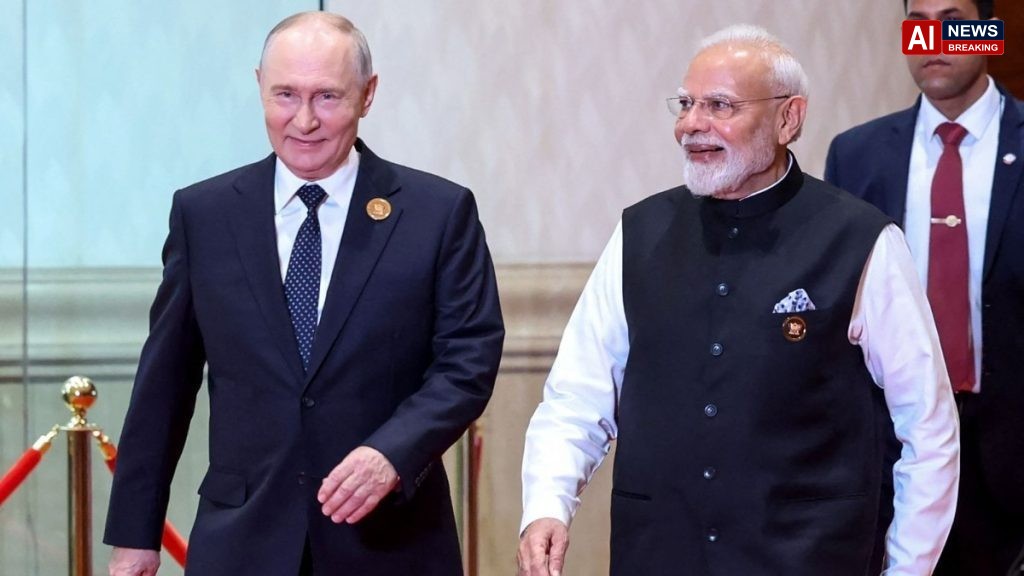
Putin praises India’s linguistic diversity. - AI News Breaking
putin praises indias linguistic:
Russian President Vladimir Putin has once again turned his diplomatic attention to India, this time highlighting the country’s linguistic mosaic after a recent conversation with Prime Minister Narendra Modi. The exchange, which took place during Modi’s official visit to Moscow in late October, was framed by both leaders as an opportunity to deepen strategic ties, but it also afforded a rare moment for cultural commentary. Putin’s remarks about India’s “rich tapestry of languages” were met with a mixture of appreciation in New Delhi and cautious analysis among observers who note the broader geopolitical context in which such praise is offered.In a televised joint press conference, Modi thanked the Russian leader for his “warm acknowledgment of India’s cultural pluralism.” Putin responded, “India’s linguistic diversity is extraordinary..
Over a thousand languages thrive across the subcontinent, each contributing to a vibrant civilisational heritage. It is a testament to the strength that comes from embracing plurality.” The president’s statement, while seemingly ceremonial, carries significance for several reasons: it underscores the personal rapport between the two heads of state, signals Moscow’s interest in soft‑power engagement, and subtly reflects the Russian narrative of multiculturalism as a counterpoint to Western criticism of its own domestic policies.The dialogue came at a time when India is navigating a complex set of foreign policy priorities. While the country has deepened its defence and energy cooperation with Russia, it simultaneously seeks to maintain a balanced relationship with the United States, the European Union, and its Asian neighbours..
Modi’s visit, which featured the signing of multiple agreements ranging from nuclear energy to cybersecurity, was therefore closely watched for any indication of a shift in India’s strategic calculus. Putin’s cultural commendation, inserted into the political discourse, can be interpreted as an attempt to reinforce a personal bond that may smooth over any friction arising from India’s broader diplomatic engagements.Analysts point out that Russia has long used cultural diplomacy to cultivate influence in regions where it wishes to counterbalance Western sway. In the post‑Cold War era, Moscow’s outreach has included literary festivals, language institutes, and film collaborations, particularly in nations with historic ties to the Soviet Union..
By highlighting India’s linguistic plurality, Putin taps into a narrative that celebrates diversity as a universal value, aligning Russia with a cause that resonates globally. This approach may serve to present Russia as a partner that respects and acknowledges the internal complexities of its allies, a subtle contrast to accusations of cultural homogenisation levelled against the West.Indian reactions to the president’s comments were largely positive, though measured. The Ministry of External Affairs issued a statement noting that “the President’s appreciation of India’s linguistic heritage reflects the deepening friendship between our nations.” Cultural organisations, including the Sahitya Akademi and various regional language bodies, welcomed the acknowledgment, viewing it as an endorsement that could potentially boost international interest in Indian literature and arts..
However, some scholars cautioned that the praise should not be conflated with concrete policy support, emphasizing that genuine promotion of linguistic diversity requires sustained investment in education and media, areas where India still faces challenges.The broader diplomatic backdrop includes ongoing tensions between Russia and Western powers over the conflict in Ukraine. India has maintained a nuanced stance, abstaining from United Nations votes that directly condemn Russia while continuing to import Russian oil at discounted rates. This balancing act has drawn criticism from some quarters, particularly in the United States, where policymakers argue that India’s engagement with Moscow may undermine collective efforts to isolate Russia..
In this context, Putin’s positive remarks about Indian culture could be seen as an attempt to deepen goodwill and perhaps secure a more favourable position for Russia in any future negotiations concerning trade or security.Domestic politics in Russia also provide a lens through which to view the comments. President Putin has frequently invoked themes of multiculturalism and historical continuity to bolster his own legitimacy, especially as the country grapples with demographic shifts and regional disparities. By lauding India’s linguistic landscape, he aligns his narrative with that of a fellow large, diverse nation, subtly reinforcing the idea that strong, centralized leadership can accommodate a multitude of identities..
This rhetorical parallel may be intended for both domestic consumption and international audiences.From India’s perspective, the recognition of linguistic diversity touches on a long‑standing internal debate. The Indian Constitution recognises 22 scheduled languages, while the census identifies over 1,600 mother tongues spoken across the country. Policies aimed at preserving and promoting these languages have varied in effectiveness, often hampered by limited funding and the dominance of Hindi and English in education and administration..
International acknowledgment, such as Putin’s, may provide a morale boost, but experts warn that substantive progress will depend on domestic policy reforms rather than diplomatic platitudes.The meeting also included discussions on collaborative projects in the field of technology and space exploration. Both nations have a history of joint ventures, dating back to the 1970s when Soviet engineers assisted India in developing its early launch capabilities. Recent agreements aim to expand cooperation in satellite navigation, remote sensing, and joint research on climate‑resilient technologies..
While these technical accords were the headline of the visit, the cultural commentary served to humanise the partnership, reminding both publics that the relationship extends beyond strategic assets.International media have portrayed Putin’s remarks as a diplomatic flourish, noting that leaders often use cultural references to soften the edges of hard‑nosed negotiations. The Times of India highlighted the president’s “unexpected yet heartfelt tribute,” whereas Russian outlets framed the exchange as evidence of mutual respect. Western commentators, however, remained skeptical, suggesting that such soft‑power gestures could be employed to deflect attention from Russia’s geopolitical ambitions and the sanctions regime imposed by the West.In the weeks following the visit, Indian officials have signalled an intent to organise a series of cultural exchanges, including literary festivals and language workshops, with Russian participation..
These initiatives, if realised, could foster people‑to‑people contact and deepen mutual understanding, aligning with the rhetoric of diversity celebrated by Putin. Yet, the success of such programs will likely hinge on logistical support, funding, and the ability to navigate differing political climates, especially as both countries confront internal challenges and external pressures.Ultimately, the episode reflects a broader pattern in contemporary diplomacy where cultural acknowledgment is leveraged as a tool to reinforce strategic alliances. Putin’s praise of India’s linguistic richness, while ostensibly a courteous compliment, operates within a matrix of geopolitical maneuvering, domestic narratives, and soft‑power aspirations..
For India, the acknowledgement offers an opportunity to spotlight its cultural heritage on the world stage, but it also underscores the need for concrete policy measures to preserve and promote the very diversity that was lauded. As the two nations continue to chart their partnership amidst a shifting global order, the interplay between rhetoric and action will determine whether.
Putin’s praise of India’s linguistic mosaic is less a cultural celebration than a subtle nod that Moscow can count on a partner who thrives on pluralism while quietly sidestepping Western scrutiny. It signals Russia’s desire to weave soft‑power into a strategic partnership that may cushion India’s own






