Pakistan’s leaders hail first astronaut aboard Chinese craft: ‘Proud one of us has gone into space’
 British tourist travels 29 hours from Mumbai to Amritsar for ₹5,461, rates Indian Railways 10/10 | Viral video
 The Supreme Court will decide whether assault weapons bans violate the Second Amendment
 A Critic of Beijing Falls Short in Taiwan’s Key Mayoral Election
 EPA says no rise in contamination after Army detonates lead azide stockpile in Iowa
Trump Administration Blocks China from Indirect Access to U.S. AI
**
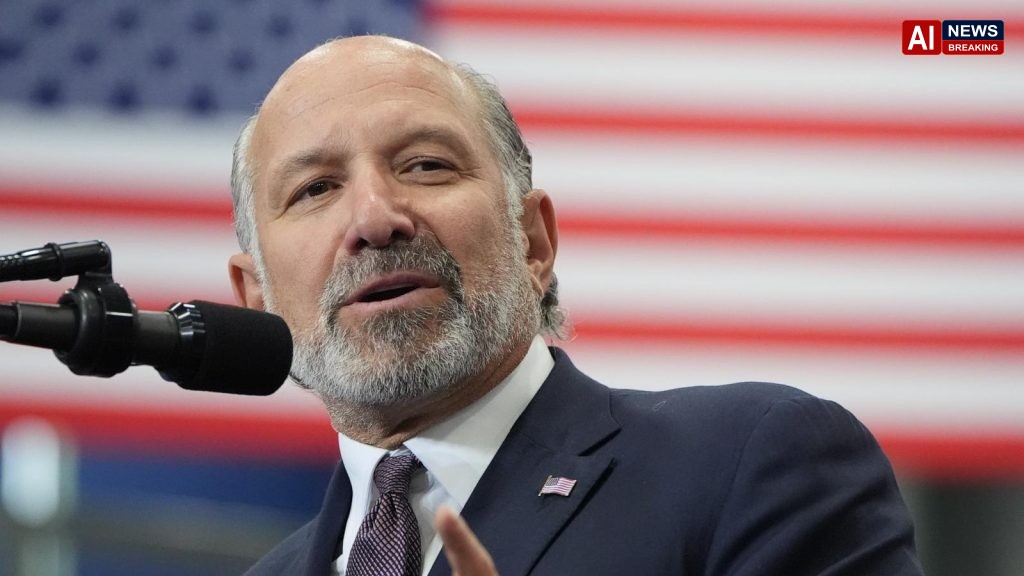
Trump Administration Blocks China from Indirect Access to U.S. AI - AI News Breaking
Trump administration moves to block China from indirect access to American AI technology The White House unveiled a sweeping set of regulations on Monday aimed at preventing Chinese entities from obtaining advanced U.S. artificial‑intelligence hardware through indirect channels. The new rules, issued by the Department of Commerce under the Export Administration Regulations, extend existing export controls to cover remote access to high‑performance computing chips and cloud‑based servers located in the United States..
Officials say the move is a “necessary safeguard” against the rapid militarisation of AI by Beijing and a response to growing evidence that Chinese firms have been sidestepping earlier restrictions by using foreign subsidiaries and third‑party service providers. Under the revised framework, U.S. chip manufacturers such as Nvidia, AMD and Intel will be required to embed “end‑use” verification mechanisms into their products, ensuring that any remote‑access request originates from a vetted U.S..
Cloud operators, including Amazon Web Services, Microsoft Azure and Google Cloud, must also implement real‑time monitoring tools that flag connections from IP addresses linked to sanctioned Chinese institutions. Failure to comply could trigger civil penalties of up to $1 million per violation, a figure that underscores the administration’s intent to enforce the rules aggressively. The policy shift follows a series of high‑profile incidents in which Chinese research groups allegedly accessed U.S..
supercomputing resources to train large‑scale language models. In one case, a university in Shanghai was found to have used a U.S.‑based cloud platform to run a transformer model with billions of parameters, prompting concerns that sensitive algorithmic techniques could be weaponised. The administration argues that the indirect pathways—often hidden behind layers of corporate restructuring—pose a greater risk than direct exports, because they are harder to track and can circumvent existing licensing regimes..
Industry reaction has been mixed. While many technology executives welcome clearer guidance on compliance, they warn that the added administrative burden could slow innovation. “We understand the national‑security rationale, but the requirement to vet every remote session adds latency that could affect time‑critical research,” said a senior engineer at a leading AI startup..
Trade groups, however, have largely backed the move, noting that the United States cannot afford to cede its AI lead to a rival that is rapidly scaling its own capabilities through state‑backed investment and talent acquisition. Congressional oversight committees are already gearing up for hearings on the new rules. Senators on the Senate Commerce Committee have expressed both support and skepticism, with some urging the administration to provide more transparency about the data that triggered the policy change..
Democratic members have called for a bipartisan review to ensure that the measures do not inadvertently harm allied partners who rely on U.S. cloud services for their own AI research, while Republican legislators have praised the administration for taking a “tough stance” on China’s techno‑strategic ambitions. Legal experts point out that the regulations could be tested in court, given their broad scope..
The Export Administration Regulations have historically been challenged on the grounds of overreach, and the inclusion of remote‑access controls may raise novel questions about jurisdiction and extraterritorial enforcement. company provides a service to a foreign user, the line between export and service provision becomes blurry,” noted a professor of international trade law. He added that any enforcement action will need to balance national security with the principles of free commerce that underpin the global tech ecosystem..
The Chinese government has condemned the rules as “unjustified discrimination” and a violation of international trade norms. In a statement released by the Ministry of Commerce, Beijing warned that the United States was “undermining the foundations of a fair and open digital market” and hinted at reciprocal measures targeting American firms operating in China. Diplomatic sources say that Beijing is preparing a formal complaint to the World Trade Organization, though analysts believe the likelihood of a successful challenge is low given the security‑focused nature of the restrictions..
Despite the diplomatic tension, some Chinese researchers appear to be seeking workarounds. Reports from cybersecurity firms indicate that certain Chinese entities are experimenting with “shadow” cloud environments hosted in third‑party jurisdictions such as Singapore and the United Arab Emirates, where U.S. export controls are less direct..
These satellite clouds could act as intermediaries, funneling data to U.S. hardware while obscuring the ultimate end‑user. The administration’s rules explicitly forbid such circumvention, but enforcement will require close cooperation with foreign regulators..
The Biden administration, which is still in the process of finalising its own AI strategy, has signalled that it will review the Trump‑era measures for consistency with broader policy objectives. Sources within the Office of Science and Technology Policy say that a “coordinated approach” is needed, one that aligns export controls with domestic investment in AI research and workforce development. However, they also note that the geopolitical urgency of the issue may limit the scope for major revisions before the next election cycle..
Analysts at think tanks specialising in technology security argue that the United States is entering a new phase of “digital containment,” where the battle lines are drawn not only in hardware but also in the software pipelines that run on them. By tightening remote‑access rules, the administration hopes to create a firewall around its most powerful AI tools, making it harder for adversaries to replicate cutting‑edge models. Critics warn that such containment could spur.
Updated: November 17, 2026
Summary: The White House announced new export‑control rules that force U.S. chip makers and cloud providers to verify the end‑use of high‑performance AI hardware and services, aiming to stop Chinese entities from accessing the technology via indirect channels. The move, framed as a national‑security safeguard, has drawn mixed industry reactions and sparked concerns over compliance burdens and potential trade disputes with Beijing.
By forcing AI firms to police every remote session, the U.S. is turning its own cloud infrastructure into a frontline checkpoint—turning convenience into a strategic choke point. This “digital containment” may slow Chinese model‑training, but it also risks turning the global AI ecosystem into a bureaucratic maze that