
 Pakistan’s leaders hail first astronaut aboard Chinese craft: ‘Proud one of us has gone into space’
 British tourist travels 29 hours from Mumbai to Amritsar for ₹5,461, rates Indian Railways 10/10 | Viral video
 The Supreme Court will decide whether assault weapons bans violate the Second Amendment
 A Critic of Beijing Falls Short in Taiwan’s Key Mayoral Election
 EPA says no rise in contamination after Army detonates lead azide stockpile in Iowa
Voyager 1 reaches one light‑day from Earth.
**
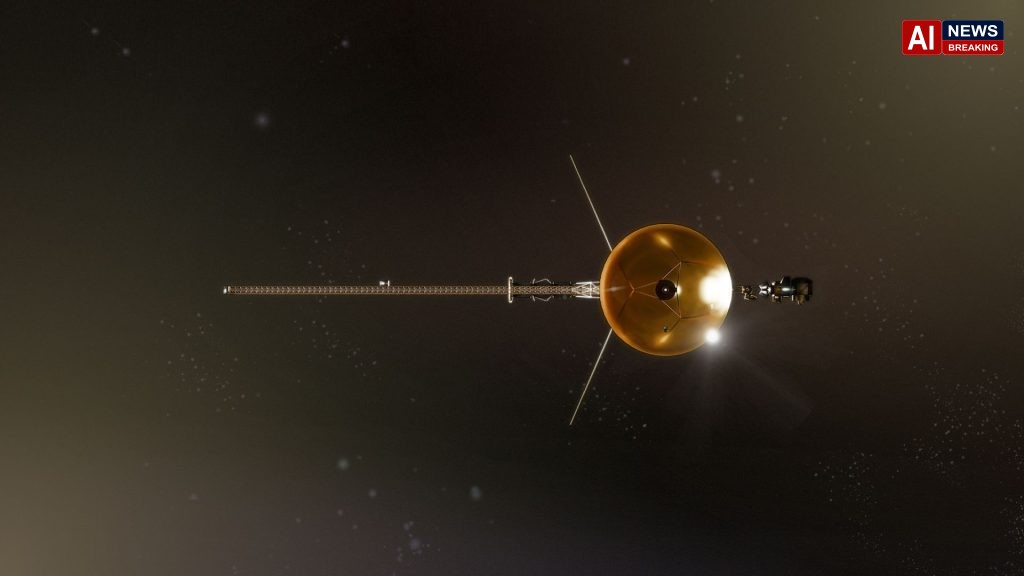
Voyager 1 reaches one light‑day from Earth. - AI News Breaking
voyager reaches lightday earth:
NASA’s interstellar Voyager 1 probe is about to reach 1 light-day from Earth after nearly 50 years in space NASA’s long‑running Voyager 1 mission is poised to celebrate a historic milestone this November. After almost half a century of travel, the spacecraft will be one light‑day from Earth, a distance equivalent to the time it takes light to cover the space between the two bodies. The event is scheduled for November 18th, when the probe is 49 years, two months and 11 days old, a moment that NASA has described as “a huge milestone by any measure, and a day worth celebrating.” The exact timing of the milestone is 5:16:07 a.m..
Eastern Standard Time, which corresponds to 10:16:07 a.m. At that instant, Voyager 1 will have traversed more than 6.9 astronomical units beyond the orbit of Pluto, venturing deeper into the interstellar medium than any other human‑made object has ever reached. The probe’s trajectory will bring it into the realm where the Sun’s solar wind gives way to the galactic environment..
For the milestone, Voyager 1 will maintain communication with the Madrid Deep Space Network station, one of the three globally distributed antennas that support all deep‑space missions. The Madrid station has been a reliable partner since the probe’s launch in 1977, relaying data that helps scientists understand both the probe’s health and the environment it has entered. The link will remain active for several hours to allow scientists to collect and transmit the data collected during the crossing..
The spacecraft’s current path takes it through the Ophiuchus constellation from Earth’s perspective, according to NASA official Jeffrey Hayes. Although the probe is no longer visible to the naked eye, its journey continues to be tracked by the Deep Space Network with high precision. This constellational reference helps scientists calibrate its position and anticipate future communication windows as the probe moves further into the outer reaches of the heliosphere..
Voyager 1 was launched on 5 September 1977, as part of NASA’s twin‑probe Voyager program designed to study the outer planets. Its primary mission included close encounters with Jupiter, Saturn, and their moons, but the probe exceeded all expectations by entering interstellar space in 2012. The data returned from its journey has reshaped our understanding of the heliospheric boundary and the nature of the interstellar medium..
The probe carries a “Golden Record” that contains sounds and images intended to portray the diversity of life and culture on Earth. Although the record will never be reached by any living being, it remains a symbolic testament to humanity’s reach into the cosmos. The record’s contents were carefully curated by a committee chaired by Carl Sagan, and the final product is a 12‑inch gold‑plated copper disc..
As Voyager 1 crosses the one‑light‑day mark, scientists will record the time it takes for radio signals to travel back to Earth. The light‑day distance provides an exact reference point for calibrating models of signal delay and the speed of the interplanetary medium. Precise timing will help refine our understanding of the Sun’s influence on space weather and the transition to the galactic environment..
The spacecraft is powered by three radioisotope thermoelectric generators that convert heat from the natural decay of plutonium‑238 into electricity. Despite the ageing power source, the probe remains fully functional, with instruments operating at a fraction of their original output. The engineering team continues to monitor the power levels and schedule instrument usage to maximize the scientific return from the remaining years of operation..
Public interest in Voyager 1 remains high, with many people following the probe’s progress on social media and through official NASA updates. The upcoming milestone will be highlighted by a series of educational outreach activities, including virtual tours of the Deep Space Network and interactive sessions with scientists who have worked directly on the Voyager mission. These events aim to inspire a new generation of scientists and engineers..
The celebration is also a reminder of the longevity and resilience of space missions. Voyager 1’s continued operation more than 45 years beyond its design life underscores the quality of its engineering and the foresight of its designers. The probe’s longevity offers valuable lessons for future interstellar missions that may require decades of uninterrupted operation in harsh space environments..
As the world watches the probe cross the one‑light‑day threshold, scientists are already planning for the next phase of data collection. The focus will shift to measuring the density and composition of the interstellar medium, as well as studying the cosmic rays that permeate our galaxy. Each new datum will add to our understanding of the universe beyond the Sun’s reach..
In conclusion, Voyager 1’s upcoming milestone is more than a numerical achievement; it is a testament to human curiosity and technological prowess. The probe’s journey has already expanded our knowledge of the solar system and the interstellar environment. As it enters a new chapter, the world will continue to watch its signal return, a silent conversation across the vastness of space..
Updated: November 16, 2026
Insight: Voyager 1’s one‑light‑day crossing isn’t just a distance marker—it’s a living proof that human ingenuity can outlast a planet’s own life cycle. Each radio ping it sends back is a quiet reminder that our curiosity keeps pushing the boundary of what a single spacecraft can endure, offering






