Pond heron found dead in Coimbatore tests positive for avian influenza
 Pakistan’s leaders hail first astronaut aboard Chinese craft: ‘Proud one of us has gone into space’
 British tourist travels 29 hours from Mumbai to Amritsar for ₹5,461, rates Indian Railways 10/10 | Viral video
 The Supreme Court will decide whether assault weapons bans violate the Second Amendment
 A Critic of Beijing Falls Short in Taiwan’s Key Mayoral Election
The New World Order: Is Global Leadership Becoming a Contest of Power Rather Than Principles AI News Breaking Editorial Analysis
The global order is changing as military power, economic pressure and technological rivalry reshape international politics. This editorial examines the crisis of global leadership and India’s role in the emerging multipolar world.
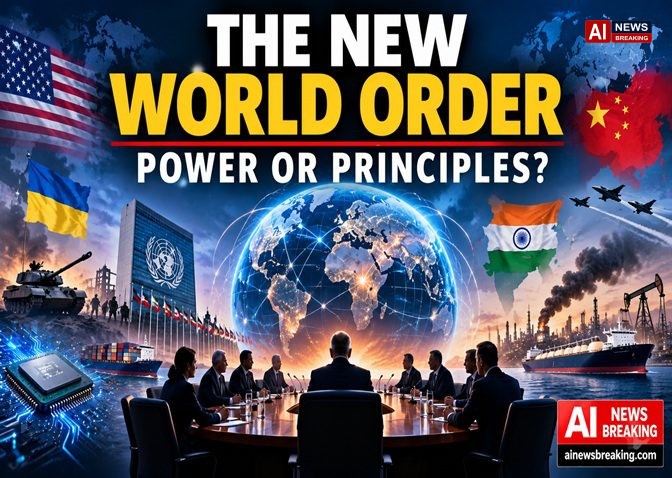
world order global leadership:
From Ukraine and Iran to US-China rivalry, economic sanctions and trade wars, the international system is facing a crisis of consistency. Powerful nations continue to speak about democracy, sovereignty and international law, but their actions increasingly raise questions about whether global leadership is guided by universal principles or strategic interests.
The world is witnessing a profound transformation in international politics. The institutions, diplomatic conventions and principles that shaped the post-Second World War international order are facing growing pressure. Military strength, economic influence, technological control, energy security and strategic alliances are increasingly determining how countries pursue their national interests.
The language of international diplomacy remains familiar: democracy, sovereignty, human rights, peace, freedom and international law. Yet the application of these principles often appears inconsistent when powerful nations confront geopolitical rivals, strategic partners or their own economic interests.
This raises a difficult question for the international community: Is the world moving towards a new international order governed by common principles, or one increasingly determined by the power to impose them?
The issue is particularly important for countries such as India, which seek strategic independence while navigating an increasingly competitive global environment.
Key Highlights
- Power politics is returning: Military capabilities, economic pressure and technological dominance are becoming central instruments of international influence.
- Ukraine peace negotiations: US-mediated talks between Russia and Ukraine have resumed in Abu Dhabi on November 10–11, highlighting the difficulty of reconciling territorial demands, sovereignty and security guarantees.
- US-China rivalry continues: Despite a temporary trade truce, Washington and Beijing remain competitors in technology, trade, strategic resources and global influence.
- Sanctions raise questions: Economic restrictions can serve foreign-policy objectives, but their humanitarian consequences and legal foundations remain subjects of international debate.
- International institutions face pressure: The effectiveness and independence of the United Nations and international judicial institutions are being tested.
- India’s strategic autonomy matters: New Delhi must protect its national interests without becoming dependent on any single geopolitical power.
1. The old international order is under pressure
The modern international order emerged from the destruction of the Second World War. The United Nations was established in 1945 with an ambition to prevent another global conflict and create a framework for cooperation among sovereign states.
The UN Charter established important principles, including sovereign equality, peaceful settlement of disputes and restrictions on the threat or use of force against the territorial integrity or political independence of states.
These principles were intended to apply to all countries, regardless of their military strength, economic influence or political system.
However, the international system has never operated as a perfectly equal arrangement. The five permanent members of the UN Security Council—the United States, Russia, China, France and the United Kingdom—possess veto powers that give them exceptional influence over major international security decisions.
This structure reflected the geopolitical realities of 1945. Today, however, the distribution of global economic and political influence has changed considerably.
China has emerged as a major economic and technological power. India is seeking a larger international role. Regional powers are expanding their diplomatic and military influence, while countries across Africa, Asia, Latin America and the Middle East are demanding greater representation in global institutions.
The result is a world in which established powers are attempting to preserve their influence while emerging powers seek greater freedom to shape international decisions.
The challenge is not simply the decline of one power and the rise of another. It is the growing uncertainty over which rules will govern international relations when powerful countries disagree.
2. Ukraine: Can sovereignty survive the politics of negotiation?
The Russia-Ukraine war remains one of the clearest tests of the international commitment to territorial sovereignty.
Russia’s full-scale invasion of Ukraine in February 2022 fundamentally challenged the principle that national borders should not be changed through military force. Ukraine has continued to defend its territorial integrity, while Western countries have provided military, financial and diplomatic support.
The war has also exposed divisions among major powers over security arrangements, territorial claims, NATO’s role and the future European security architecture.
An important development has emerged on November 10, 2026: US-mediated trilateral negotiations involving Russia, Ukraine and the United States have begun in Abu Dhabi. The two-day discussions are focused on security guarantees and the possible terms of a settlement.
The positions remain sharply divided. Moscow has demanded Ukrainian withdrawal from territories it claims, rejection of NATO membership and restrictions on Ukraine’s military capabilities. Kyiv has rejected territorial concessions and military restrictions, while seeking credible security guarantees.
These negotiations raise a fundamental question: Can a lasting peace agreement be considered just if a country under military attack is pressured to surrender territory? Equally, can a sustainable security arrangement be achieved without addressing the security concerns and political demands that have contributed to the conflict?
The international community must distinguish between ending active fighting and establishing a durable peace.
A settlement that simply rewards territorial conquest could weaken the principle of sovereignty. On the other hand, refusing meaningful diplomacy could prolong the human suffering and destruction.
The objective should be a settlement based on international law, Ukraine’s participation, credible security arrangements and a sustainable end to hostilities—not merely an agreement imposed by the strongest negotiating parties.
The fact that European governments have also sought a voice in discussions affecting their own security highlights another concern: international negotiations cannot remain credible if countries directly affected by the outcome are excluded from meaningful participation.
3. The United States and China: Competition disguised as cooperation?
The relationship between Washington and Beijing represents one of the defining struggles of the emerging international order.
Both countries recognise the economic benefits of cooperation, but they also compete for technological leadership, military influence, supply-chain security, critical minerals, artificial intelligence and control over strategic industries.
Trade has become an important instrument in this competition.
On November 9, 2026, China extended the suspension of additional tariffs of 24% on US imports for another two months, while maintaining a 10% tariff. It also extended the suspension of special port fees on US-linked vessels until January 10, 2027.
This follows earlier negotiations aimed at reducing trade tensions between the two economies.
At the same time, the latest Chinese trade figures demonstrate the scale of the economic relationship. China’s trade surplus reached approximately $1.04 trillion during January–October 2026, while exports rose 35.2% year-on-year in October, according to reported customs figures.
These developments reveal an important contradiction in modern power politics.
The world’s two largest national economies can negotiate tariff reductions and seek commercial stability while continuing to compete strategically in technology, manufacturing, security and international influence.
The United States has also moved to strengthen restrictions on certain investments in sensitive Chinese technologies, including artificial intelligence, biotechnology, hypersonics and supercomputing.
Washington describes such restrictions as national-security measures. Beijing has criticised them as attempts to restrict legitimate economic cooperation.
Both countries are using economic policy to defend what they consider strategic interests.
The broader question is whether national security is becoming an increasingly expansive justification for economic protectionism.
If every strategic competitor becomes an economic threat, global trade could increasingly be divided into political blocs. Businesses would face uncertainty, supply chains could become less efficient and smaller economies would be forced to navigate competing regulatory systems.
The future of globalisation may therefore depend less on whether countries continue trading and more on whether they can prevent strategic competition from destroying the rules of economic cooperation.
4. Iran and the Middle East: Security, sovereignty and the consequences of power
The Middle East illustrates how military power, energy security and geopolitical interests can become deeply interconnected.
The US-Israel war with Iran, which began with military strikes in February 2026, has transformed regional security calculations. The conflict has affected relations among regional governments, raised concerns about energy supplies and placed pressure on international diplomatic institutions.
On November 9, President Donald Trump said the war was effectively over militarily but that the United States would maintain economic pressure and its regional military presence. His position indicates that the end of major military operations does not necessarily mean the end of geopolitical confrontation.
The continued use of economic restrictions and strategic pressure raises important questions about the relationship between national security, international law and humanitarian consequences.
The United States maintains that preventing Iran from obtaining nuclear weapons is a fundamental security objective. Iran, meanwhile, has rejected American pressure and disputes Washington’s approach to its sovereignty and regional role.
These competing positions cannot be evaluated simply through political declarations. They must be examined against the legal framework governing the use of force, the rights of states, civilian protection and the responsibilities of all parties under international law.
There is also a wider economic dimension.
The Middle East is central to global energy markets. Conflict and restrictions affecting oil transportation can increase uncertainty for countries that depend on imported energy.
For India, this is particularly significant. Higher energy costs can affect transport, manufacturing, inflation, the current account and household expenditure.
The strategic lesson is that military confrontation between powerful nations does not remain confined to the battlefield. Its economic consequences can reach millions of people who have no direct role in the conflict.
5. Economic sanctions: Foreign-policy instruments or economic coercion?
Sanctions have become one of the most frequently used instruments of modern international politics.
Governments impose restrictions on trade, banking, investment, technology transfers, financial transactions and access to international markets to influence the behaviour of other governments.
The United States and its allies have used sanctions against Russia, Iran and other countries. Russia has also used economic restrictions and energy leverage in its relations with other states.
Sanctions can be designed to discourage military aggression, restrict access to sensitive technologies, weaken the financial capacity of targeted governments or pressure political leaders to change their policies.
However, sanctions also create a difficult question: who ultimately pays their price?
When restrictions affect banking, energy, medicines, transportation and international trade, ordinary citizens can experience consequences that extend far beyond the political leadership being targeted.
A United Nations expert warned in September 2026 about the humanitarian impact of unilateral coercive measures, including restrictions affecting access to food, healthcare, education and essential services.
This debate does not mean every sanction is unjustified. Nor does it mean that governments should be immune from economic consequences for violations of international law.
It means that sanctions must be assessed according to their legal basis, objectives, proportionality, humanitarian safeguards and actual effectiveness.
A system in which powerful countries can impose far-reaching restrictions without adequate international accountability risks turning economic interdependence into a tool of political domination.
The world needs a more transparent framework for evaluating sanctions, protecting humanitarian trade and ensuring that economic pressure does not become collective punishment of civilian populations.
6. The United Nations: Is the institution powerful enough to control powerful nations?
The United Nations remains the central international institution for diplomacy, conflict prevention, humanitarian coordination and international cooperation.
Yet its effectiveness is frequently questioned when conflicts involve permanent members of the Security Council or their close strategic partners.
The veto system is one of the most important reasons.
A permanent member can block substantive Security Council decisions even when a majority of the Council supports action. This can prevent collective responses to serious international crises.
The structure creates an uncomfortable contradiction: an institution designed to protect international peace can find itself constrained by the geopolitical interests of the very powers entrusted with maintaining it.
The Security Council’s November 5, 2026 presidential statement reaffirmed that states should resolve international disputes through peaceful means, including dialogue and diplomatic engagement.
Such commitments are important, but declarations alone cannot guarantee compliance.
The credibility of international institutions depends on whether their principles are applied consistently, whether their decisions are respected and whether violations have meaningful consequences.
There is also a growing debate over the independence of international judicial institutions.
The International Criminal Court and other legal bodies are expected to examine alleged violations according to law rather than political convenience. Yet their authority can be weakened when powerful states reject their jurisdiction, challenge their independence or impose pressure on institutions investigating matters involving their interests.
The solution is not to abandon international institutions. It is to strengthen their legitimacy, improve representation, increase transparency and reduce the ability of individual powers to obstruct accountability.
7. The double standard in global leadership
Perhaps the most damaging problem facing international diplomacy is the perception of selective morality.
Governments frequently defend principles such as sovereignty, democracy, freedom and human rights when addressing the conduct of geopolitical rivals. However, their responses may become more cautious when the same principles conflict with strategic partnerships, military cooperation or economic interests.
This perception is not limited to one country or political alliance. Major powers across the geopolitical spectrum have been accused of applying international principles inconsistently.
Russia’s position on sovereignty is questioned because of its invasion of Ukraine. Western governments face scrutiny over the consistency of their responses to conflicts involving allies and adversaries. China faces questions about its regional security policies, human rights record and economic influence. Other regional powers also face criticism over their own military and political conduct.
The important distinction is that criticism must be supported by evidence and legal assessment rather than political affiliation.
No country should be considered automatically innocent because it supports a preferred geopolitical alliance. Equally, no country should be treated as automatically guilty simply because it challenges an established power.
International law cannot function as a selective instrument.
If the rules are universal, their application must also be universal.
This is where global leadership faces its greatest credibility challenge. A nation cannot convincingly defend a rules-based international order while demanding exceptions whenever those rules become inconvenient.
8. The technological battlefield: Who controls the future?
The new international order is not being shaped by military power alone.
Artificial intelligence, semiconductors, satellite networks, digital infrastructure, telecommunications and critical minerals have become strategic assets.
Countries that control advanced technologies can influence industrial development, military capabilities, information networks and the economic choices of other nations.
The US-China competition demonstrates how technology has become part of national security policy.
Restrictions on advanced chips, artificial intelligence investment and technology transfers are increasingly being used to protect strategic advantages.
The competition also raises questions about the concentration of power in private technology companies.
Large corporations can influence how information is distributed, how businesses operate and how digital infrastructure develops. Their decisions can have consequences extending beyond national borders.
For developing countries, technological dependence creates a new form of vulnerability.
A nation may possess political sovereignty but remain dependent on foreign providers for critical digital infrastructure, cloud computing, telecommunications equipment, semiconductors or advanced software.
India’s ambitions in semiconductor manufacturing, artificial intelligence, defence technology and digital infrastructure should therefore be viewed not only as economic programmes but also as strategic investments in national autonomy.
The next international power struggle may be decided as much by control over data, computing capacity and technological standards as by traditional military strength.
9. India’s position: Strategic autonomy in a divided world
For India, the emerging international order presents both opportunities and risks.
India has traditionally sought to maintain independent foreign-policy choices rather than become permanently aligned with one major power bloc.
Its relationships with the United States, Russia, Europe, Japan, the Gulf countries and the Global South reflect different strategic and economic priorities.
India has defence relationships with Russia, expanding technology and security cooperation with the United States, growing trade connections with Europe and important energy and commercial relationships across the Middle East.
This approach is often described as strategic autonomy.
India’s challenge is to maintain this flexibility while protecting its national security, economic interests and international credibility.
In September 2026, Defence Minister Rajnath Singh reiterated that India seeks peace but will safeguard its security and strategic autonomy when threatened.
That position captures an important feature of India’s foreign-policy approach: cooperation should not require surrendering independent decision-making.
However, strategic autonomy cannot be maintained through diplomatic statements alone.
It requires strong domestic manufacturing, diversified energy supplies, technological capacity, resilient supply chains, credible defence capabilities and a stable economic foundation.
India must also contribute more actively to international institutions and negotiations, particularly on issues affecting developing economies.
The country has an opportunity to become a bridge between established powers and emerging nations, but that role will require consistency, credibility and a willingness to defend international principles even when doing so is politically difficult.
India’s future influence will depend not simply on which countries it partners with, but on whether it can help shape the rules of the emerging international system.
10. What could the new world order look like?
The international system could develop along several possible paths.
A multipolar world: Multiple major powers, including the United States, China, India, Russia and regional groupings, influence international decisions. This could create a more balanced distribution of power, although competition could also become more complicated.
A divided world of strategic blocs: Countries increasingly align around competing military, technological and economic partnerships. Trade, investment, security and digital infrastructure could become fragmented along geopolitical lines.
A transactional international system: Governments prioritise immediate national interests, negotiating cooperation issue by issue while avoiding permanent commitments to common rules.
A renewed rules-based order: Countries recognise that global problems—including climate change, nuclear proliferation, artificial intelligence governance, pandemics and financial instability—cannot be managed through unilateral power alone. They strengthen international institutions and restore confidence in universal principles.
The fourth outcome offers the greatest long-term benefits, but it requires political will from both established and emerging powers.
A stable international system cannot be built by one country demanding obedience from others. It requires rules that are legitimate, institutions that are credible and responsibilities that apply to all.
AI NEWS BREAKING EDITORIAL ANALYSIS: The world needs leadership, not domination
The new world order is not simply a story about the decline of Western influence, the rise of China or the growing importance of India. It is a deeper struggle over the meaning of international leadership.
Military strength can force negotiations. Economic power can influence decisions. Technological superiority can create dependence. Sanctions can impose costs. Alliances can provide security.
But none of these instruments alone can create lasting international legitimacy.
A world governed primarily by power may produce temporary victories, but it also creates resentment, instability, arms races and new conflicts.
The real strength of a global leader should be measured not only by its ability to defeat an adversary, impose sanctions or dominate markets, but also by its willingness to respect international law, protect civilians, honour agreements and accept accountability.
The same standards must apply to Washington, Moscow, Beijing, New Delhi and every other capital.
The international community must also recognise that the concerns of smaller countries and developing economies cannot remain secondary to the interests of major powers. Nations should not have to choose between economic survival and political independence.
For India, the changing order presents an important opportunity. Its diplomatic influence, economic growth, democratic institutions and strategic position can help promote a more balanced international system.
But India must ensure that its pursuit of national interests remains consistent with its commitment to sovereignty, peaceful coexistence and international cooperation.
The defining question of the 21st century is not simply who will lead the world. It is what principles will govern that leadership.
If global power becomes the only measure of international authority, the world risks replacing cooperation with coercion and diplomacy with domination.
If, however, countries can rebuild trust in universal rules and accountable institutions, the emerging multipolar world could become an opportunity for greater balance rather than another era of confrontation.
The world does not need another empire. It needs responsible leadership, equal rules and a system in which no nation is powerful enough to stand above international law.
Editorial disclaimer: This article represents an independent editorial assessment of international developments. It distinguishes reported events, government positions and analytical arguments. Allegations and competing claims should be assessed against verified evidence and applicable international law.