Pond heron found dead in Coimbatore tests positive for avian influenza
 Pakistan’s leaders hail first astronaut aboard Chinese craft: ‘Proud one of us has gone into space’
 British tourist travels 29 hours from Mumbai to Amritsar for ₹5,461, rates Indian Railways 10/10 | Viral video
 The Supreme Court will decide whether assault weapons bans violate the Second Amendment
 A Critic of Beijing Falls Short in Taiwan’s Key Mayoral Election
Ring launches indoor security drone for autonomous home patrol.
**
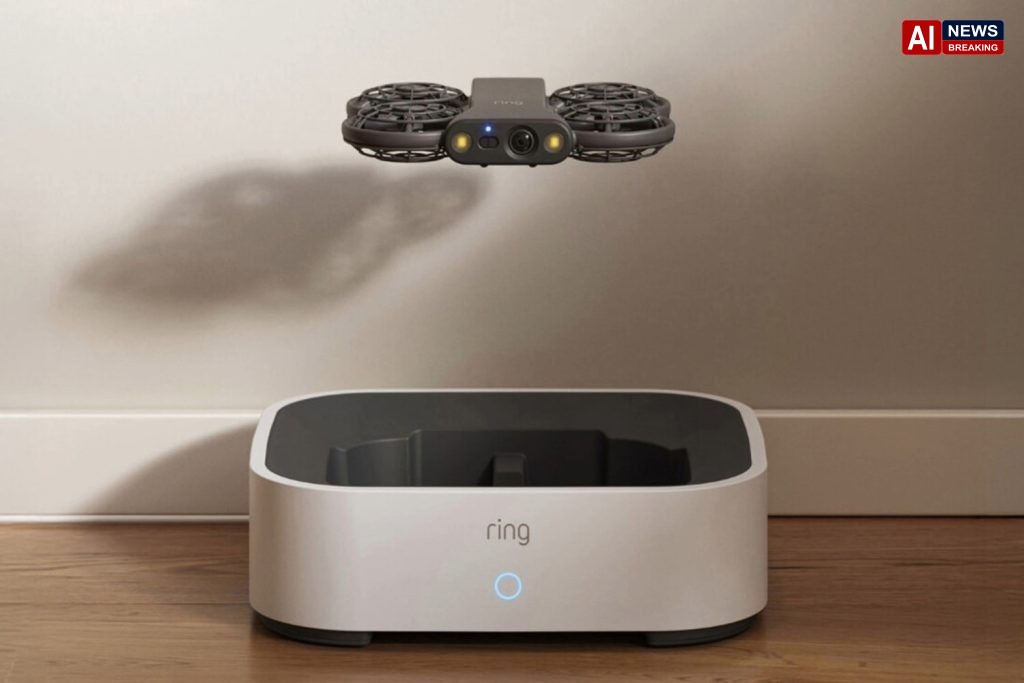
Amazon’s Ring debuts security robots including a drone - AI News Breaking
Amazon’s Ring has expanded its portfolio of home‑security products with the introduction of an indoor drone designed to patrol residences autonomously. The company announced the new device on Tuesday, positioning it as a complement to its existing line of fixed cameras and video doorbells. Marketed as a “room‑to‑room” surveillance solution, the drone is intended to navigate interior spaces where conventional cameras struggle to provide clear coverage, such as tight corridors, stairwells and large open‑plan areas.The device, dubbed the Ring R‑Drone, resembles a compact quadcopter with a lightweight carbon‑fiber frame and a 1080p camera mounted on a gimbal for stabilised footage..
Ring says the drone can fly for up to 25 minutes on a single charge and can be programmed to follow preset routes or respond to motion alerts generated by other Ring sensors. When an alarm is triggered, the drone will automatically launch from a discreet charging dock, ascend to a pre‑determined altitude and capture video of the incident, transmitting the feed in real time to the Ring app on the homeowner’s smartphone or tablet.Ring’s announcement comes at a time when the smart‑home market is witnessing a surge in demand for integrated security solutions that blend artificial‑intelligence analytics with physical hardware. Analysts at Counterpoint Research note that the global market for connected home devices is set to exceed $150 billion by 2028, driven largely by consumer concerns over burglary, vandalism and the increasing prevalence of remote work..
Ring, which was acquired by Amazon in 2018 for $1 billion, has leveraged Amazon’s cloud infrastructure and machine‑learning capabilities to enhance the functionality of its products, and the R‑Drone is the latest iteration of that strategy.Technical specifications suggest the drone is equipped with a suite of sensors designed to avoid obstacles and maintain stable flight in cluttered environments. Infra‑red proximity detectors, ultrasonic rangefinders and a downward‑facing optical flow sensor work in tandem to map rooms and adjust the drone’s trajectory in real time. According to Ring, the drone can recognise and bypass common household items such as furniture, hanging decorations and pet toys, reducing the likelihood of accidental collisions..
The device also features an emergency‑stop function that can be triggered manually via the app or automatically if a sudden loss of altitude is detected.Privacy advocates have raised concerns about the implications of an autonomous flying camera inside private homes. The Electronic Frontier Foundation (EFF) issued a statement urging Ring to be transparent about data handling practices, particularly regarding the storage and processing of video captured by the drone. While Ring maintains that all footage is encrypted end‑to‑end and stored in Amazon Web Services’ secure cloud, critics argue that the addition of a mobile camera introduces new vectors for potential misuse, especially if the device were to be hacked or commandeered remotely..
Ring has pledged to implement multi‑factor authentication for drone activation and to provide users with the ability to delete recordings automatically after a set period.The regulatory landscape for indoor drones remains nascent, with most existing legislation focused on outdoor unmanned aerial vehicles. The Federal Aviation Administration (FAA) currently exempts indoor flight from its standard certification requirements, but the agency has indicated that it is monitoring emerging technologies that could blur the line between consumer electronics and aerial surveillance equipment. In a recent briefing, FAA spokesperson Karen Miller said that the agency would work with manufacturers to develop best‑practice guidelines that address safety, privacy and security concerns without stifling innovation.Ring’s pricing strategy positions the R‑Drone at $299, a figure that places it above the company’s flagship video doorbell models but below the price of high‑end professional security drones used by commercial enterprises..
The package includes a charging dock, a spare battery, a wall‑mounted base station for wireless connectivity and a three‑month subscription to Ring Protect Plus, which offers cloud storage for video recordings and advanced AI‑driven alerts. Ring Protect Plus is optional; users can operate the drone with local storage on a micro‑SD card, though the company recommends cloud backup for full functionality.Early adopters who participated in Ring’s beta testing programme report mixed experiences. Some users praised the drone’s ability to quickly locate a wandering pet or to provide a visual confirmation of a false alarm triggered by a motion sensor in a dark hallway..
Others highlighted challenges, such as occasional difficulty navigating spaces with low ceilings or the need to manually reposition the charging dock to achieve optimal coverage. Ring says that firmware updates will address many of these issues, and the company plans to release a software development kit later this year to allow third‑party developers to create custom patrol routes and integrate the drone with other smart‑home platforms.The launch of the indoor security drone reflects Amazon’s broader ambition to dominate the connected home ecosystem. In recent years the tech giant has expanded its hardware lineup to include smart speakers, thermostats, lighting systems and now aerial surveillance devices..
Industry observers note that Amazon’s vast logistics network and data‑processing capabilities give it a competitive edge in scaling new products quickly, but also raise questions about the concentration of consumer data within a single corporate entity. The European Union’s Digital Services Act, which came into force earlier this year, imposes stricter transparency and accountability obligations on large online platforms, and regulators are expected to scrutinise how Amazon leverages data from Ring’s devices for targeted advertising and other commercial purposes.Consumer response will likely hinge on the perceived balance between convenience and privacy. A survey conducted by the Pew Research Center in September 2024 found that 58 percent of American adults were comfortable with indoor cameras if they could control when they were active, while 32 percent expressed “significant” concerns about constant monitoring..
The addition of an autonomous drone may tip the scales for some households, prompting them to reconsider the trade‑offs inherent in a fully connected security system. Ring’s marketing material emphasizes the device’s role in “enhancing peace of mind” and “reducing blind spots,” but the company has also committed to a public FAQ that outlines data‑retention policies and offers step‑by‑step guidance on disabling the drone’s autonomous mode.As the R‑Drone hits retail shelves next month, its performance in the market will serve as an early indicator of how consumers respond to mobile, AI‑driven surveillance inside their homes. If adoption proves robust, other manufacturers are likely to follow suit, potentially spurring a new wave of indoor drone innovations that blend security, convenience and smart‑home integration..
Conversely, if privacy backlash intensifies or technical limitations prove prohibitive, the product could become a niche offering rather than a mainstream staple. Either outcome will shape the evolving dialogue between technology providers, regulators and the public on.
Updated: November 10, 2026
Ring has launched the R‑Drone, a $299 indoor quadcopter that patrols homes autonomously, linking to its existing Ring cameras and app for real‑time video alerts. Privacy groups warn the flying camera could create new data‑security risks, while analysts see it as a push to cement Amazon’s hold on the expanding smart‑home market.