Pond heron found dead in Coimbatore tests positive for avian influenza
 Pakistan’s leaders hail first astronaut aboard Chinese craft: ‘Proud one of us has gone into space’
 British tourist travels 29 hours from Mumbai to Amritsar for ₹5,461, rates Indian Railways 10/10 | Viral video
 The Supreme Court will decide whether assault weapons bans violate the Second Amendment
 A Critic of Beijing Falls Short in Taiwan’s Key Mayoral Election
A.I. and Market Whiplash
**
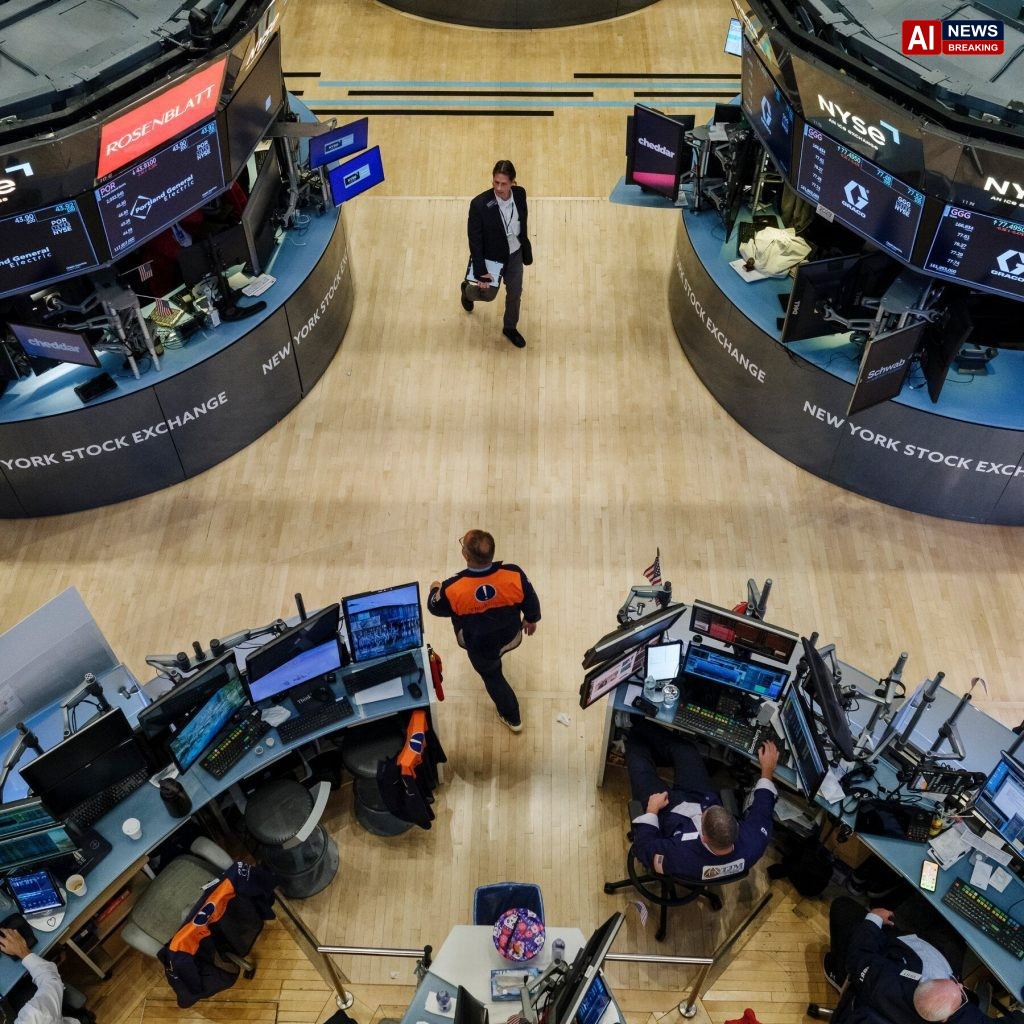
A.I. and Market Whiplash - AI News Breaking
The volatility that has characterised global equity markets over the past twelve months can be traced to a single, pervasive force: artificial intelligence. From the launch of new generative‑AI products to the frantic scramble for talent, the sector has injected a fresh dose of speculation into an already jittery environment, prompting investors to reassess valuations, risk appetites and the very contours of future growth. In this piece, I draw on interviews with market participants, data from trading desks and insights from technology analysts to explain why AI has become the engine of market whiplash and what the likely trajectory may be as the hype settles into a more measured reality.When OpenAI unveiled ChatGPT in late 2022, the reaction was immediate and dramatic..
Within weeks, the chatbot’s user base swelled to tens of millions, and venture capital funds poured billions into start‑ups promising to embed large language models into everything from customer service to drug discovery. The rally in AI‑related stocks was swift: Nvidia, the maker of graphics processing units that power most AI training workloads, saw its market capitalisation more than double in a six‑month span, while lesser‑known firms such as C3.ai and Palantir enjoyed surges of 250 % and 180 % respectively. The sheer speed of the price movements caught many investors off guard, and the ensuing corrections highlighted the thin line between genuine technological progress and speculative excess.For institutional investors, the challenge has been to separate the signal from the noise in a market where sentiment can shift on a single tweet..
“We were seeing portfolios swing wildly on news that, in hindsight, had limited substance,” says a senior portfolio manager at a European asset manager who requested anonymity. “One day a CEO would announce a partnership with an AI firm, and the next day the stock would tumble because analysts questioned the commercial viability of the product.” This pattern of rapid inflows followed by sharp outflows has amplified price swings, leading to higher implied volatility across the board and prompting many fund managers to increase their cash buffers as a defensive measure.The impact has not been confined to pure‑play AI companies. Traditional sectors such as banking, energy and consumer goods have also felt the tremor..
Banks have been forced to confront the prospect of AI‑driven underwriting and fraud detection, prompting a wave of fintech collaborations that have, in turn, spurred stock price fluctuations for both incumbents and challengers. In energy, firms that claim to optimise drilling operations with AI have seen their shares rise on announcements, only to fall back when regulators question the robustness of the underlying data. Even consumer staples have not been immune; a major retailer’s decision to deploy AI‑generated marketing copy sparked a brief rally that collapsed when analysts highlighted the risk of brand dilution.One of the most telling indicators of market whiplash is the surge in short‑selling activity around AI‑centric equities..
Data from a leading market‑data provider shows that short interest in the top ten AI‑related stocks rose by 42 % between March and August, a clear sign that traders are betting on a correction. Yet the same period also recorded a 67 % increase in options volume for those stocks, indicating that many participants are simultaneously hedging and speculating on upside moves. This duality reflects an underlying uncertainty: while the long‑term potential of AI is widely acknowledged, the timeline for monetisation and the competitive landscape remain opaque.Regulators have begun to grapple with the fallout as well..
In the United States, the Securities and Exchange Commission has launched a review of disclosures related to AI‑driven products, warning that investors need clearer information about the assumptions baked into revenue forecasts. Across the Atlantic, the European Securities and Markets Authority has issued guidance urging listed companies to detail the governance frameworks they have put in place to mitigate algorithmic bias and data‑privacy risks. Such regulatory scrutiny, while aimed at protecting investors, can also fuel short‑term volatility as companies scramble to comply and update their prospectuses.From a macroeconomic perspective, the AI frenzy has intersected with other headwinds, compounding the market’s instability..
Rising interest rates, driven by central banks’ efforts to curb inflation, have already made growth‑oriented stocks more vulnerable. In this environment, any hint of over‑optimism in AI valuations is amplified by the cost of capital, leading to sharper price corrections when earnings fail to meet lofty expectations. Moreover, the sector’s heavy reliance on high‑performance computing has raised concerns about energy consumption, prompting environmental, social and governance (ESG) analysts to flag potential sustainability issues that could affect institutional allocations.Looking ahead, many analysts predict a gradual moderation rather than a sudden collapse..
“The hype cycle is certainly in its later stages, but the underlying technology is still evolving rapidly,” notes a senior research analyst at a global investment bank. “We expect a re‑pricing where only the firms with clear pathways to revenue and defensible IP will retain premium valuations.” In practice, this could mean a consolidation of market share among a handful of dominant players, while a wave of smaller start‑ups either gets acquired or exits the market altogether.For individual investors, the key takeaway is prudence. Diversification across sectors and geographies remains the most reliable defence against the kind of sector‑specific turbulence that AI has generated..
Investors should also pay close attention to the quality of earnings reports, looking beyond headline growth numbers to understand the proportion of revenue that is recurring versus one‑off project work. In addition, monitoring regulatory developments can provide early warning signs of potential disruptions to business models that rely heavily on data processing and AI deployment.In sum, AI has acted as both a catalyst and a magnifier of market dynamics that were already in flux. Its promise of transformative efficiency has drawn unprecedented capital, but the speed at which that capital has moved has also vulnerabilities in pricing, risk management and governance..
As the industry matures, the market is likely to settle into a more measured rhythm, rewarding those companies that can substantiate their claims with tangible products and sustainable revenue streams while penalising those that remain reliant on hype. For now, however, the whiplash continues, and investors would do well to keep a steady hand, a critical eye and a willingness to adapt to a landscape that is still very much in the making..
Updated: November 12, 2026
AI‑driven volatility shows that markets are still learning to price uncertainty, treating every new GPT‑style claim as a gamble rather than a revenue stream. This short‑term risk‑premium is likely to contract as only firms that prove sustainable, defensible AI applications survive, turning hype into hard cash—or