Pond heron found dead in Coimbatore tests positive for avian influenza
 Pakistan’s leaders hail first astronaut aboard Chinese craft: ‘Proud one of us has gone into space’
 British tourist travels 29 hours from Mumbai to Amritsar for ₹5,461, rates Indian Railways 10/10 | Viral video
 The Supreme Court will decide whether assault weapons bans violate the Second Amendment
 A Critic of Beijing Falls Short in Taiwan’s Key Mayoral Election
Gaza’s Health Ministry says an Israeli strike on a hospital killed 6 people
**
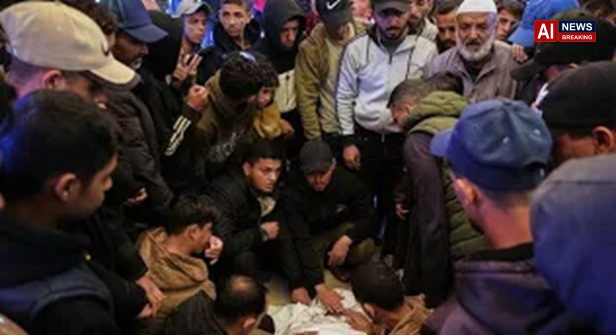
Gaza's Health Ministry says an Israeli strike on a hospital killed 6 people - AI News Breaking
gazas health ministry says:
The Gaza Health Ministry confirmed on Tuesday that an Israeli airstrike struck Al‑Shifa Hospital in the northern district of Gaza City, killing six patients and injuring dozens more, a development that has intensified calls for an urgent investigation into the conduct of hostilities in the enclave. The ministry said the victims included two children, a pregnant woman and three other civilians, all of whom were receiving treatment for war‑related injuries at the time of the attack. The strike, which occurred at approximately 14:30 local time, has prompted renewed condemnation from international humanitarian organisations, who warn that the targeting of medical facilities contravenes the Geneva Conventions and could constitute a war crime.According to a statement released by the Ministry of Health, the blast hit the hospital’s emergency department, where a large number of patients had been gathered after earlier bombardments..
Ambulances arrived within minutes, but the influx of casualties overwhelmed the already strained medical staff, who have been operating with limited electricity, water and medical supplies for more than two years of conflict. “We are doing everything we can to save lives, but the loss of these six individuals is a tragic reminder of the unbearable conditions under which our health workers are forced to function,” the statement read.The Israeli Defence Forces (IDF) issued a brief response, saying that the strike was carried out in accordance with “operational necessity” and that the target had been identified as a “terrorist command centre” based on intelligence that was later found to be inaccurate. A senior IDF spokesperson told reporters that the forces had no intention of striking a civilian medical facility and that an internal review was already underway..
“We regret any civilian casualties and are committed to investigating the incident thoroughly,” the spokesperson added, without providing further details on the alleged command centre or the intelligence that guided the operation.Human Rights Watch, which has been monitoring the conflict since its escalation in October, called the incident “deeply troubling” and urged both parties to adhere strictly to international humanitarian law. “Hospitals are protected spaces under the Geneva Conventions. Any attack that results in the death of patients and medical staff must be investigated with transparency and accountability,” said the organisation’s Middle East director..
The UN Office for the Coordination of Humanitarian Affairs (OCHA) also released a statement warning that repeated strikes on health infrastructure are eroding the capacity of the already overburdened health system, potentially leading to a secondary humanitarian crisis as treatable conditions become fatal.Local witnesses described the scene as chaotic, with smoke rising from the shattered wing of the hospital and families screaming for their loved ones. “We heard a loud explosion and then the building shook. The doors were blown open and blood was everywhere,” recounted a nurse who asked to remain anonymous for fear of reprisals..
She said that some of the wounded were transferred to other facilities, including the Rafah field hospital, which is also operating at maximum capacity. “We are losing patients not because of the disease, but because the very places where we try to heal are being destroyed,” she added.The incident has also sparked a diplomatic flare‑up in the United Nations Security Council, where several member states demanded an independent inquiry into the strike. The United States, a close ally of Israel, has so far refrained from supporting a formal resolution, urging instead that “all parties respect the protection afforded to medical facilities.” Russia and China, meanwhile, voted in favour of a resolution calling for a fact‑finding mission, citing the need for “impartial verification of the facts on the ground.”In Gaza, the health ministry’s director of public health warned that the loss of six patients is only the latest in a series of attacks that have crippled the enclave’s capacity to respond to the influx of war casualties..
“We have lost more than 80 percent of our hospitals’ functional capacity,” he told a press briefing on Monday. “Every day we lose more doctors, nurses and support staff, either because they are killed, injured or forced to flee. The cumulative effect is a collapse of the health system that will affect not only those injured in the conflict but also patients with chronic illnesses, mothers in labour and children with preventable diseases.”The Palestinian Authority, which does not have direct control over Gaza but maintains a parallel health administration, condemned the strike as “another blatant example of the Israeli army’s disregard for civilian life.” In a televised address, President Mahmoud Abbas called for “urgent international action to hold those responsible accountable and to ensure that hospitals and schools are respected as sanctuaries.” He also appealed to the Arab League and the European Union for emergency medical aid, noting that the supply lines for essential pharmaceuticals have been repeatedly disrupted.International NGOs have mobilised emergency medical teams to assist the remaining functional wards of Al‑Shifa, which now operate under makeshift conditions with generators and portable equipment..
Médecins Sans Frontières (MSF) announced that it would dispatch a rapid response unit equipped with surgical kits and field hospitals to the site within 48 hours. “The resilience of the Gaza health workers is extraordinary, but they cannot shoulder this burden alone,” said the organisation’s head of operations in the region. “We urge all parties to observe the principles of distinction and proportionality, and to refrain from any actions that jeopardise the lives of patients and health personnel.”The broader context of the strike remains tied to the ongoing Israeli‑Palestinian conflict, which entered its tenth month of heightened violence after a surprise attack by Hamas in early October..
Since then, Israeli forces have conducted a sustained campaign targeting what they describe as Hamas infrastructure, while Hamas and other militant groups have launched rockets into southern Israel. The humanitarian toll has been severe: the United Nations estimates that more than 8,000 Palestinians have been killed, the majority of them civilians, and that over 1.5 million people have been displaced within the densely populated strip.Analysts note that incidents such as the Al‑Shifa strike could have far‑reaching implications for the conduct of the war and for diplomatic efforts aimed at brokering a ceasefire. “When medical facilities become targets, the conflict escalates beyond a purely military contest and enters the realm of humanitarian catastrophe,” said a senior fellow at the International Crisis Group..
“It erodes any remaining goodwill for negotiation and fuels cycles of retaliation that prolong suffering on both sides.”As the investigation promised by the IDF proceeds, families of the victims and the broader Gaza population await answers. For many, the loss of loved ones in a place meant for healing underscores the stark reality that, in this war, the lines between combatants and civilians have become increasingly blurred. The international community, meanwhile, faces renewed pressure to enforce the norms of international law and to deliver the humanitarian.
Updated: November 12, 2026
The Al‑Shifa strike turns Gaza’s health system from a fragile lifeline into a battlefield casualty, eroding any remaining moral leverage Israel might use to justify its campaign. If hospitals are no longer safe, the conflict risks crossing a “humanitarian red line” that could galvanize global pressure for