Pond heron found dead in Coimbatore tests positive for avian influenza
 Pakistan’s leaders hail first astronaut aboard Chinese craft: ‘Proud one of us has gone into space’
 British tourist travels 29 hours from Mumbai to Amritsar for ₹5,461, rates Indian Railways 10/10 | Viral video
 The Supreme Court will decide whether assault weapons bans violate the Second Amendment
 A Critic of Beijing Falls Short in Taiwan’s Key Mayoral Election
Pawan Kalyan pitches Andhra Pradesh as trusted global hub; Lokesh unveils red-carpet framework at 31st Vizag CII Summit
**
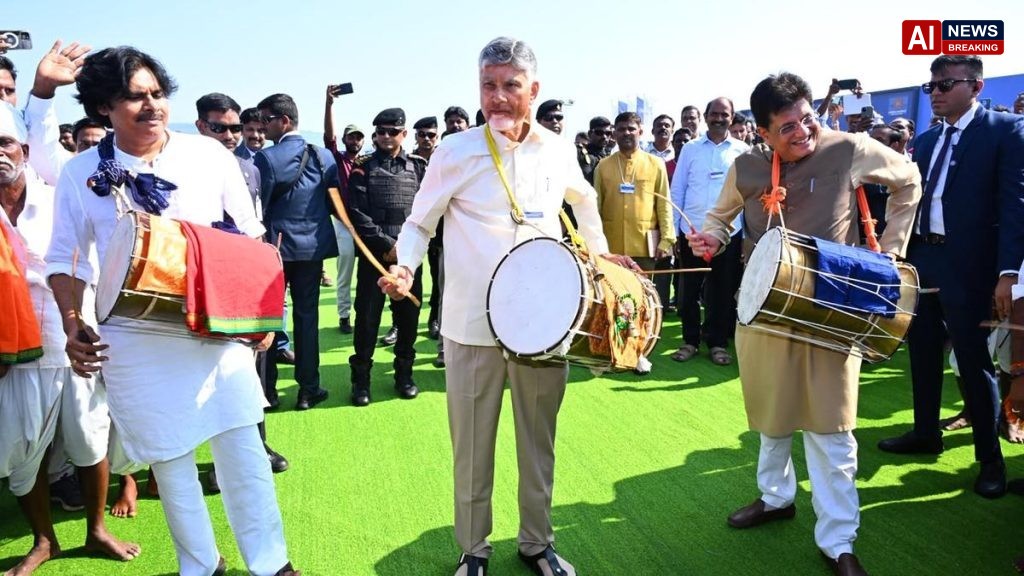
Pawan Kalyan pitches Andhra Pradesh as trusted global hub; Lokesh unveils red-carpet framework at 31st Vizag CII Summit - AI News Breaking
Pawan Kalyan, the veteran actor‑turned‑politician who leads the Jana Sena Party, used a high‑profile event in Hyderabad to present Andhra Pradesh as a “trusted global hub” for investment and innovation. Speaking to a gathering of business leaders, policy makers and media representatives, he highlighted the state’s recent infrastructure upgrades, its strategic location on the eastern seaboard and a series of reforms aimed at simplifying regulations for foreign and domestic investors. Kalyan argued that the combination of robust logistics, a growing talent pool and a pro‑business governance model could reposition the state alongside other Indian economic powerhouses such as Maharashtra and Karnataka..
He underscored the need for “visionary leadership” from both the public and private sectors to translate these assets into sustained, high‑value job creation.The remarks came on the sidelines of the 31st Vizag CII (Confederation of Indian Industry) Summit, a flagship conference that draws senior executives from manufacturing, services and technology firms. The summit, held at the picturesque beachfront venue of Visakhapatnam, provided a platform for the state’s chief minister, Y. S. Jagan Mohan Reddy, to unveil a series of policy initiatives aimed at deepening the integration of Andhra Pradesh into global supply chains. Among these were incentives for green manufacturing, tax breaks for research and development, and a streamlined single‑window clearance system for foreign direct investment..
The government also pledged to expand the digital infrastructure that underpins e‑commerce and fintech, citing the recent rollout of high‑speed broadband in rural districts.A key feature of the summit’s agenda was the presentation by Lokesh Rao, head of the state’s newly created Investment Promotion Board. Rao called on corporate leaders to look beyond the traditional model of setting up isolated manufacturing units and to consider relocating their primary corporate headquarters to Andhra Pradesh. He argued that a head‑quarter presence would enable firms to tap into the state’s “superior quality of life, skilled talent pipelines and seamless connectivity”..
Rao pointed to a series of new ports along the coast, most notably the expansion of Visakhapatnam Port, which he said could handle a larger share of container traffic and reduce turnaround times for exporters. The narrative was reinforced by the imminent commissioning of Bhogapuram International Airport, slated to open in 2027, which will provide direct links to major Asian and Middle Eastern hubs.Rao’s “red‑carpet framework” – a term he coined to describe a suite of incentives for companies moving their corporate functions to the state – includes preferential land allocation, tax holidays for up to ten years, and expedited approval processes for building office parks and research facilities. He cited a recent case study involving a multinational automotive component maker that relocated its regional headquarters to the capital, Amaravati, and reported a 25 percent increase in employee retention and a 30 percent reduction in logistics costs within the first two years..
The framework also promises tailored training programmes in partnership with local universities, aimed at bridging skill gaps in emerging technologies such as artificial intelligence, renewable energy and advanced manufacturing.The state’s emphasis on talent development forms a central pillar of its attraction strategy. In the past five years, Andhra Pradesh has seen a surge in enrolments at engineering and management institutions, with the Andhra Pradesh State Skill Development Corporation reporting that more than 300,000 graduates have completed industry‑aligned courses since 2020. The government has entered into Memoranda of Understanding with several private universities to set up dedicated research centres focused on biotechnology, aerospace and clean energy..
Rao highlighted the upcoming launch of the “Andhra Pradesh Innovation Hub” in Visakhapatnam, a mixed‑use campus that will house incubators, venture capital funds and corporate R&D labs under one roof. He suggested that such ecosystems could reduce the time to market for new products and foster collaborations across sectors.Critics, however, caution that the state’s ambitious plans must be matched by concrete execution. Analysts from the Indian Institute of Management, Ahmedabad, note that while the infrastructural upgrades are impressive on paper, the quality of implementation, especially in terms of land acquisition and environmental clearances, remains a challenge in many Indian states..
They point to recent delays in the Bhogapuram airport project, which has faced setbacks due to funding gaps and local opposition. Moreover, they argue that the promised tax incentives could erode the state’s fiscal base if not carefully calibrated, potentially limiting its ability to fund social welfare programmes.In response to such concerns, Kalyan stressed that the state’s reforms are “transparent and accountable”. He cited the establishment of an independent monitoring committee comprising representatives from the finance ministry, civil society and the private sector, tasked with reviewing the impact of incentives on revenue and social outcomes..
The committee, he said, will publish quarterly reports and adjust policy levers as necessary. Kalyan also referenced the successful implementation of the “Andhra Pradesh Business Facilitation Centre”, which has reportedly reduced the average time for obtaining a manufacturing licence from 120 days to under 30 days over the past two years.The summit concluded with a panel discussion on the role of Indian states in the post‑pandemic global economy. Participants highlighted the importance of resilience, sustainability and digital integration..
While acknowledging the competitive pressures from other emerging hubs in Southeast Asia, several speakers agreed that Andhra Pradesh’s combination of coastal logistics, a growing skilled workforce and proactive governance could give it a distinctive edge. They urged that the state continue to focus on upskilling, especially in green technologies, to align with global trends toward decarbonisation and circular economies.As the conference drew to a close, the atmosphere was one of cautious optimism. Corporate delegations left with detailed proposals for establishing regional headquarters, while state officials prepared to fine‑tune the red‑carpet framework based on feedback received during the summit..
The next steps, according to Rao, will involve finalising the legal statutes that underpin the incentives and launching a targeted outreach campaign to European and East Asian firms. If the state can deliver on its promises, the vision articulated by Pawan Kalyan – that Andhra Pradesh could become a trusted global hub – may move from rhetoric to reality in the coming years..
Updated: November 12, 2026
Pawan Kalyan used the Vizag CII Summit to pitch Andhra Pradesh as a future global investment hub, touting infrastructure, talent and pro‑business reforms. The state’s leaders unveiled incentives and a “red‑carpet” framework aimed at attracting corporate headquarters, while critics warn execution gaps could dent the promised gains.
If Andhra Pradesh can translate its infrastructure and talent buzz into a consistently efficient bureaucracy, it may lure firms that today still view the state as a logistical gamble. Yet the real test will be whether the red‑carpet incentives can be balanced against a shrinking fiscal base, or whether the state’s “transparent” oversight becomes merely a post‑hoc check that stalls the very investors it seeks.